
Will Store Expansion and Other Initiatives Boost Ross Stores' Growth?
Source: zacks.com
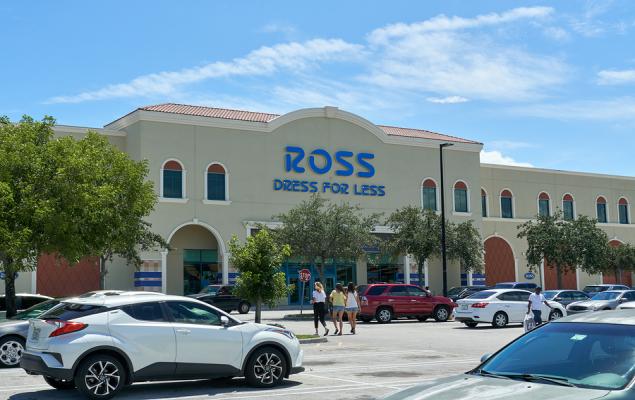
Ross Stores is pursuing store expansion, merchandise improvements and supply-chain investments to drive traffic and sales in the value-focused off-price retail market. ROST shares have gained 8.7% over six months versus a 4.1% industry decline, while fiscal 2026 and 2027 EPS consensus estimates call for growth of 32.7% and 2%, respectively, and have risen over the past 30 days. Risks include higher occupancy, labor and capital costs, slower new-store maturation, competition and variability in consumer spending.
Analysis
This is not a fresh earnings catalyst; it reinforces a well-understood unit-growth narrative already reflected in ROST's premium multiple. The key incremental variable is not store count but whether marginal locations sustain mature-store sales productivity while occupancy and wage costs rise. With consensus growth heavily front-loaded and then flattening, even modest new-store deleverage or comparable-sales normalization could produce a disproportionate multiple reset over the next 1-3 quarters.
Competitive intensity makes real estate availability a double-edged signal. More available boxes can lower entry costs for ROST and BURL, but it also permits all off-price formats to expand simultaneously, raising local cannibalization and markdown risk. TJX's scale and sourcing breadth should be the most durable beneficiary if branded inventory supply remains ample; BURL has greater upside torque if execution improves, but also greater sensitivity to freight, labor and distribution-center inefficiency.
The contrarian view is that value retail is not automatically defensive if lower-income consumers weaken: trade-down helps traffic, but discretionary apparel baskets can still compress. Watch monthly retail sales, apparel import flows and management commentary on shrink, wage rates and new-store payback. The thesis is falsified by sustained comp acceleration alongside stable merchandise margin, which would demonstrate that capacity additions are being absorbed without promotional pressure.
Near term, the signal is insufficient to chase ROST after recent relative strength. The better setup is to wait for quarterly evidence on comp versus new-unit contribution and operating-margin progression; a positive surprise would validate the premium valuation, while a margin miss would expose the lack of longer-duration earnings growth.
AllMind Terminal
AI-powered research, real-time alerts, and portfolio analytics for institutional investors.
Request TrialMarket Sentiment
Overall Sentiment
mildly positive
Sentiment Score
0.32
Ticker Sentiment
Key Decisions for Investors
- No outright ROST add before the next earnings print; retain only benchmark exposure. Upgrade to a tactical long only if comparable sales and operating margin both exceed consensus, with a 1-3 month target of 8-12% upside; exit on a comp miss or evidence of negative new-store margin leverage.
- Construct a 3-6 month long TJX / short ROST relative-value position if ROST continues to outperform into earnings. TJX offers superior sourcing scale and international diversification, while the short leg hedges off-price demand; reassess if ROST demonstrates materially faster comp growth without margin dilution.
- Keep BURL on a catalyst watch rather than initiating on this item. A long BURL is warranted only after confirmation that supply-chain productivity and store-level contribution margins are improving; its higher operating leverage could support 15%+ upside, but a freight or labor-cost reversal creates asymmetric downside.
- Avoid treating DLTR store activity as a direct read-through for off-price apparel. Use DLTR only as a lower-income consumer stress indicator: deteriorating traffic or margins there would increase caution on ROST and BURL discretionary basket assumptions over the following 1-2 quarters.
More News
- In photos: China's Xi hardens Taiwan warning as country celebrates week-long National Day holiday
- RAM supply set to worsen, says Micron, as CEO celebrates ‘much higher’ prices
- Tencent leases 100,000 chips from Oracle for $7 bln- FT
- Asia stocks rise on chipmaker gains, soft U.S. inflation; Nikkei outperforms
- Why is Nidec stock plunging today?
- Micron Forecast Tops Estimates on Booming AI Memory Demand
From AllMind Research
- Anthropic IPO Preview: Valuation, Timing, and What to Watch
- Shein After the IPO: Venue, Valuation, and What Must Be Proved
- What AI Research Tools Should a Small Hedge Fund Buy First?
- Run Cost-Controlled Financial Research in AllMind Agent Studio
- State of Public Markets, June 2026: Higher for Longer Meets the AI Supercycle