
Velocys expands Fischer-Tropsch reactor roadmap with AlphaCore 800 for larger-scale SAF and e-fuels projects
Source: PR Newswire
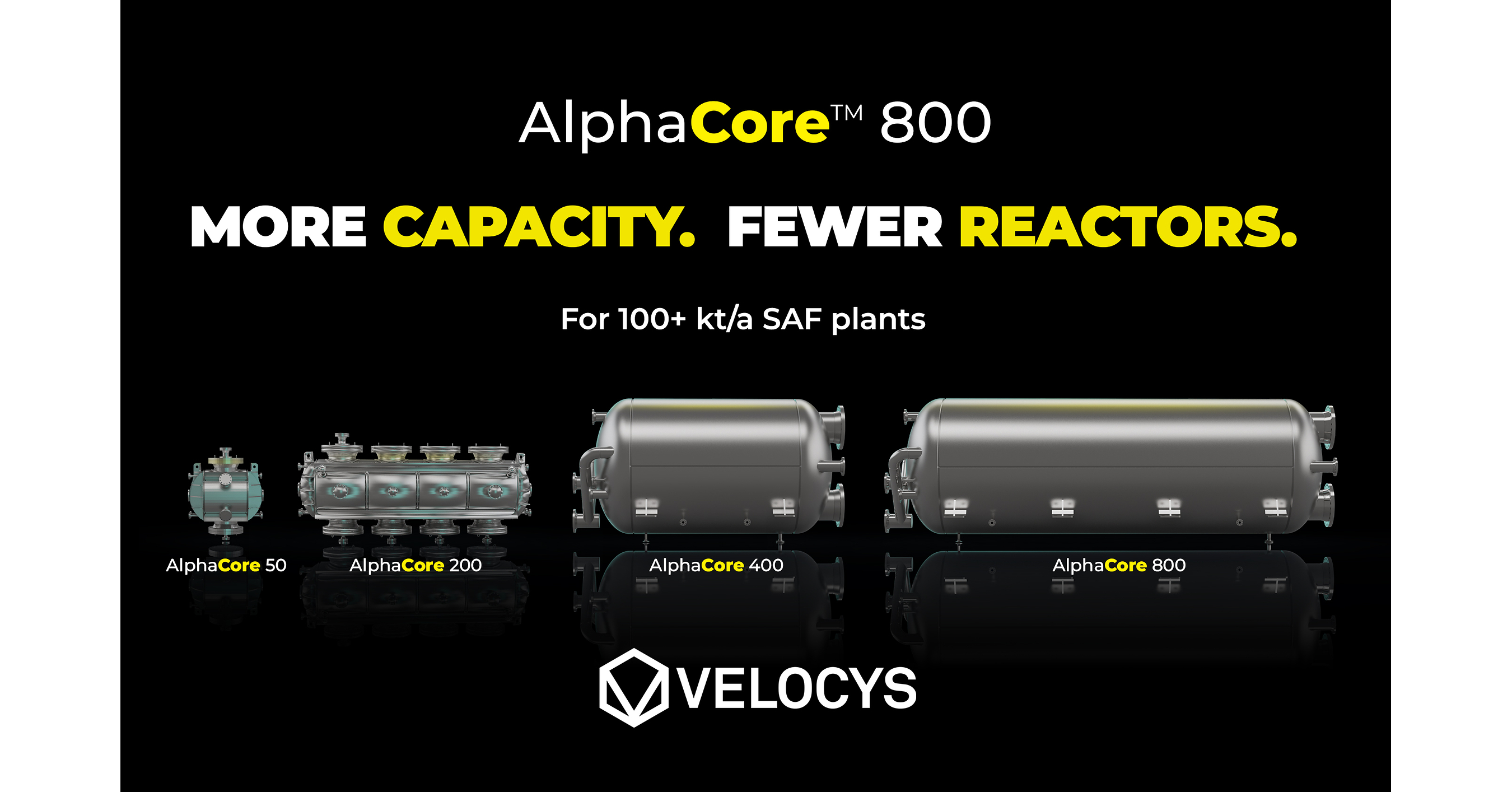
Velocys launched its AlphaCore 800 microchannel Fischer-Tropsch reactor, designed to produce up to 800 barrels per day or 30,000 tonnes annually of FT liquids—double the capacity of its AlphaCore 400. For a 60 kt/a FT-liquids plant, two AlphaCore 800 units could replace eight AlphaCore 200 reactors, reducing reactor count by 75% and potentially lowering unit costs. The product targets SAF and e-fuels projects of roughly 100,000 tonnes per year or more, addressing demand for simpler and more scalable sustainable-fuel facilities.
Analysis
The economic significance is not reactor throughput alone but the potential reduction in balance-of-plant complexity: fewer trains can lower engineering hours, piping, controls, spares inventories and construction-interface risk. That matters most for first-of-a-kind SAF projects, where EPC contingency and financing costs—not just conversion efficiency—have been the binding constraint. If independently validated at commercial duty cycles, this could improve bankability for FT-based developers relative to smaller modular configurations, but it does not resolve the larger exposure to low-carbon hydrogen, biomass/syngas availability, power prices, or SAF offtake economics.
Near term, there is no clear listed-equity earnings read-through because the announcement lacks disclosed orders, customer commitments, delivered cost, warranty terms, or third-party operating data. The likely second-order pressure is on competing technology providers whose value proposition depends on modular redundancy or lower-scale deployment; however, larger single-reactor trains also concentrate outage risk, which lenders may penalize until multi-year reliability data exist. The critical 1-3 month catalyst is a named project award with EPC and financing counterparties; the 6-18 month test is whether developers translate simplified configurations into lower total installed cost and improved project IRRs.
Consensus may overvalue the apparent unit-cost benefit because SAF projects are increasingly constrained by feedstock qualification, carbon-intensity scoring, electrolyzer utilization, and tax-credit/regulatory eligibility. A lower-cost FT island can be economically immaterial if upstream syngas costs dominate the delivered-fuel cost curve. Conversely, if the design cuts enough capex to move projects below financing thresholds, the option value is nonlinear and could revive stalled project pipelines, benefiting process-equipment suppliers before fuel producers.
AllMind Terminal
AI-powered research, real-time alerts, and portfolio analytics for institutional investors.
Request TrialMarket Sentiment
Overall Sentiment
moderately positive
Sentiment Score
0.42
Key Decisions for Investors
- No directional trade on the announcement alone: treat this as a project-award alert rather than a revenue catalyst until a customer, contract value, delivery schedule, and independent performance guarantee are disclosed.
- Monitor Honeywell (HON) and Chart Industries (GTLS) for a broader SAF-project FID inflection over the next 6-18 months; initiate only after at least two financed FT-SAF projects demonstrate that lower process complexity is translating into committed equipment spend. Falsifier: continued FID delays despite improving technology claims.
- Avoid using GEVO or LanzaTech (LNZA) as direct beneficiaries: their economics are driven primarily by project financing, feedstock/carbon-intensity pathways and offtake, not by this reactor architecture. Any sympathy move should be sold absent project-specific adoption evidence.
- For a thematic expression, prefer a small watchlist position in GTLS rather than speculative SAF developers if evidence emerges of increased project awards: GTLS has diversified cryogenic/process exposure and less single-project financing risk. Exit the thesis if SAF developers continue to defer capital spending or if policy-credit uncertainty weakens contracted offtake pricing.
More News
- Taiwan benchmark Taiex rises to record intraday high as tech stocks advance
- AMD joins the $1 trillion club as chip rally surges - our AI Strategy saw it early
- Latest Oil Market News and Analysis for Sept. 22
- Oil Settles Near $100 as Hormuz Flows Stunt Rally
- How a Bangladeshi garment-maker is fighting the Middle East energy crunch
- Here's who we know is going to the Trump-Xi dinner so far
From AllMind Research
- Anthropic IPO Preview: Valuation, Timing, and What to Watch
- Shein After the IPO: Venue, Valuation, and What Must Be Proved
- What AI Research Tools Should a Small Hedge Fund Buy First?
- 2026 Global Markets Outlook: Asset Allocation After the Great Disconnect
- Fintool Alternatives After the Microsoft Acquisition