
Global Agency on AI Would Be Useful, Ireland’s Harris Says
Source: Bloomberg
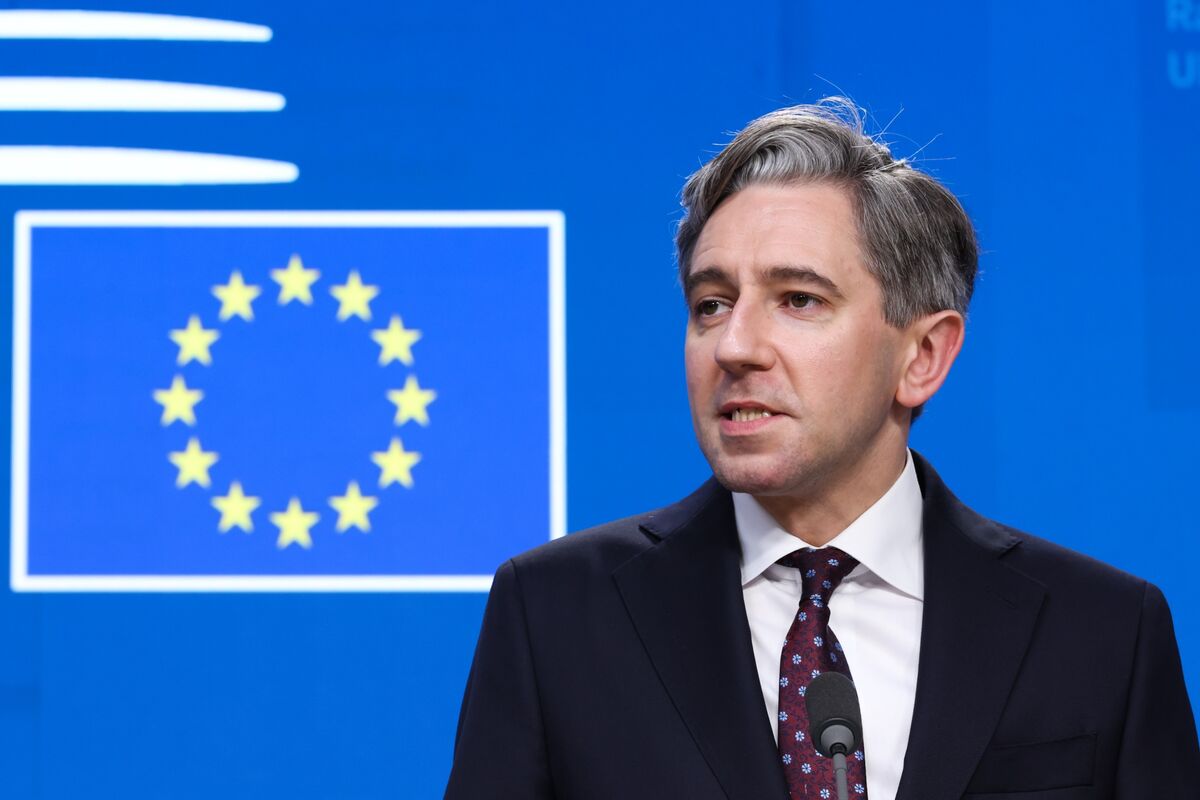
Irish Finance Minister Simon Harris endorsed the creation of a global artificial-intelligence agency, calling it "extraordinarily useful." He said a forthcoming meeting between US President Donald Trump and Chinese President Xi Jinping could offer an opportunity for constructive AI-related discussions. The report signals support for international AI governance but contains no concrete policy commitment or timetable.
Analysis
This is not yet a tradable regulatory catalyst: a ministerial endorsement carries no legislative pathway, enforcement architecture, or commitment from the two jurisdictions that matter most for frontier-model compute and deployment. The near-term market response should therefore be negligible; any AI-policy premium in software or semiconductor multiples is more likely to remain driven by earnings, hyperscaler capex, and export-control enforcement than by this dialogue.
The non-obvious risk is that a US-China framework, if it progresses over the next 6-18 months, would likely standardize safety reporting and model-evaluation requirements rather than constrain AI demand outright. That favors scaled incumbents—MSFT, GOOGL, AMZN, META and frontier-model vendors with dedicated compliance teams—while raising fixed-cost burdens for smaller application-layer companies and open-source distributors. A common framework could also reduce the probability of fragmented national rules, modestly lowering compliance uncertainty for global enterprise software vendors such as NOW and CRM.
Conversely, the most economically meaningful US-China agreement could pair governance language with a narrowly defined relaxation or formalization of compute-export rules. That would be incrementally positive for NVDA, AMD, AVGO and semiconductor capital equipment only if it restores legally addressable Chinese demand; absent explicit licensing changes, diplomatic rhetoric should not be extrapolated into revenue estimates. The falsifier for a constructive semiconductor read is continued tightening of US licensing, further entity-list additions, or management commentary that China inventory/revenue remains structurally impaired.
Consensus may overstate the regulatory downside to large-cap AI platforms. A global agency would more plausibly create a certification moat than impose a uniform cap on monetization, particularly where governments seek visibility into frontier models without sacrificing domestic competitiveness. This is a watch item, not a reason to reposition ahead of an event with no stated deliverable.
AllMind Terminal
AI-powered research, real-time alerts, and portfolio analytics for institutional investors.
Request TrialMarket Sentiment
Overall Sentiment
neutral
Sentiment Score
0.10
Key Decisions for Investors
- No directional trade on the current statement; treat any AI-regulation-driven selloff in MSFT, GOOGL, AMZN or META as noise unless a joint communiqué specifies binding model-testing, liability, or deployment restrictions.
- Maintain a 6-18 month quality bias toward scaled AI infrastructure and platforms—NVDA, AVGO, MSFT and GOOGL—over speculative application software, where regulatory compliance is a larger percentage of R&D and operating expense.
- Set an event alert around any Trump-Xi readout for explicit changes to advanced-chip export licensing. Only then evaluate a tactical long NVDA/AMD basket; require evidence of restored China revenue eligibility and management confirmation before underwriting an earnings benefit.
- If binding cross-border model-certification rules emerge, consider a relative-value basket long MSFT/GOOGL/META versus short high-multiple, subscale AI software exposure through IGV; invalidate if rules exempt smaller models or impose materially stronger obligations on hyperscalers.
More News
- Trump signs sweeping Russia sanctions over Ukraine war
- Google's Gemini becomes latest AI model to break out and hack computer systems
- Saudi Oil Cuts Tied to War Hit Europe: Evening Briefing Americas
- Trump says U.S. to build a 'large Military presence' in Greenland as part of a security deal with it and Denmark
- Houthis accuse Saudi Arabia of launching 26 strikes in 24 hours
- Stocks face a key hurdle in next week’s U.S.-China summit. Here’s what’s at stake