
BGL Welcomes Tyler Leung as Managing Director in Technology Investment Banking
Source: PR Newswire
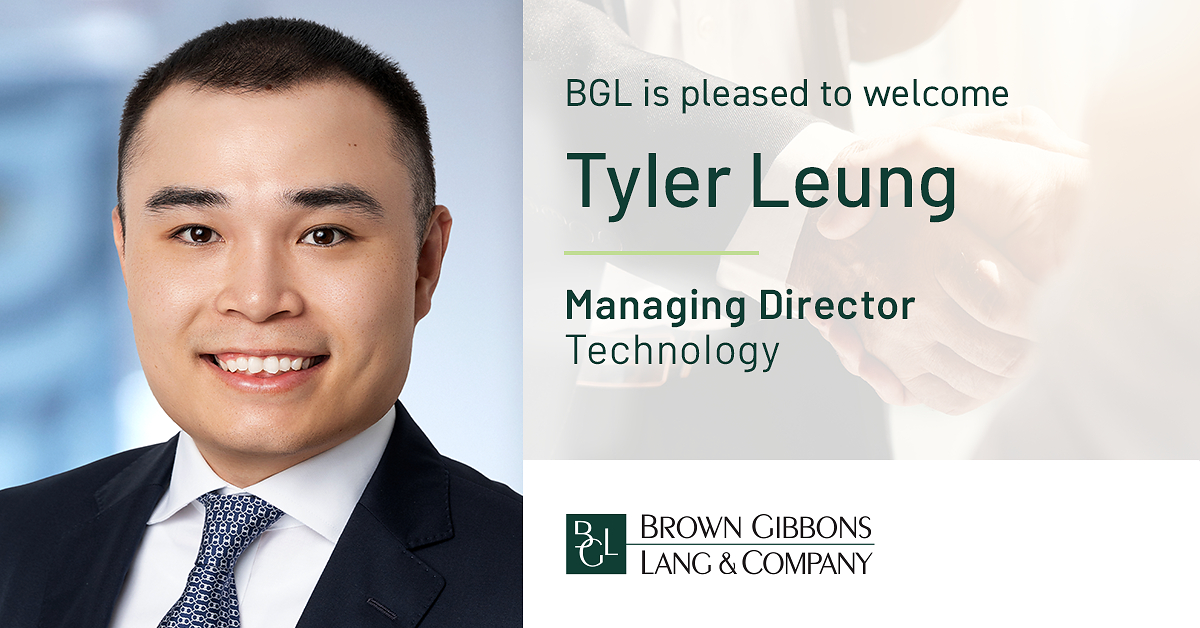
Brown Gibbons Lang & Company hired Tyler Leung as managing director in its Technology investment-banking group to establish and lead coverage of insurance software and construction software. Leung joins from Rothschild & Co., where he spent more than a decade advising on M&A, leveraged buyouts, take-privates, capital raises and IPOs. The move expands BGL's vertical-software advisory platform as AI, digitalization and automation reshape the targeted end markets.
Analysis
This is not independently actionable public-equity information: BGL is private, the announcement contains no mandate pipeline, fee guidance, or transaction backlog, and senior hiring is a weak near-term read-through for listed software valuations. The only useful signal is directional: middle-market advisory capacity is being allocated toward two verticals where fragmented customer bases and legacy workflows can support recurring M&A demand if financing conditions remain accommodative.
For listed insurance software, the more relevant question is whether carrier IT budgets migrate from point solutions to platform consolidation. Guidewire (GWRE) is best positioned if modernization projects remain centered on core-policy replacement; Duck Creek (private) was a logical consolidation target, underscoring scarcity value for narrower public workflow assets. Vertically exposed construction software—Procore (PCOR), Autodesk (ADSK), and Trimble (TRMB)—would benefit more from sustained non-residential activity and contractor digitization than from advisory-industry hiring itself.
Over 1-3 months, treat this as a watch signal for sponsor-led deal announcements rather than a catalyst. A revival in vertical-software transactions could expand EV/revenue multiples for durable recurring-revenue assets, but elevated rates, weak construction starts, or insurer expense cuts would quickly shift buyers toward lower valuations and smaller tuck-ins. The thesis is falsified by declining sector transaction volumes, PCOR net-retention or billings deceleration, GWRE cloud subscription/guidance misses, or worsening commercial construction indicators.
Contrarian view: the market may over-attribute AI narratives to these categories. AI can raise implementation and workflow value, but it can also reduce differentiation for standalone analytics and documentation tools; incumbents with embedded data, distribution, and mission-critical systems should capture more value than smaller AI-feature vendors. No immediate trade is warranted from the release alone.
AllMind Terminal
AI-powered research, real-time alerts, and portfolio analytics for institutional investors.
Request TrialMarket Sentiment
Overall Sentiment
mildly positive
Sentiment Score
0.28
Key Decisions for Investors
- No position based solely on this announcement; add an alert for announced insurance- or construction-software deals above $250M enterprise value over the next 90 days, especially sponsor-backed transactions, as evidence that financing and valuation clearing prices are improving.
- Watch-list long GWRE versus short IGV on a confirmed acceleration in cloud subscription ARR or raised full-year guidance; target a 3-6 month relative-value horizon. Exit if cloud ARR growth decelerates for two consecutive quarters or sector M&A multiples compress.
- For construction-digitization exposure, prefer a quality pair of long ADSK / short PCOR only if commercial construction data weakens while enterprise software budgets hold. ADSK has broader installed-base and FCF support; the pair is invalidated by PCOR reaccelerating billings and net retention or ADSK subscription-growth disappointment.
- Monitor TRMB as a potential second-order beneficiary of construction workflow consolidation, but require evidence of organic ARR improvement and margin delivery before entry; absent those data, the M&A premise does not justify valuation risk.
More News
- What investors need to know about Alphabet's stock-busting earnings report
- Our next steps for Alphabet stock after earnings disappoint at nearly every turn
- Budget 2026 speech
- Wendy's shares jump 15% as Nelson Peltz's Trian offers $1.4 billion to buy burger chain
- The UK cuts energy bills, taxes banks and boosts defense in high-stakes budget
- Microsoft's Big Bets on AI Start to Pay Off