
Siemba Named a Sample Vendor in Three 2026 Gartner® Hype Cycle™ Reports for the Third Consecutive Year
Source: PR Newswire
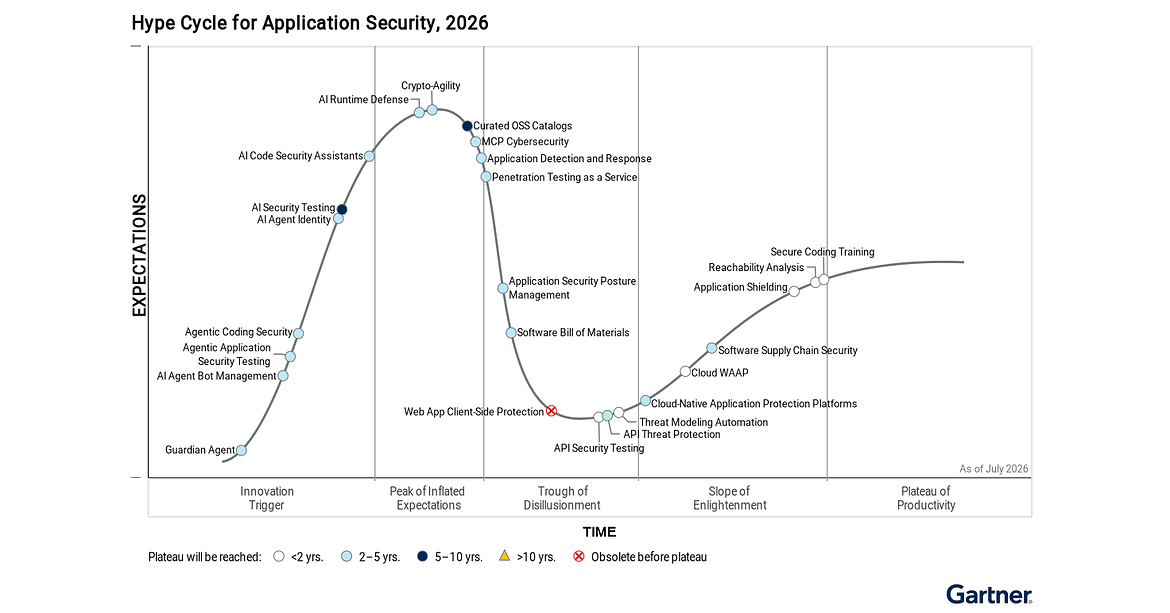
Siemba was named a Sample Vendor for Penetration Testing as a Service in Gartner's 2026 Hype Cycle reports for Security Operations, Application Security and XaaS, marking its third consecutive year appearing in all three reports. The company highlighted demand for continuous threat-exposure management as AI-assisted development and agentic applications expand enterprise attack surfaces. The announcement is a favorable third-party visibility milestone but provides no revenue, customer, contract, or financial-performance figures.
Analysis
This is not a fundamental catalyst for Gartner (IT): vendor inclusion in research does not create identifiable revenue exposure, and the zero per-ticker linkage is appropriate. For the private PTaaS vendor ecosystem, however, repeated placement across security operations, application security, and XaaS workflows reinforces a procurement shift from episodic consulting spend toward recurring exposure-management platforms. The economic value accrues to vendors that can attach discovery, validation, remediation workflow, and compliance evidence—not standalone penetration-testing firms that risk labor-margin compression.
The more investable read-through is competitive pressure on legacy vulnerability-management and application-security vendors. AI-generated code and agentic workflows expand testing frequency and coverage requirements, favoring platforms with integrated attack-surface management and continuous validation; this supports strategic positioning for Tenable (TENB), Rapid7 (RPD), Qualys (QLYS), Palo Alto Networks (PANW), and CrowdStrike (CRWD), but only where net retention and module attach demonstrate monetization. Incumbents face a countervailing risk: autonomous testing features can commoditize point products and push buyers toward platform consolidation, particularly in the 6-18 month budget cycle.
Consensus may overstate the near-term revenue impact of AI-security rhetoric. Enterprise adoption is constrained by false-positive rates, liability around production testing, and integration into remediation teams; Gartner recognition is marketing validation rather than independent evidence of bookings, retention, or pricing power. Over the next 1-3 months, watch cybersecurity earnings commentary for CTEM pipeline conversion, attack-surface-management attach, and AI application-security bookings; absent disclosed acceleration, this is not a reason to chase sector beta.
AllMind Terminal
AI-powered research, real-time alerts, and portfolio analytics for institutional investors.
Request TrialMarket Sentiment
Overall Sentiment
mildly positive
Sentiment Score
0.28
Key Decisions for Investors
- No directional trade in IT: maintain neutral exposure. Reassess only if Gartner discloses measurable acceleration in security-research subscription demand or vendor demand-generation monetization; this release alone has no earnings bridge.
- Create a 1-3 quarter watch basket: long PANW and CRWD versus short RPD, sized small, conditional on PANW/CRWD reporting sustained platform-module attach and RPD failing to reaccelerate ARR. Thesis is consolidation toward broader platforms; invalidate if RPD returns to durable double-digit ARR growth or larger platforms guide security growth lower.
- Monitor TENB and QLYS earnings for exposure-management ARR, dollar-based net retention, and operating-margin trajectory. A long TENB/short QLYS relative trade is only actionable if TENB shows faster recurring-revenue growth without incremental sales-and-marketing deterioration; otherwise avoid, as both remain vulnerable to price competition.
- Avoid treating private-vendor press releases as a cybersecurity-sector catalyst. Require independently verifiable signals—customer wins, funding terms, channel partnerships, or disclosed renewal metrics—before using PTaaS adoption as an input to public-equity estimates.
More News
- Siemba Automates IDOR Detection Across Live APIs
- US, China Kick Off Trade Talks Ahead of Trump-Xi Summit
- US, China open high-level talks ahead of Trump-Xi summit
- U.S. economy hits pivotal milestone: Spending on data centers and other information-processing hardware now exceeds housing investment
- The economy has undergone a structural transformation that ended the low-cost era. ‘The regime change in inflation and interest rates is the outcome’
- Why have US prosecutors labelled China’s Huawei a criminal enterprise?