
SBCA's "Big Green House" Returns to the National Mall for HUD's 2026 Innovative Housing Showcase
Source: PR Newswire
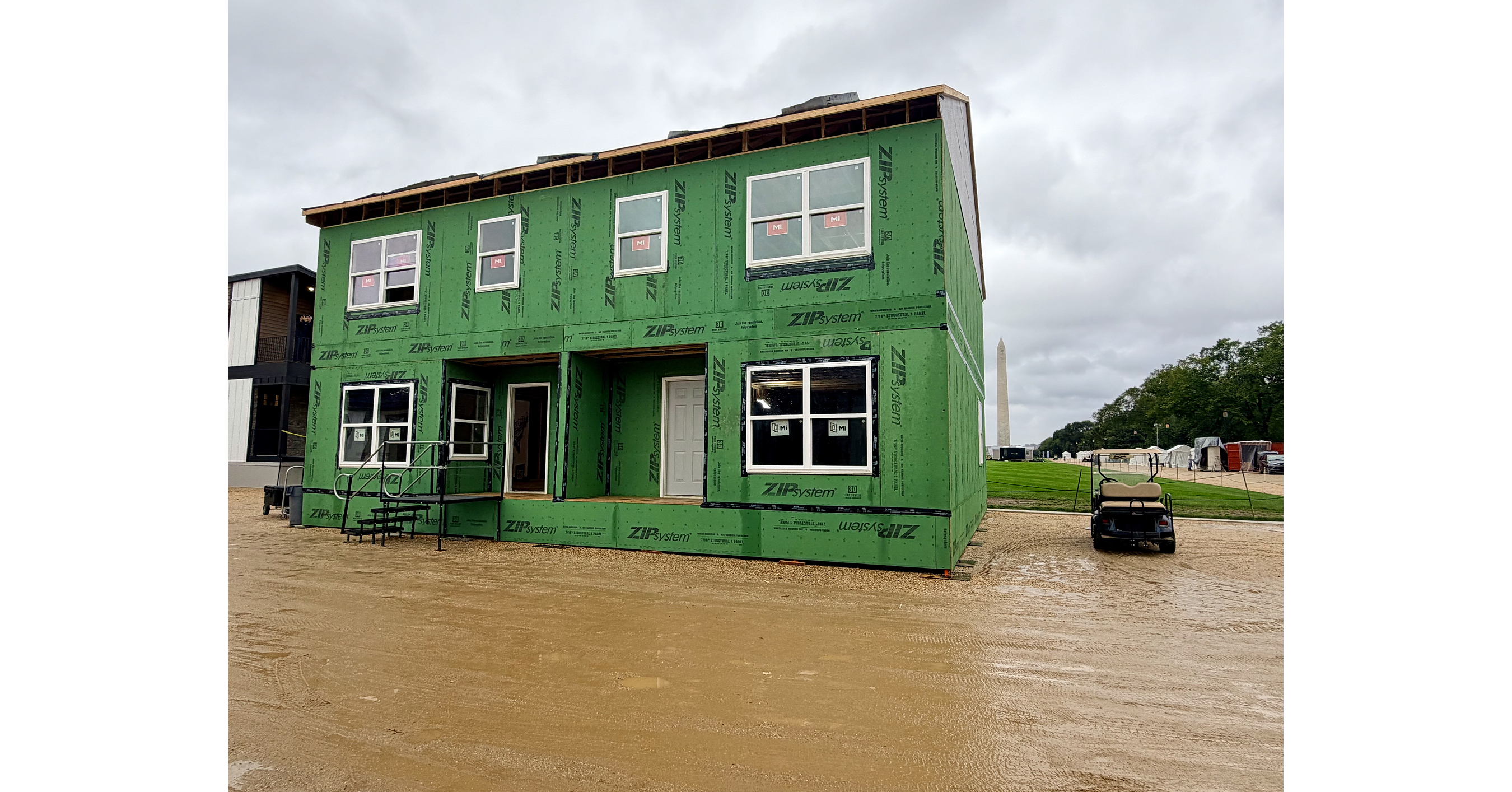
The Structural Building Components Association is displaying a 3,000-square-foot, two-story duplex at HUD's September 22-24 Innovative Housing Showcase to promote offsite-manufactured roof trusses, floor trusses and wall panels. SBCA says componentized framing can assemble in 8-12 hours and may reduce labor, material and construction-time requirements versus traditional stick framing. The industry has more than 1,300 U.S. manufacturing locations, but the announcement is primarily a trade-association showcase rather than a material market-moving development.
Analysis
This is not a near-term earnings catalyst; it is trade-association advocacy with no disclosed orders, policy commitment, or adoption data. Public-market exposure is indirect: builders with standardized, high-throughput product lines—D.R. Horton (DHI), Lennar (LEN), PulteGroup (PHM), and NVR (NVR)—could realize modest cycle-time and labor-productivity gains if panelized/truss penetration rises, but those gains are likely competed away into home-price affordability rather than retained entirely as margin.
The more investable second-order exposure sits with wood-products and component inputs. Higher offsite framing utilization raises demand visibility for engineered wood and truss-related products, favoring Weyerhaeuser (WY), Boise Cascade (BCC), and potentially Louisiana-Pacific (LPX), while reducing jobsite waste and labor intensity. BCC is the cleaner cyclical proxy because distribution volume benefits from construction starts, whereas WY's result remains more dominated by lumber/OSB pricing than component adoption. The offset is that component manufacturing can improve material yield per home, limiting unit wood intensity even as housing throughput improves.
Over 6-18 months, the relevant catalyst is not this showcase but whether HUD, GSEs, or state/local code authorities translate housing-supply rhetoric into permitting standardization, factory-built financing, or procurement preferences. Consensus may overstate the speed of modular/panelized disruption: fragmented builders, local inspection regimes, transport constraints, and upfront design coordination make adoption most viable in production housing, not the broader custom-build market. A falling mortgage-rate cycle would matter far more to these equities than incremental componentization.
Near term, no standalone trade is warranted. Monitor quarterly commentary from DHI, LEN and PHM on construction cycle times, starts per community, and labor costs, plus BCC sales volumes and gross margin. A thesis of meaningful component-driven margin expansion is falsified if builders report faster starts without lower cycle times or if affordability incentives force realized-price concessions that exceed labor/material savings.
AllMind Terminal
AI-powered research, real-time alerts, and portfolio analytics for institutional investors.
Request TrialMarket Sentiment
Overall Sentiment
mildly positive
Sentiment Score
0.18
Key Decisions for Investors
- No event-driven position on this release; treat it as a policy/watch-list item rather than a catalyst.
- If 30-year mortgage rates fall by at least 50bp and DHI or LEN guides to lower construction cycle times or higher starts per community over the next 1-3 quarters, favor long DHI versus short ITB: DHI has scale to operationalize standardized components, while the pair reduces broad housing-beta risk.
- Watch BCC for two consecutive quarters of volume growth exceeding US single-family starts growth; that would support a long position as evidence that distribution/component penetration is adding share. Exit if gross-margin compression offsets volume gains or housing starts roll over.
- Do not underwrite a structural long in WY solely on componentization: require confirmation in engineered-wood pricing and housing-start momentum, since yield improvements can dilute lumber demand per home.
More News
- Wall Street’s Nasdaq hits all-time high as AI frenzy gathers pace
- Data-Center Bet Makes ESDS One of India’s Best New Listings
- Asia stocks ride tech wave higher, oil stays subdued
- South Korean solar stocks jump as curbs on Chinese sector expected to remain in place
- ‘I have a big decision to make’: Trump had a ‘good meeting’ with Iranian officials warning he may ‘annihilate the Islamic Republic’
- Zelenskyy says Ukraine ready for energy truce with Russia after Trump talks
From AllMind Research
- Anthropic IPO Preview: Valuation, Timing, and What to Watch
- Shein After the IPO: Venue, Valuation, and What Must Be Proved
- What AI Research Tools Should a Small Hedge Fund Buy First?
- How to Track Guidance Changes Across a Coverage List With AI
- Stop Treating AI Like a Chatbot: What Are Agents, SubAgents, MCP, and Skills, and How Do They Actually Work?