
Acosta Group Affordability Tracker Finds Shopper Confidence Falling Despite Steady Purchasing Power
Source: PR Newswire
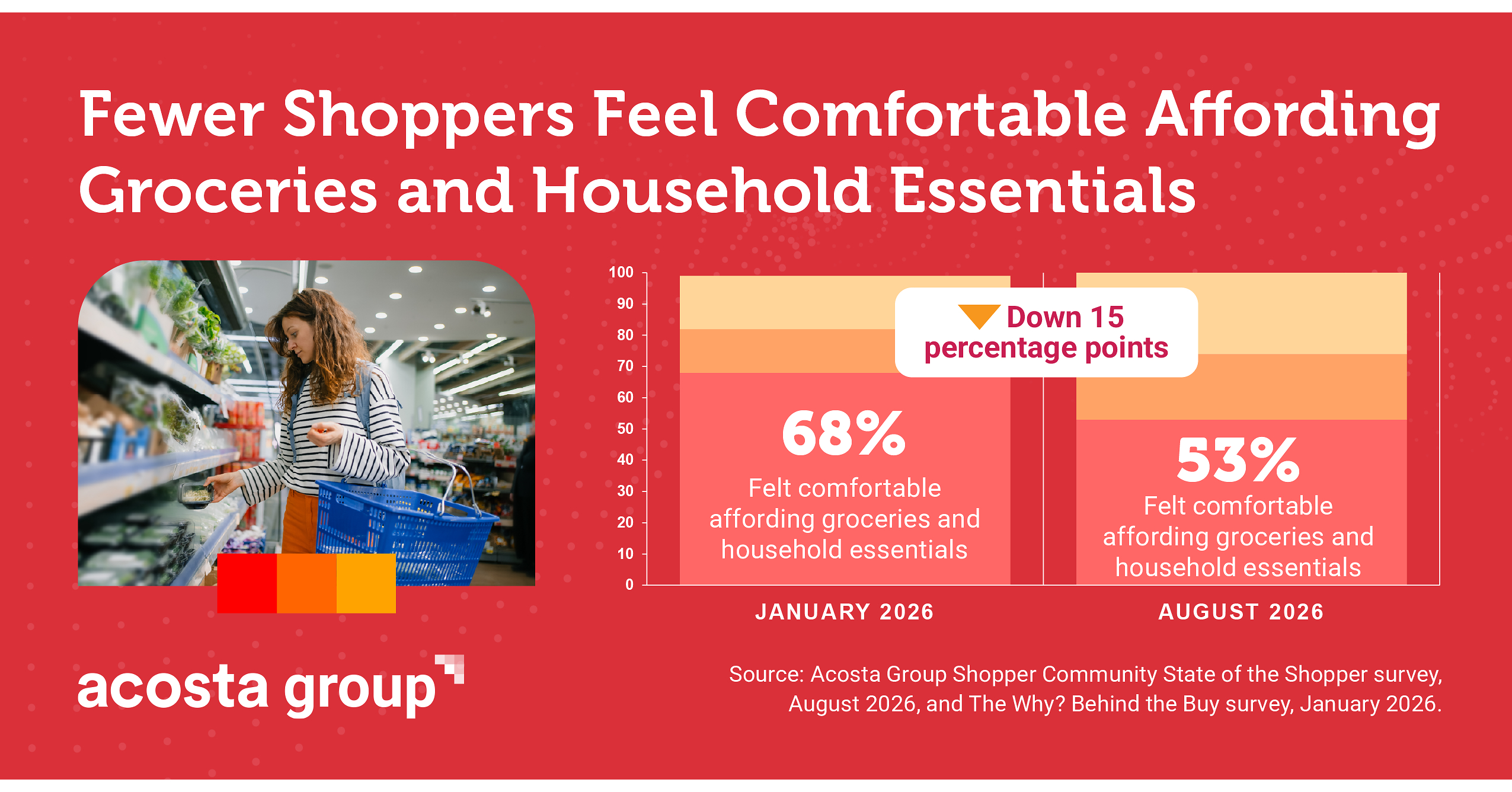
The share of shoppers comfortable affording groceries and household essentials fell 15 percentage points, from 68% in January to 53% in August; 26% reported discomfort, up from 17%. Acosta Group’s 84-item basket cost $366.42 for the four weeks ending Sept. 5, 2026, up 3.5% year over year and about 31% from 2020, while improved purchasing power reduced the required work time by just seven minutes. Shoppers are cutting nonessential spending, seeking deals and switching to store brands or lower-priced retailers, while the report describes the outlook as cautious.
Analysis
The investable signal is mix shift, not necessarily a collapse in grocery volumes: households can preserve essential spending while trading down across brands, pack sizes, promotions, and retail channels. That favors operators able to convert value perception into traffic and gives private label more room, while branded suppliers may face greater promotional demands and weaker mix. The pressure is not uniformly bullish for discount retail—customers may shift channels, but this survey does not establish which retailers are gaining trips or whether value offers are improving margins.
Near term, treat the report as corroboration of consumer-trading-down risk, not a stand-alone earnings revision catalyst. The sample is a national shopper measure, and the basket/work-hours metric is not a company-level sales or margin indicator. Acosta’s report uses NIQ pricing data, but that linkage alone does not demonstrate incremental demand for NIQ’s products or revenue impact for NIQ Global Intelligence.
Over 1–3 months, retailer earnings and guidance should determine whether value-seeking is translating into share gains, basket growth, or simply more promotions. Over 6–18 months, persistent pressure could structurally strengthen private-label penetration and increase branded suppliers’ cost of defending shelf space. Contrarian point: grocery demand may remain resilient in aggregate even as brand-level economics deteriorate. This thesis weakens if retailers report stable branded mix with limited discounting, or if real disposable-income improvement is broad enough to restore shopper confidence.
AllMind Terminal
AI-powered research, real-time alerts, and portfolio analytics for institutional investors.
Request TrialMarket Sentiment
Overall Sentiment
mildly negative
Sentiment Score
-0.25
Key Decisions for Investors
- Do not trade NIQ Global Intelligence on this report alone: the article identifies NIQ as a pricing-data source, not as a beneficiary of consumer trade-down. Reassess only if the company reports a measurable commercial or subscription impact.
- Put a relative-value trade on watch: favor value-oriented grocery/retail exposure over branded consumer staples only after earnings confirm traffic or share gains without disproportionate margin erosion. Use retailer commentary on comparable sales, private-label mix, and promotional intensity as entry evidence; avoid assuming all discount formats benefit equally.
- For branded staples, keep a selective underweight bias rather than a blanket short. Favor companies with credible value tiers and pack-size flexibility; trim exposure where guidance shows rising promotion or volume weakness. Falsify the view if subsequent results show stable branded volumes and margins despite continued shopper concern.
- Track the next 1–3 months of retailer earnings and household real-income data. If real income improves but affordability confidence and value-seeking behaviors persist, that would support a longer-lived mix shift; if confidence rebounds and promotions ease, reduce the trade-down thesis.
More News
- Fed expected to hold rates steady, but Warsh may point way to more hikes
- Labubu-maker Pop Mart's shares extend declines as third-quarter sales plunge
- Oil rebounds as Houthi attacks on Saudi Arabia overshadow diplomatic efforts
- RBNZ holds rates at 2.75% in split vote, signals further hikes likely
- Airlines are trading nearly 23% higher ticket prices for emptier planes as jet fuel prices spike over 90% from the Iran War’s fuel squeeze
- The Trump admin said energy costs were a small price to pay in Iran war, but U.S. consumers are paying nearly 8x more than anyone else in fuel costs