
Chonnam National University Researchers Develop New Composite Electrolyte That Improves Safety and Lifespan of Lithium-Metal Batteries
Source: PR Newswire
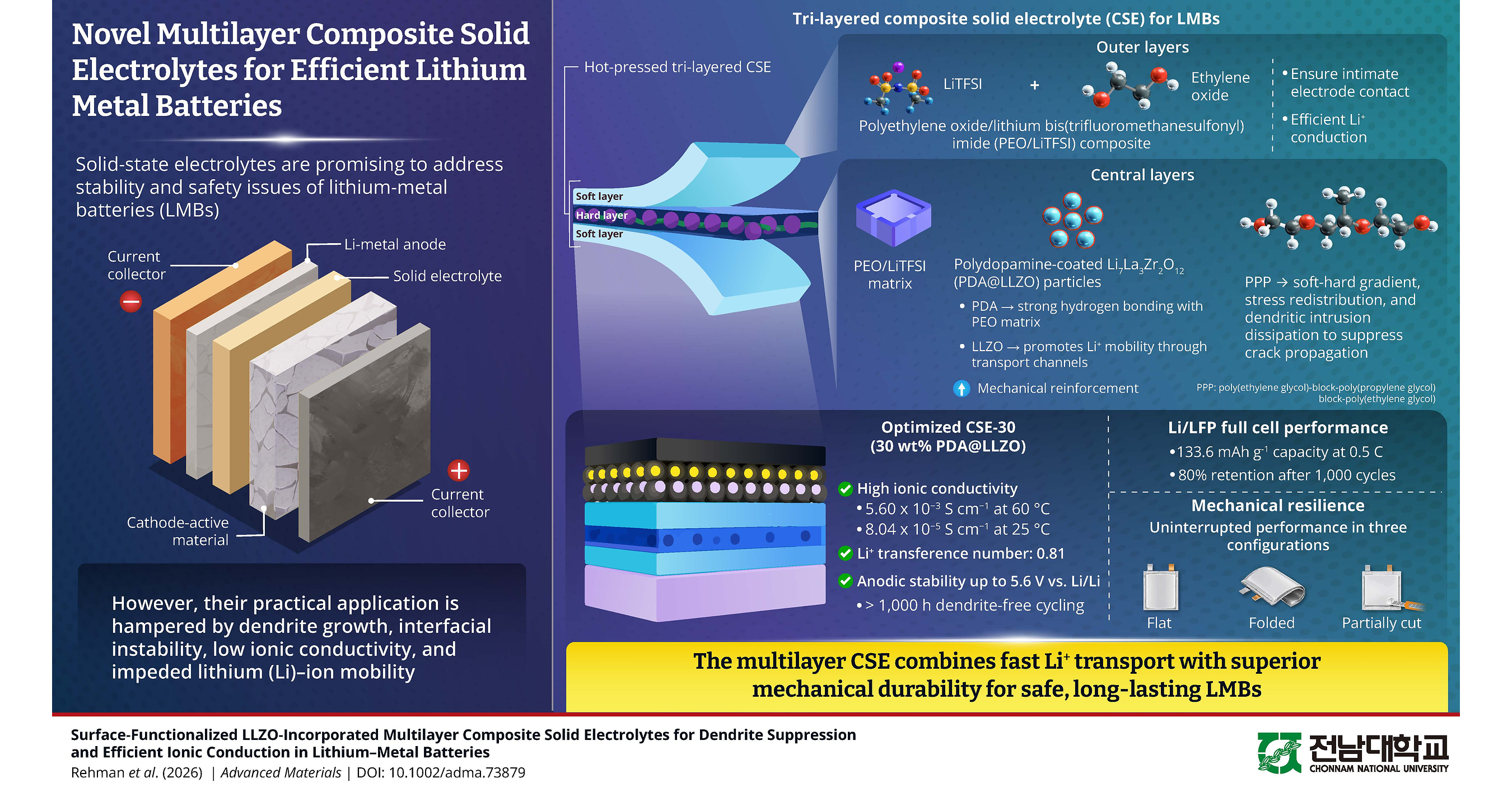
Chonnam National University researchers report a tri-layer composite solid electrolyte (CSE) for lithium-metal batteries that boosts ionic performance and safety, reaching ~4x higher ionic conductivity versus plain PEO and a lithium transference number of 0.81. In symmetric cells, the optimized CSE-30 runs >1,000 hours of dendrite-free cycling, while full cells deliver 133.6 mAh/g with >80% capacity retention after 1,000 cycles, and a flexible pouch cell powers an LED even when folded/partially cut. This is a promising materials breakthrough for longer-life, safer lithium-metal batteries, though it’s at the research/publishing stage with limited immediate market impact.
Analysis
This is bullish for the solid-state battery narrative, but the market should treat it as an R&D de-risking event, not a commercial one. The economic value is in proving the hard part is still hard: if the conductivity/dendrite problem can be improved in a lab, then the remaining bottlenecks shift to yield, moisture control, large-format lamination, and cost per kWh — all of which are where most programs stall.
The immediate winners are the “picks-and-shovels” around ceramic powder processing, dry-room equipment, and pilot-line tooling; the first-order equity beneficiaries are more likely the pure-play solid-state names like QS and SLDP than legacy lithium-ion incumbents, but only if this is followed by OEM validation. For WLDS specifically, the upside is optionality only: flexible, safer cells matter for wearables, but that is a product-roadmap story with a 6-18 month minimum lag, not something that changes next quarter revenue.
Contrarian view: the consensus tends to overpay for academic headlines and underweight scale economics. The real falsifier is not another good paper; it is whether a large-format pouch cell can hold cycle life and abuse tolerance while meeting cost targets. If the next 1-3 month catalyst is a strategic investment or automaker pilot announcement, the sector can rerate; if not, the move likely fades as investors remember that conductivity gains rarely translate 1:1 into commercial battery performance.
AllMind Terminal
AI-powered research, real-time alerts, and portfolio analytics for institutional investors.
Request TrialMarket Sentiment
Overall Sentiment
mildly positive
Sentiment Score
0.25
Ticker Sentiment
Key Decisions for Investors
- No direct long in WLDS on this headline; treat it as a watch item only. Reassess only if the company shows a signed battery-related design win or product announcement within 1-2 quarters.
- For investors wanting exposure, prefer a small starter basket long in QS and/or SLDP on sector weakness over chasing headline momentum; this is a 6-18 month optionality trade with high execution risk.
- Fade any sharp bounce in WLDS if the stock gaps on the article alone; use the rally to sell into strength because there is no near-term P&L linkage.
- Set a catalyst alert for OEM validation or large-format pouch-cell data. That is the event that would falsify the 'science-only' thesis and justify a more aggressive long.
More News
- Nvidia GPUs are everywhere. Here are the ways companies are accessing them
- Why is US turning to Russia for diesel despite sanctions?
- India unveils tough curbs on dollar demand to defend rupee
- Bank of America is bullish on these top stocks ahead of earnings
- Trump's Russian Diesel Deal Draws Ukraine Criticism
- Stocks were up this week. Here are the names that are now overbought
From AllMind Research
- Anthropic IPO Preview: Valuation, Timing, and What to Watch
- Shein After the IPO: Venue, Valuation, and What Must Be Proved
- What AI Research Tools Should a Small Hedge Fund Buy First?
- Run Cost-Controlled Financial Research in AllMind Agent Studio
- State of Public Markets, June 2026: Higher for Longer Meets the AI Supercycle