
Fair Finance Asia appelle à une gouvernance plus solide et équitable ainsi qu'à un partage des bénéfices dans le commerce et le financement des minerais critiques au sein de l'ASEAN
Source: PR Newswire
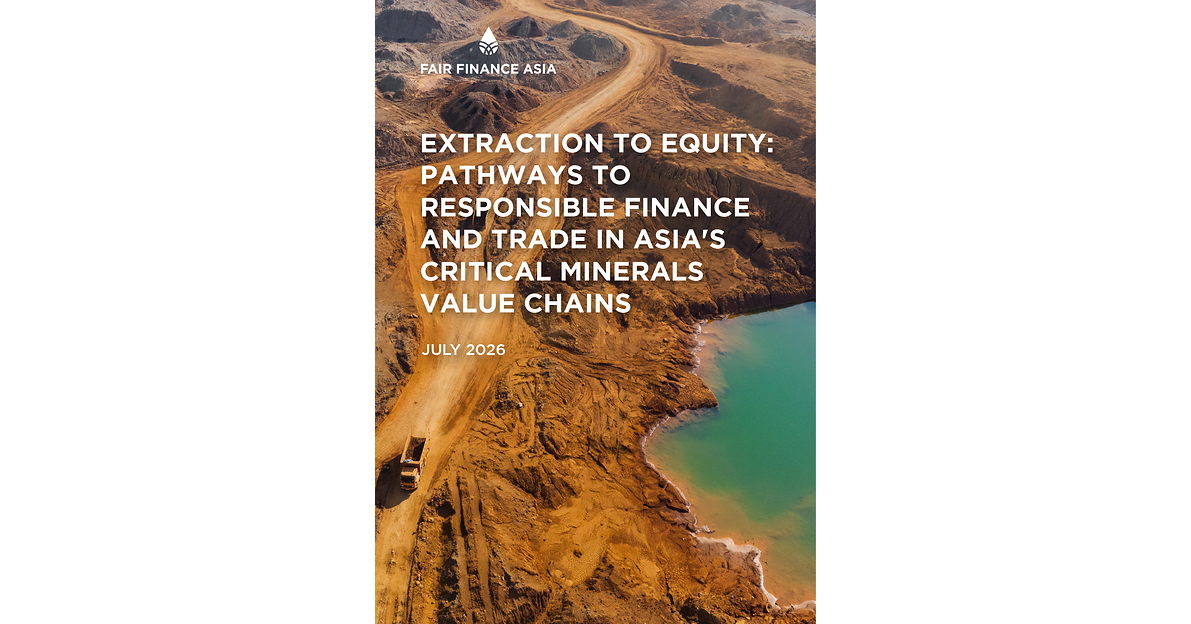
Fair Finance Asia and Profundo report that critical-mineral trade and financing agreements involving Cambodia, Indonesia, the Philippines and Thailand frequently lack enforceable local-benefit, sustainability and equitable value-sharing provisions. Based on public information through December 2025, the study finds that ASEAN source countries tend to export raw minerals while higher-value processing occurs elsewhere. The groups urge ASEAN governments, financial regulators, banks and investors to impose mandatory ESG, community-consent, transparency and decarbonization safeguards.
Analysis
This is not an investable near-term policy event; it is an NGO-led pressure signal. The relevant transmission channel is higher permitting, consultation, remediation and financing costs for ASEAN upstream projects, but only if national regulators or major lenders convert voluntary standards into binding covenants. In the next 1-3 months, monitor Indonesian and Philippine ministry consultations, Equator Principles bank disclosures, and Japanese trading-house sustainability updates rather than positioning on the release itself.
The asymmetric exposure sits with refiners, smelters and battery-material supply chains that rely on low-cost Southeast Asian feedstock. Tighter local-content, benefit-sharing or FPIC requirements would raise the delivered cost of Indonesian nickel and Philippine nickel ore, indirectly supporting higher-cost but politically stable supply outside the region; it would also pressure thin-margin Chinese nickel-pig-iron and precursor capacity more than diversified OEMs. For Japanese buyers and financiers, reputational risk can become a cost-of-capital issue before any legal restriction, particularly where project finance must be refinanced or expanded.
Consensus is likely to dismiss this because ASEAN governments still prioritize investment and export growth. That is reasonable near term, but the market may underprice a 6-18 month shift toward domestic processing mandates and stricter community-consent rules: such measures can delay supply additions even while nominal reserve availability remains ample. The thesis is falsified if Indonesia/Philippines explicitly streamline permits without added ESG conditions, or if nickel prices remain weak enough to defer projects regardless of regulation.
No directional trade is warranted absent evidence of enforceable regulation or project-specific financing stress. Treat this as a watch item for relative-cost dispersion in nickel and battery materials, not a broad renewable-energy demand signal.
AllMind Terminal
AI-powered research, real-time alerts, and portfolio analytics for institutional investors.
Request TrialMarket Sentiment
Overall Sentiment
moderately negative
Sentiment Score
-0.35
Key Decisions for Investors
- No new position on this release; create a 1-3 month regulatory alert for Indonesian nickel-processing rules, Philippine mining-permit/FPIC changes, and ESG-linked lending terms from Japanese banks and trading houses.
- If binding Indonesian benefit-sharing or permitting rules emerge, evaluate a relative long in diversified nickel exposure via JJN versus short Chinese stainless/nickel-processing proxies; require confirmation through a sustained nickel-price move and disclosed project-delay guidance before entry.
- Monitor Vale Base Metals and diversified miners with non-ASEAN nickel optionality as potential 6-18 month beneficiaries of higher Indonesian marginal costs; do not initiate solely on this report because oversupply and Chinese processing economics remain the dominant price drivers.
- For lenders with concentrated ASEAN mining-project finance, flag refinancing dates and sustainability-linked covenant disclosures. A downgrade in ESG underwriting standards or a contested-project delay would be a credit-spread catalyst, while clear government indemnities or permit acceleration would negate the risk.
More News
- South Korea’s exports hit record high on AI boom
- In photos: China's Xi hardens Taiwan warning as country celebrates week-long National Day holiday
- US judge approves settlement allowing Paramount to acquire Warner Bros
- RAM supply set to worsen, says Micron, as CEO celebrates ‘much higher’ prices
- Greer urges G20 to back Trump tariff agenda, takes aim at China
- Why is Nidec stock plunging today?