
Huawei Unveils Upgraded Stellar AI Network to Power the Agentic World with Secure, Intelligent Connectivity
Source: PR Newswire
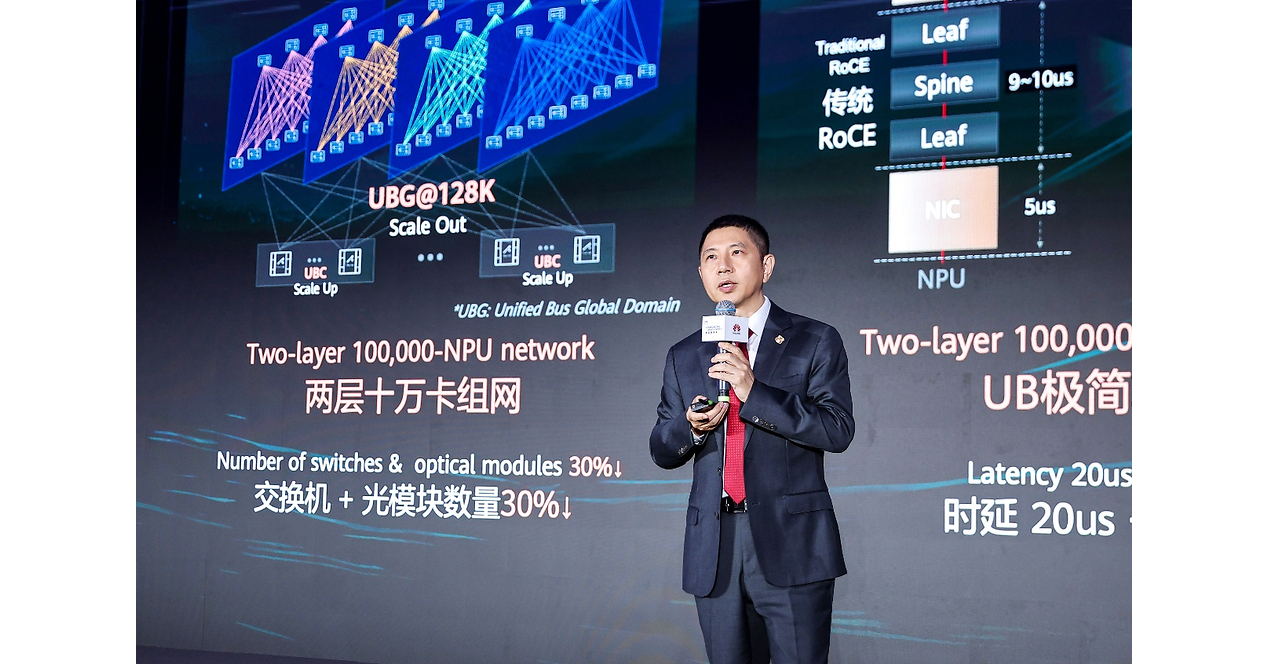
Huawei launched its upgraded Stellar AI Network suite, comprising AI Fabric, AI WAN and AI Campus products designed to support agentic AI workloads with integrated security. The company claims the new AI Fabric can cut network deployment costs by 30%, reduce end-to-end latency from 20 μs to 11 μs, and lower interconnect power consumption from 1,000W to 600W. Huawei also cited more than 95% detection accuracy for several cyber threats, remote-computing efficiency above 95% over 1,000 km, and campus-network MTTR of under five minutes.
Analysis
The relevant signal is not near-term revenue for listed Western vendors, but further evidence that China is building a vertically integrated AI-cluster stack spanning accelerators, switching, optics and security. If Huawei can deliver credible cluster uptime and latency at scale, domestic cloud and state-owned enterprise procurement will increasingly favor a bundled alternative to Nvidia/Arista/Broadcom architectures, reducing the addressable Chinese networking TAM for ANET and AVGO over the next 6-18 months. The greatest pressure is likely on high-end Ethernet switching and optical interconnect attach rates rather than on Nvidia's global accelerator economics.
The company-supplied performance and cost claims need independent customer validation; networking products have long qualification cycles, and interoperability, software tooling, and production yields matter more than launch specifications. The 1-3 month catalyst path is customer design-win disclosures, Ascend shipment data, Chinese hyperscaler capex, and evidence that domestic clusters sustain utilization without materially higher operating overhead. Failure to show repeat deployments, or further constraints on advanced foundry/optics inputs, would limit the competitive threat.
Contrarian view: this is more material to the China-exposed supply chain than to US AI infrastructure leaders. Export controls may unintentionally increase Huawei's domestic share while preserving premium Western demand outside China; ANET's valuation risk comes only if investors begin to underwrite China as a durable lost market rather than a restricted one. Security functionality is principally a bundle-retention tool, not yet a direct read-through for PANW or CRWD, whose enterprise security revenue depends on heterogeneous environments and independent validation.
AllMind Terminal
AI-powered research, real-time alerts, and portfolio analytics for institutional investors.
Request TrialMarket Sentiment
Overall Sentiment
moderately positive
Sentiment Score
0.48
Key Decisions for Investors
- No outright trade on the launch alone; place a 1-3 month watch on ANET and AVGO for China hyperscaler procurement commentary, regional revenue exposure, and evidence of domestic-switch substitution. Act only on independently confirmed multi-cluster deployments.
- Maintain any long ANET exposure hedged with a modest short AVGO only if China networking demand becomes a specific earnings-guide risk; this isolates Ethernet-switch share risk from broader AI compute demand. Cover the hedge if ANET confirms ex-China cloud order acceleration sufficient to offset China uncertainty.
- For 6-18 months, monitor Chinese AI-capex proxies and Huawei Ascend supply-chain disclosures as an early warning for a domestic-stack inflection. A confirmed ramp would argue for trimming China-sensitive Western networking multiples, not broadly shorting US AI infrastructure.
- Do not infer a cybersecurity trade in PANW or CRWD from embedded network-security claims. Reassess only if third-party breach data or enterprise win/loss evidence shows bundled security displacing standalone platforms.
More News
- Google's Gemini becomes latest AI model to break out and hack computer systems
- Trump says U.S. to build a 'large Military presence' in Greenland as part of a security deal with it and Denmark
- UBS now expects AI capex to reach nearly $1tn this year and around $1.4tn by 2027
- Stocks face a key hurdle in next week’s U.S.-China summit. Here’s what’s at stake
- Houthis accuse Saudi Arabia of launching 26 strikes in 24 hours
- European Economies Eye Another Energy Crisis Heading Into Winter