
Netwrix Research: 79% of Healthcare Organizations Face Security Risks Due to Gaps in Governing AI Agents and Other Non-Human Identities
Source: PR Newswire
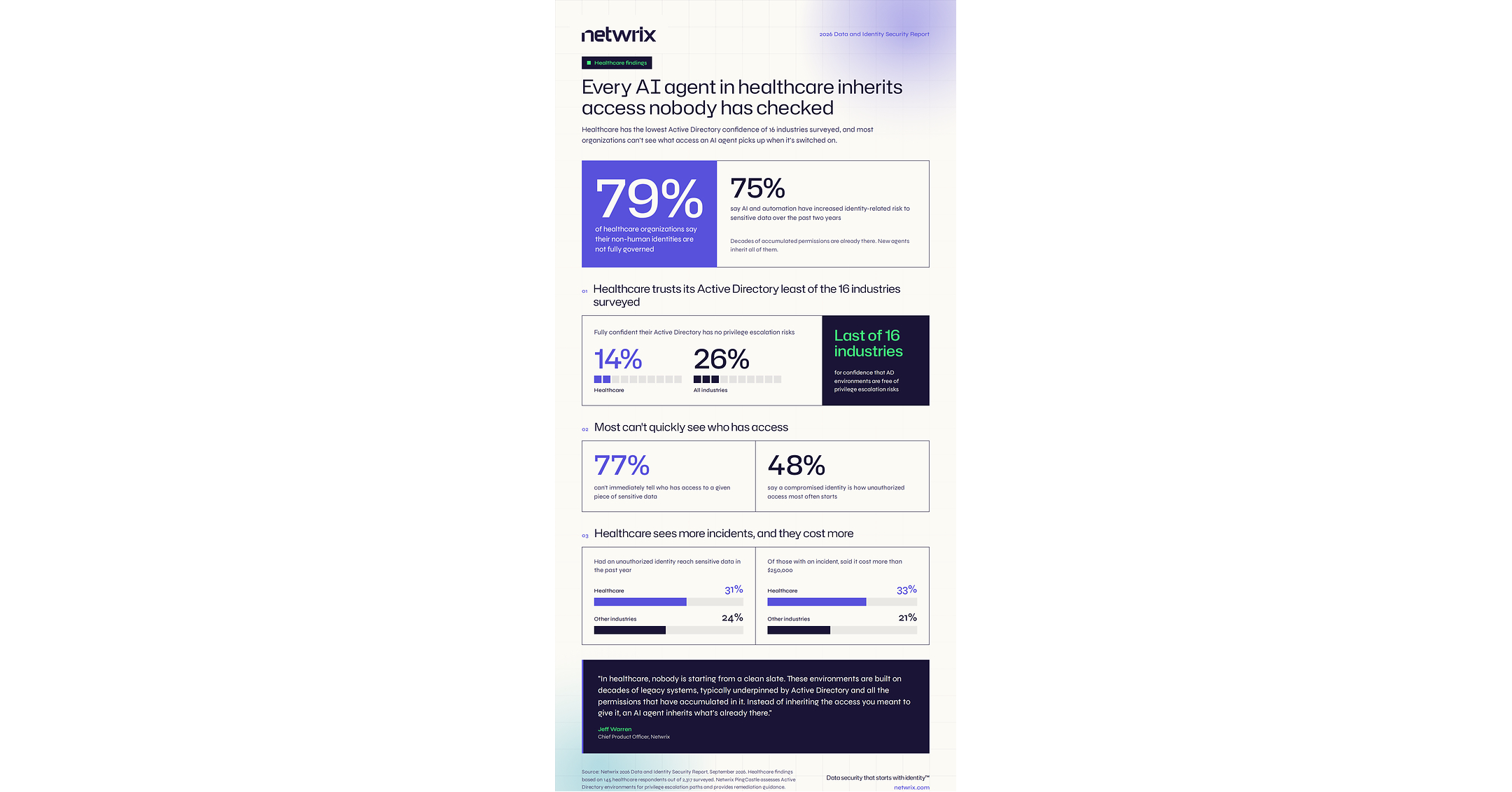
Netwrix reported that 31% of healthcare organizations suffered unauthorized identity access to sensitive data in the past year, versus 24% in other industries, and 33% of affected providers incurred costs above $250,000. Healthcare ranked lowest among 16 industries for Active Directory security confidence, with 86% not fully confident their environments are protected from privilege-escalation risks. AI adoption is adding governance pressure: 79% said non-human identities are not fully governed and 75% said AI and automation have increased identity-related data-access risk.
Analysis
This is not independently verified incident data and the healthcare sample is too small to underwrite a sector-wide demand step-up. Still, it highlights a budget reallocation mechanism: hospitals adding AI workflows are likely to prioritize identity visibility, privileged-access management and data-access governance over discretionary point-security tools. The near-term beneficiaries are scaled platforms with healthcare channels and cross-sell capacity—PANW, CRWD, MSFT, OKTA and CYBR—rather than private Netwrix itself; MSFT is especially positioned where Entra/Active Directory remediation can be bundled into existing enterprise agreements.
Over the next 1-3 months, the relevant catalyst is not this release but evidence that identity-security bookings and remaining performance obligations are accelerating in healthcare vertical commentary. A breach at a major provider or payer could force emergency spend, benefiting incident-response and endpoint vendors first (CRWD, PANW) while lifting identity vendors on subsequent remediation cycles. Conversely, hospital operating-margin pressure and reimbursement uncertainty can defer broad governance projects, favoring vendors offering low-friction modules or consolidating incumbent spend over standalone deployments.
The underappreciated 6-18 month effect is that unmanaged machine identities make AI deployment a security architecture issue rather than a model-spending issue. This supports identity platforms with privileged-access, lifecycle management and governance capabilities, but may pressure narrowly differentiated AI-security vendors if buyers standardize on platform bundles. Avoid extrapolating this into a broad cyber long: valuation dispersion remains critical, and an absence of healthcare-specific pipeline conversion would leave the theme as narrative rather than incremental revenue.
AllMind Terminal
AI-powered research, real-time alerts, and portfolio analytics for institutional investors.
Request TrialMarket Sentiment
Overall Sentiment
moderately negative
Sentiment Score
-0.38
Key Decisions for Investors
- Maintain a 3-6 month overweight in PANW versus the HACK ETF: its platform consolidation proposition is best aligned with constrained healthcare IT budgets; reassess if billings/RPO decelerate or healthcare vertical commentary fails to improve over two earnings cycles.
- Use weakness before the next earnings cycle to build a measured long MSFT / short OKTA pair over 6-12 months: Entra can be bundled into installed Microsoft agreements, while standalone identity vendors face procurement and pricing pressure. Stop if OKTA demonstrates sustained large-enterprise net-retention reacceleration or material public-sector/healthcare win momentum.
- Place an alert, not a position, on CYBR: initiate only if next-quarter annual recurring revenue and subscription bookings show acceleration alongside management confirmation of healthcare demand. The missing data are healthcare revenue exposure, deal size, and procurement-cycle conversion.
- Do not add broad healthcare-provider shorts on this signal. A cyber incident raises remediation expense but normally has insufficient duration to dominate provider earnings; use a confirmed breach plus disclosed operational disruption as the required catalyst.
More News
- South Korea’s exports hit record high on AI boom
- Asian stocks dip, bonds in focus after torrid September
- RAM supply set to worsen, says Micron, as CEO celebrates ‘much higher’ prices
- Tencent leases 100,000 chips from Oracle for $7 bln- FT
- Asia stocks rise on chipmaker gains, soft U.S. inflation; Nikkei outperforms
- We're raising our Micron price target after an incredible quarter and robust guidance