
China Orders Military Supply Chain Checks in Self-Reliance Push
Source: Bloomberg
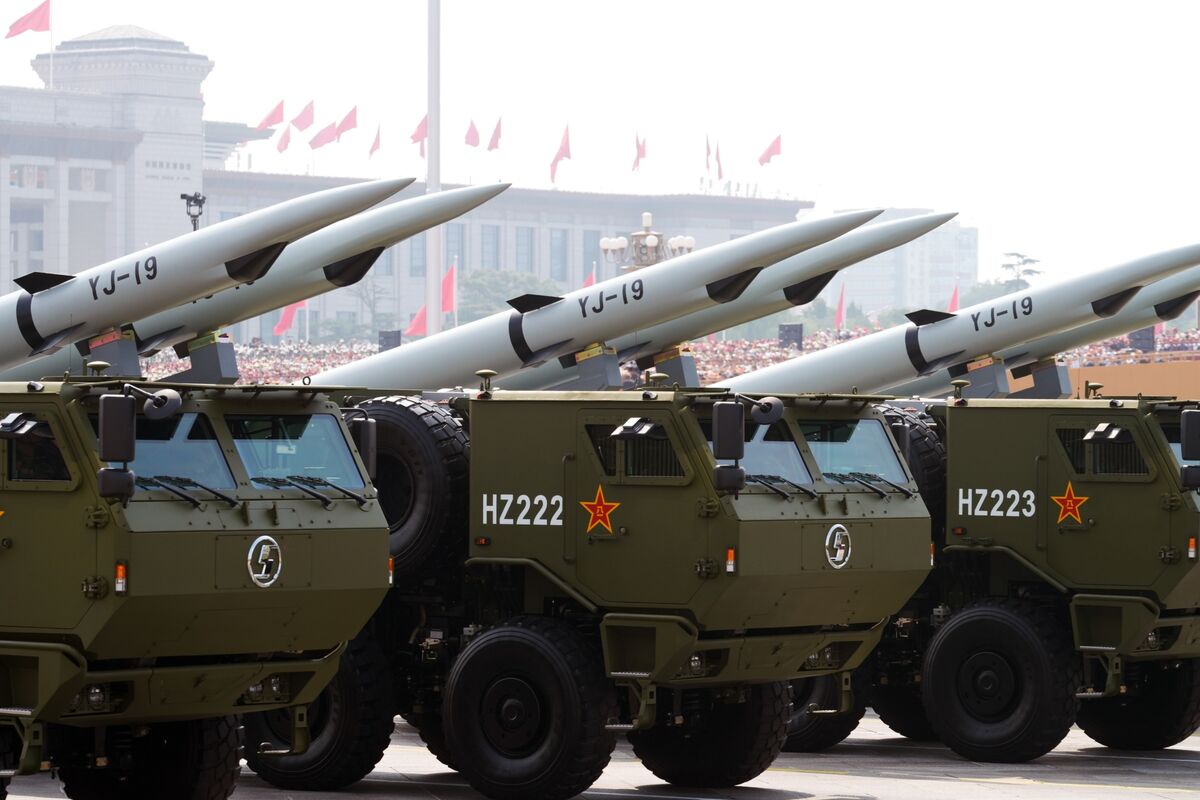
China will begin checking the security of its military supply chains under a revised National Defense Mobilization Law passed Friday, directing the Central Military Commission and State Council departments to survey military hardware, supplies, and special production equipment. The move reinforces a broader self-reliance push in defense industry sourcing. Near-term effects are likely more sector-specific than market-wide, but it raises regulatory and operational risks for defense supply chains.
Analysis
The first-order market read is not “more defense spending,” but a slower, more controlled procurement chain in China that favors firms able to localize components, certify suppliers, and absorb compliance friction. That creates a relative winner set in domestic Chinese machine tools, specialty materials, test/measurement, and industrial software, while foreign dual-use exporters with hidden military end-market exposure face longer qualification cycles and possible volume loss. The bigger second-order effect is on supply-chain opacity: once a government formally audits critical inputs, it usually uncovers bottlenecks that redirect capex toward redundancy rather than efficiency.
Near term, this is more about sentiment than earnings. Over the next 1-3 months, the tradable impact is likely limited unless the audit is paired with named procurement cuts, import bans, or budget allocations; absent that, it is a slow-burn policy signal. Over 6-18 months, it can support a broader decoupling premium across Asian defense-adjacent supply chains and raise valuation dispersion between companies with domestic sourcing power and those reliant on cross-border components.
The contrarian point is that the market may overestimate immediacy: self-reliance programs often look aggressive on paper but take years to convert into real substitution, and in the interim they can reduce efficiency and increase costs inside the defense complex. What would falsify the “decoupling premium” thesis is evidence that this is a one-time compliance exercise with no follow-on procurement changes, or that imported capital equipment and electronics keep flowing at unchanged rates. Until then, this is more a geopolitical alert than a clean alpha event.
AllMind Terminal
AI-powered research, real-time alerts, and portfolio analytics for institutional investors.
Request TrialMarket Sentiment
Overall Sentiment
neutral
Sentiment Score
-0.10
Key Decisions for Investors
- No immediate directional trade in broad China equity proxies; treat this as a watch item until there is evidence of procurement rerating or import substitution data.
- Small tactical long ITA or PPA on pullbacks as a 3-6 month geopolitical hedge; thesis works only if this audit is followed by broader regional defense escalation, not just bureaucracy.
- If China-specific industrial suppliers with dual-use exposure rally on the headline, consider fading via a short basket against domestic-China defense beneficiaries once liquid names can be identified; the edge is in the supply-chain substitute trade, not the headline.
- Set an alert for follow-on policy: named supplier audits, import restrictions, or incremental defense budget changes. Those are the catalysts that would convert this from narrative into a tradable earnings event.
More News
- Brian Sullivan: Why the 'real' price of oil is likely $30-$40 higher than where it is now
- Latest Oil Market News and Analysis for Oct. 16
- Blackstone President Jon Gray Bets Big on AI Boom
- How the Houthis are helping Iran turn Saudi Arabia into a pressure point
- Giant Taiwanese chipmaker TSMC confirms it’s in talks with Elon Musk to join ‘Terafab’ complex in Texas: ‘The AI market continues to be very strong’
- Ukraine to resume strikes on Russian refineries, shattering hopes of an 'energy ceasefire'
From AllMind Research
- Anthropic IPO Preview: Valuation, Timing, and What to Watch
- Shein After the IPO: Venue, Valuation, and What Must Be Proved
- What AI Research Tools Should a Small Hedge Fund Buy First?
- Reading Conviction in the Tape: What Level 3 Order Book Data Really Tells Discretionary PMs
- AI Tools for CFA Charterholders: An Evidence Standard