
New APWA Toolbox Helps Communities Answer Data Center Questions
Source: PR Newswire
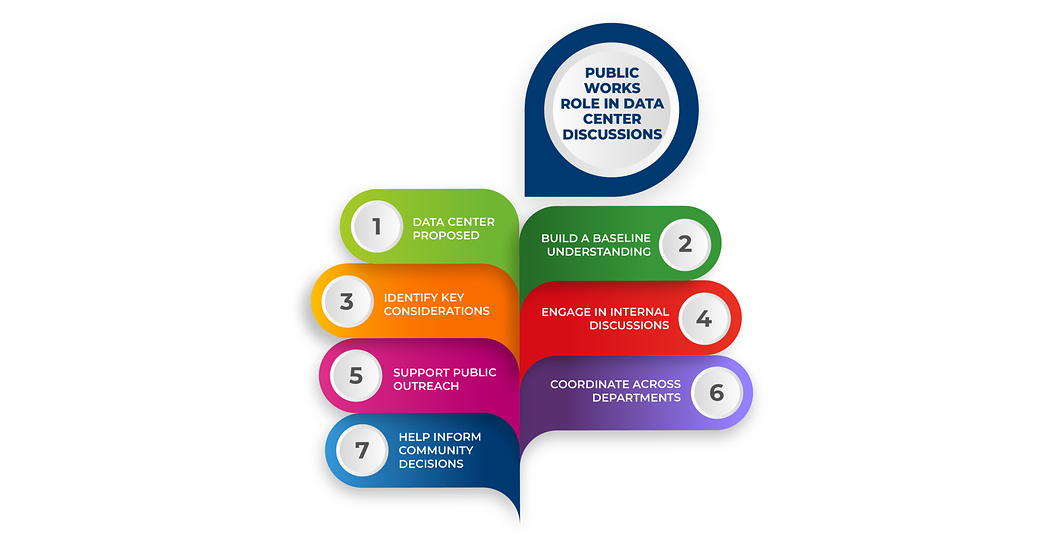
The American Public Works Association released a Data Center Development Toolbox to help local governments assess proposed data-center projects. The resource highlights potential demands on water and power, transportation, stormwater systems, utilities, zoning, environmental planning, incentives, and eventual decommissioning. It is an informational planning tool rather than a policy mandate and is unlikely to have material near-term market impact.
Analysis
This is not a demand signal for data centers; it is an early indication that local permitting friction is becoming a material execution variable. The near-term effect is likely longer entitlement cycles and higher off-site infrastructure obligations in power-constrained or water-stressed jurisdictions, raising project IRRs and favoring developers with pre-secured land, interconnection capacity, water rights, and utility relationships. That selectively supports large-scale operators such as EQIX and DLR relative to smaller private developers, while potentially slowing hyperscaler capacity delivery rather than reducing underlying AI-compute demand.
The more consequential second-order effect is on regulated utilities. If municipalities require developers to fund substations, transmission upgrades, water treatment, or decommissioning security, utilities including DUK, SO, AEP, EXC and ETR could see lower balance-sheet burden and more rate-base investment, but only where regulators permit timely cost recovery. Conversely, mandatory curtailment, stricter water-use rules, or moratoria could impair load-growth assumptions already embedded in utility valuations; the risk is greatest in ERCOT, Northern Virginia, Arizona, and parts of the Southeast where grid and water constraints are politically salient.
Over 1-3 months, this is primarily a diligence and earnings-call risk rather than a standalone catalyst. Watch for disclosed queue withdrawals, revised energization dates, developer-funded interconnection terms, and state/local restrictions; these would challenge the market's assumption that announced AI capacity converts cleanly into revenue. Over 6-18 months, permitting scarcity should increase the value of powered land and existing campuses, but it may also shift marginal compute investment toward regions with surplus generation, including nuclear-heavy or renewable-rich service territories.
Consensus remains focused on incremental megawatts and underweights the local-social-license constraint. The likely outcome is not broad cancellation, but a widening gap between announced and commissioned capacity, which can tighten colocated capacity pricing for incumbents even as capex returns deteriorate for late entrants. No immediate directional trade is warranted from this release alone because it contains no binding policy, project-specific restriction, or measurable change in approval timelines.
AllMind Terminal
AI-powered research, real-time alerts, and portfolio analytics for institutional investors.
Request TrialMarket Sentiment
Overall Sentiment
neutral
Sentiment Score
0.05
Key Decisions for Investors
- Maintain a watchlist long DLR / short a diversified data-center construction-and-development proxy only after evidence of permitting delays or higher infrastructure contributions emerges; target initiation on a disclosed 6+ month energization delay, with thesis invalidated by unchanged commissioning schedules and stable development yields.
- Monitor regulated-utility earnings for data-center load additions versus committed transmission and substation capex. Favor utilities with contracted load, constructive rate recovery, and excess power capacity; avoid adding exposure to utilities where projected load growth is not matched by approved capital plans or firm interconnection agreements.
- For existing AI-infrastructure longs, distinguish announced capacity from energized capacity. Reduce exposure if hyperscalers begin citing local permitting, water, or grid constraints as reasons for capex deferrals; add selectively to established colocation operators if constrained supply drives pricing or backlog conversion higher.
- Set an alert for municipal moratoria, mandatory water limits, or developer-funded grid-upgrade requirements in Northern Virginia, ERCOT, Arizona, and Southeast utility territories. Those events would be tradeable only if linked to named projects, quantified megawatt impacts, or revised utility load forecasts.
More News
- Saudi coalition says Houthi drone destroyed near Mecca
- Iran war increasing inflation, straining US munitions: congressional report
- Attacks on Saudi oil expose Iraqi PM’s struggle to control armed factions
- China's AI leaders keep quiet despite U.S. 'publicity' on tech risks
- Oil prices dip as U.S. inventory build offsets M.East supply jitters
- Exclusive-Malaysia talks to rival airlines as it monitors AirAsia’s financial health, sources say
From AllMind Research
- Anthropic IPO Preview: Valuation, Timing, and What to Watch
- Shein After the IPO: Venue, Valuation, and What Must Be Proved
- What AI Research Tools Should a Small Hedge Fund Buy First?
- How to Search Earnings Call Transcripts With AI
- What a Concept From Nature Tells Us About How C-Suite Executives Actually Think About AI