
Integrated U.S.-Mexico Avocado Supply Chain Fuels Economic Growth, Generating $7.1 Billion in U.S. Output
Source: PR Newswire
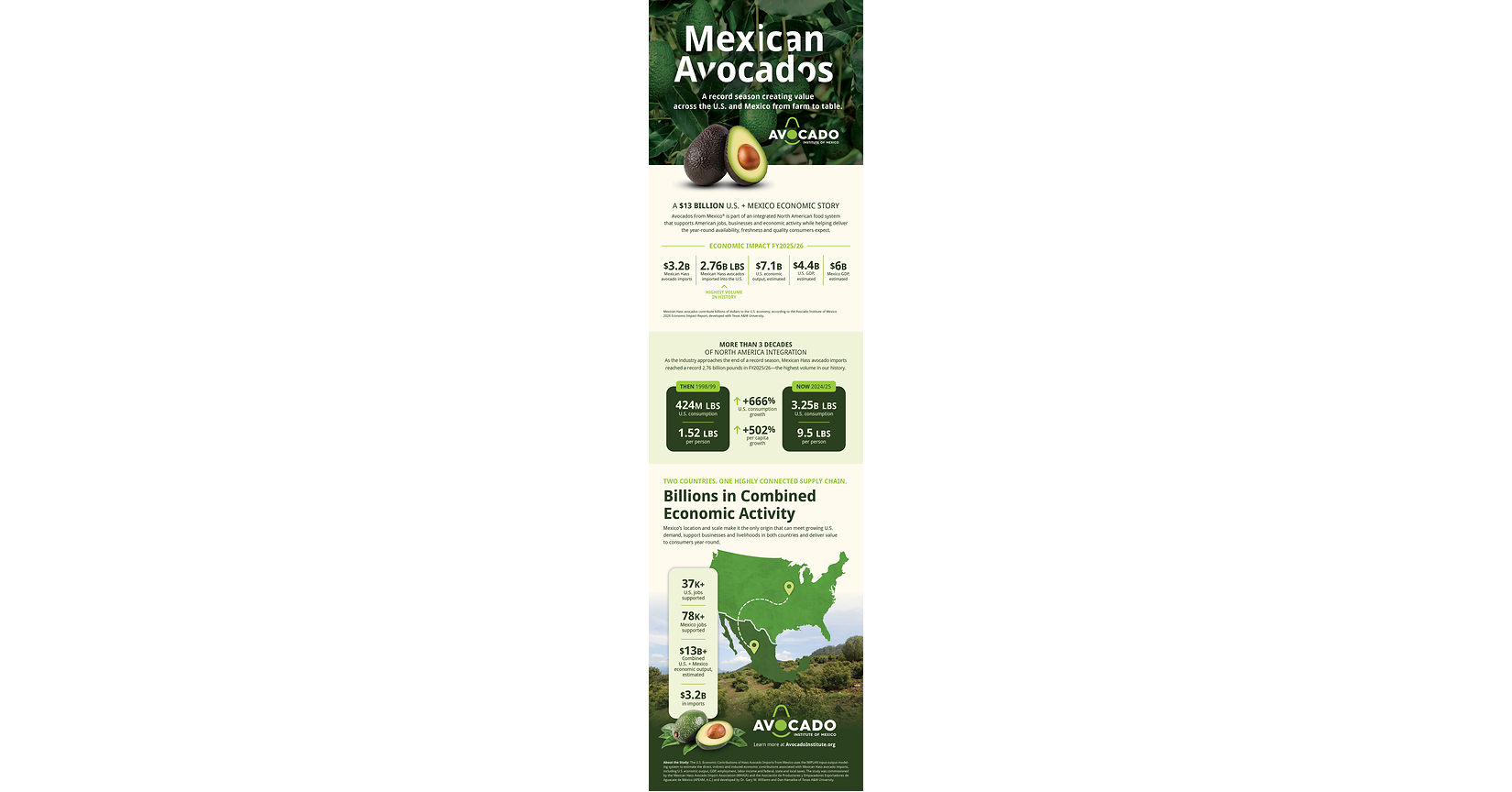
A Texas A&M analysis estimates that $3.2 billion of Mexican Hass avocado imports in FY2025/26 generated $7.1 billion in U.S. economic output, contributed $4.4 billion to U.S. GDP, and supported more than 37,000 U.S. jobs. U.S. avocado consumption rose 666% from 424.4 million pounds in the late 1990s to 3.25 billion pounds in 2024/25, while Mexican imports reached a record 2.76 billion pounds in the 2026 season. The article also reports combined U.S.-Mexico avocado-related output above $13 billion and 115,000 jobs, based on separate analyses.
Analysis
The investable signal is supply-chain exposure, not the headline economic multiplier. The Texas A&M study was commissioned by industry groups and uses IMPLAN input-output modeling: modeled output, jobs and GDP are not incremental public-company revenue, profit or a measure of consumer surplus. Treat the $2.21 output-per-dollar figure as an advocacy framing, not a valuation input.
The structural beneficiaries are U.S. cold-chain transport, warehousing, produce distribution, retailers and foodservice operators that monetize dependable year-round supply; these gains are diffuse and unlikely to move any one company’s earnings materially absent a disruption. California growers may benefit from seasonal complementarity rather than being displaced outright. Conversely, the category’s scale increases exposure to Mexican crop/weather, water, labor, border-inspection and trade-policy shocks. A border slowdown could raise spot prices and freight costs, pressure retailers/restaurants’ margins or volumes, and temporarily support alternative origins—but substitution capacity and timing need verification.
Near term, this release itself is unlikely to be a catalyst. Over 1–3 months, monitor import volumes, wholesale avocado prices, border clearance and retailer commentary for evidence that demand growth is translating into pricing or margin power. Over 6–18 months, the key question is whether supply can expand reliably without eroding grower economics or category affordability. The contrarian point: rapid historical consumption growth does not prove durable price-insensitive demand; promotion, availability and low prices may be as important as dietary positioning. A sustained retail price spike or volume deceleration would challenge the bullish category narrative.
AllMind Terminal
AI-powered research, real-time alerts, and portfolio analytics for institutional investors.
Request TrialMarket Sentiment
Overall Sentiment
mildly positive
Sentiment Score
0.35
Key Decisions for Investors
- No trade on the press release alone: modeled economic contribution is too indirect to support an earnings or valuation revision for listed companies.
- Add a supply-chain alert for U.S. produce distributors, cold-chain logistics providers and food retailers: track Mexican import volumes, wholesale prices, border delays and company-specific produce commentary before taking exposure.
- If a material border restriction or crop disruption emerges, assess a short-term relative-value trade favoring alternative-origin suppliers over avocado-dependent retailers and foodservice operators; size only after confirming substitution capacity, price pass-through and the duration of the disruption.
- Falsify the structural-growth thesis if sustained avocado price increases coincide with falling U.S. volumes, or if retailer/foodservice commentary indicates weaker category sales; validate with import and retail scanner data rather than the commissioned multiplier study.
More News
- The U.S. market has never been more focused on one single bet—but AI’s payoff will likely take decades
- Meta put out an ambitious roadmap to Muse monetization after strong quarter and guide
- Russian Drones Are Already Killing People Within EU Territory
- US orders departure of personnel from Saudi Arabia, citing Houthi threat
- Sovereign wealth funds' China and Hong Kong investments surge 190% after a bruising slump
- Bank of Korea holds rates after President Lee calls for boosting housing supply