
Donald Trump Just Made India’s Oil Balancing Act Even Trickier
Source: Bloomberg
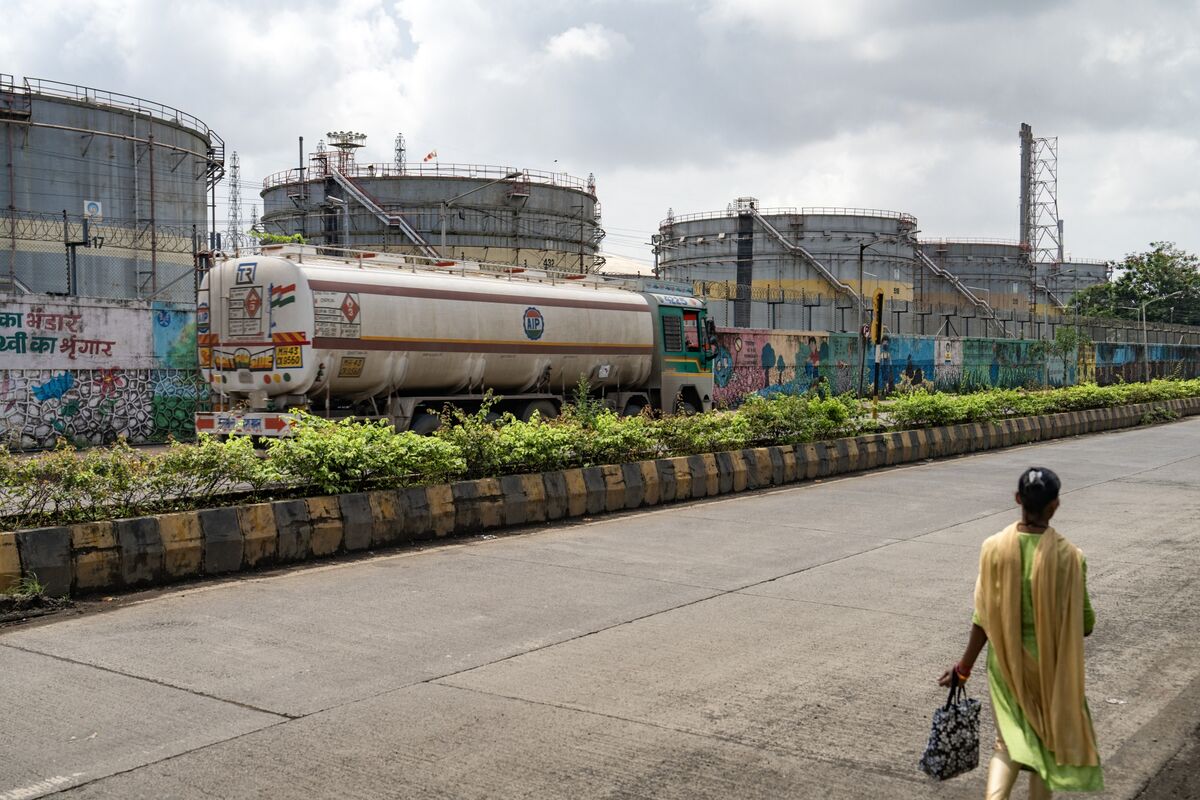
India, the world’s third-largest oil importer, faces a more difficult balancing act between securing discounted Russian crude, managing supply and prices, and adapting to shifting US policy under Donald Trump. The changing US stance raises uncertainty for Indian refiners and could complicate trade flows for Russian oil, though the excerpt provides no specific policy action or price impact.
Analysis
The investable transmission channel is not India’s headline crude import cost but refinery feedstock optionality. IOC.NS, BPCL.NS and HPCL.NS have benefited from discounted, medium-sour barrels that can widen gross refining margins versus Asian benchmark margins; a disruption to settlement, insurance, or tanker availability would remove that advantage before physical volumes necessarily decline. Reliance.NS is relatively better positioned because of greater crude sourcing flexibility, export orientation and a stronger balance sheet, while state refiners face a larger risk of politically constrained product-price pass-through if domestic pump prices become a policy tool.
Over the next days to 1-3 months, the relevant indicators are Urals-Dubai spreads, Russian-origin freight/war-risk premia, and evidence that non-Western insurers or banks are demanding higher fees. A narrowing of the delivered discount by $3-5/bbl would be material for Indian refinery earnings even if Brent is unchanged, and would support Asian refining margins only selectively: complex exporters can recapture product cracks, but domestic-oriented refiners may not. The second-order beneficiary is Middle Eastern crude suppliers, particularly Saudi Aramco, whose term-barrel pricing power improves if Indian refiners need to replace flexible spot supply.
Consensus may over-focus on an immediate supply shock. India can substitute physical barrels over several months, but replacing financing, shipping and blending economics is harder; therefore earnings risk arrives through margin normalization rather than an outright shortage. Conversely, the bearish refinery thesis is falsified if Urals delivered into India retains a discount of more than roughly $8/bbl to comparable Middle Eastern grades, or if product cracks rise enough to offset a narrower crude advantage. This is primarily a 1-2 quarter relative-earnings issue, not a broad directional oil trade absent a verified loss of export volumes.
AllMind Terminal
AI-powered research, real-time alerts, and portfolio analytics for institutional investors.
Request TrialMarket Sentiment
Overall Sentiment
mildly negative
Sentiment Score
-0.25
Key Decisions for Investors
- Prefer Reliance.NS over BPCL.NS and HPCL.NS for the next 3-6 months; express as a relative-value pair rather than outright energy beta. Target a 8-12% relative move if delivered Russian discounts compress materially; exit if the Urals-Dubai delivered spread remains above $8/bbl or Reliance’s refining margin guidance deteriorates.
- Avoid adding to Indian state-refiner longs until quarterly disclosures quantify crude-source mix, realized GRM and domestic marketing-margin exposure. A policy decision preventing retail fuel-price pass-through would turn an otherwise manageable feedstock issue into a material downside catalyst.
- Set an event-driven alert on tanker/insurance restrictions and Urals-Dubai spreads rather than buying oil immediately. If freight and insurance costs tighten the effective discount by $3/bbl or more for two consecutive weeks, initiate the Reliance.NS / short BPCL.NS pair with a 3-month horizon.
- For global exposure, modestly favor Saudi Aramco (2222.SE) over Asian independent refiners if substitution demand shifts toward term Middle Eastern supply. The thesis fails if replacement barrels are readily available from discounted Atlantic Basin grades or if Brent demand weakness compresses official selling-price power.
More News
- Trump signs sweeping Russia sanctions over Ukraine war
- Saudi Oil Cuts Tied to War Hit Europe: Evening Briefing Americas
- Trump says U.S. to build a 'large Military presence' in Greenland as part of a security deal with it and Denmark
- Stocks face a key hurdle in next week’s U.S.-China summit. Here’s what’s at stake
- Houthis accuse Saudi Arabia of launching 26 strikes in 24 hours
- European Economies Eye Another Energy Crisis Heading Into Winter