
Supermicro brengt NVIDIA Aerial RAN-computeroplossingen naar de netwerk-edge in samenwerking met Nokia voor low-latency AI-diensten
Source: PR Newswire
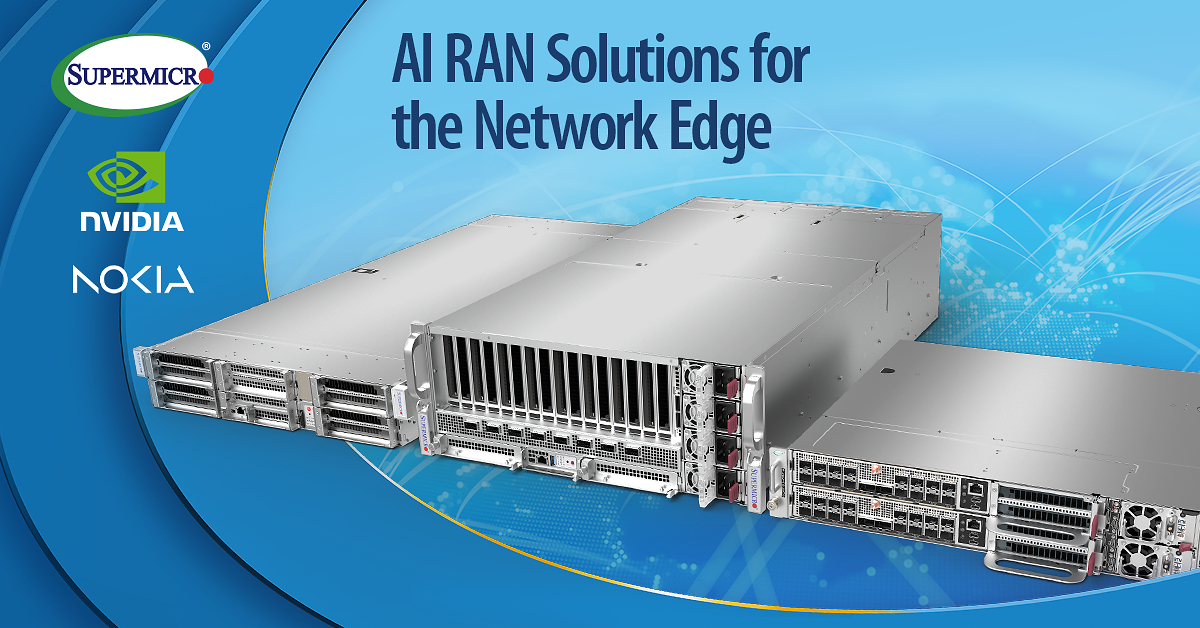
Supermicro is working with Nokia and NVIDIA to deploy AI-RAN solutions that combine Supermicro infrastructure, NVIDIA accelerated computing and Nokia RAN software, targeting shared network and AI workloads from distributed cell sites to centralized hubs. The systems are intended to support low-latency edge AI and improve spectral efficiency and network automation; Supermicro says its NVIDIA ARC servers are generally available, while the dual-Vera ARC MGX 2U is expected later in 2026 and ARC-Pro is expected to reach general availability in the first half of 2027. The announcement describes product capabilities and rollout plans but provides no sales, customer adoption or financial projections.
Analysis
This is product positioning, not evidence of customer orders or incremental earnings. The key economic test is whether operators can earn enough from edge inference and RAN efficiency to offset the cost of GPU capacity, power, cooling, and integration. Low or uneven utilization would undermine the shared-infrastructure pitch; workloads may be cheaper in centralized clouds or on purpose-built RAN silicon. That makes deployment economics—not the AI-RAN narrative—the gating factor.
SMCI has the clearest near-term product exposure, but the release gives no booked revenue, order size, or customer rollout schedule; availability and customer testing are not equivalent to scaled demand. NVIDIA may benefit if deployments use its accelerated-computing stack, though this partnership alone is unlikely to be material evidence of demand. Nokia gains a route to differentiate its RAN software, but also takes on execution and partner-dependence risk. Ericsson is a competitive pressure point if AI-RAN becomes a procurement criterion.
Days: sentiment may support SMCI and AI-infrastructure narratives, but a durable re-rating is unsubstantiated. Over 1–3 months, seek named operator pilots, awards, and conversion to orders. Over 6–18 months, watch utilization, power efficiency, and whether AI services generate incremental operator revenue. The contrarian risk is that markets capitalize infrastructure capability before operators prove monetization; the upside counterpoint is that automation and RAN efficiency could justify deployments even before new AI services scale.
AllMind Terminal
AI-powered research, real-time alerts, and portfolio analytics for institutional investors.
Request TrialMarket Sentiment
Overall Sentiment
mildly positive
Sentiment Score
0.30
Ticker Sentiment
Key Decisions for Investors
- Do not chase SMCI on this announcement alone. Treat it as an alert; upgrade the thesis only after customer awards, order disclosures, or guidance that links AI-RAN to revenue.
- Keep Nokia as a conditional strategic watch rather than a near-term earnings trade. Verify operator adoption and whether Nokia can win or retain RAN business against Ericsson; partnership language alone does not establish market-share gains.
- For NVDA, regard this as ecosystem validation, not a standalone demand catalyst. Monitor telecom-related deployments and GPU orders; reassess if operators disclose scaled rollouts rather than trials.
- Falsify the adoption thesis if customer testing fails to convert into deployments, operator commentary points to weak edge utilization or unfavorable power economics, or company guidance does not reflect meaningful orders over the next several quarters.
More News
- US tech stocks tumble as investors fret over AI spending
- AI debt and French bonds face a stress test — why it may not be over
- SK Hynix shares slide after chipmaker scraps Solidigm IPO plans
- 10-year Treasury yield tumbles below 5% to lowest level in nearly a month
- The perfect storm behind the Nasdaq's rout — plus, some of the bright spots in the market
- Markets sell off worldwide as further conflict looms in the Middle East and Elon Musk cuts capex guidance