
Global Aluminum Die Casting Market to Reach USD 179.01 Bn. by 2034 as EV Growth, Lightweighting and Advanced Casting Technologies Accelerate, reports Maximize Market Research
Source: PR Newswire
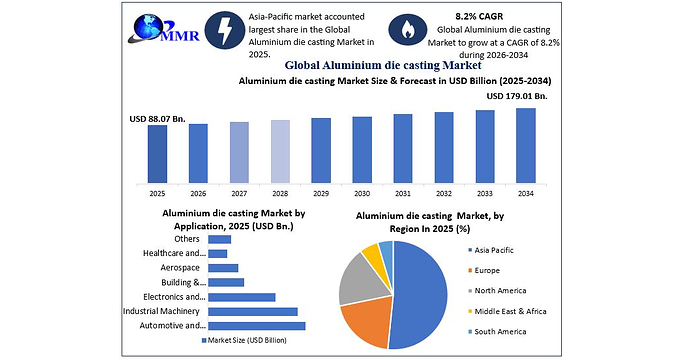
Maximize Market Research forecasts the global aluminum die-casting market to grow from $88.07 billion in 2025 to $179.01 billion by 2034, an 8.2% CAGR, driven principally by EV lightweighting and demand for battery, motor and structural housings. The report cites more than 20 million global EV sales in 2025 and China’s nearly 16 million-unit EV output as major demand supports, while giga-casting, automation, AI quality control and recycled aluminum reshape production. Industry investment includes Nemak’s $336 million acquisition of GF Casting Solutions’ automotive business and Jaya Hind’s ₹600 crore capacity expansion in India.
Analysis
The investable implication is not broad exposure to "die casting," but a bifurcation between scaled structural-casting suppliers and conventional component makers. Giga-casting lowers vehicle part counts and assembly labor, but it can also eliminate multiple legacy castings per vehicle; suppliers lacking large-tonnage presses, alloy know-how, and OEM qualification may face volume displacement despite nominal EV-content growth. CIE Automotive (CIE) is the most relevant listed proxy, but its upside depends on winning integrated EV programs rather than merely participating in industry capacity growth.
Alcoa (AA) has only indirect exposure: higher cast-component intensity supports aluminum demand, yet the earnings sensitivity is dominated by alumina, energy costs, regional premiums and scrap availability. The more consequential 6-18 month effect is a tighter market for low-carbon/recycled foundry-grade aluminum, potentially widening the premium for traceable secondary metal versus primary supply. That is positive for vertically integrated or scrap-secured casters, but not necessarily for AA unless physical premiums and realized metal pricing improve.
The release is a low-quality trading catalyst: it mixes unrelated elastomer commentary and relies on long-dated market-size estimates rather than disclosed order books, utilization, or OEM awards. BASF (BAS) and LANXESS (LXS) may benefit from EV-related specialty-material demand, but their earnings are far more exposed to European industrial volumes, Chinese competition, and feedstock spreads than aluminum casting. Rheinmetall (RHM) and Georg Fischer (GF) should not be traded on this item; RHM's defense cycle and GF's post-auto-portfolio capital allocation overwhelm any casting read-through.
Contrarian risk: OEM cost pressure can capture most of the lightweighting benefit, while rapid adoption of giga-casting raises customer concentration, warranty exposure, and capex intensity for suppliers. A downturn in global light-vehicle production would expose new Indian and Asian capacity to underutilization before the projected structural demand materializes. The thesis is falsified if CIE reports EV/structural-program wins and margin expansion without a corresponding increase in capex or customer concentration, or if aluminum premiums rise while AA's realized price and segment EBITDA fail to follow.
AllMind Terminal
AI-powered research, real-time alerts, and portfolio analytics for institutional investors.
Request TrialMarket Sentiment
Overall Sentiment
moderately positive
Sentiment Score
0.46
Ticker Sentiment
Key Decisions for Investors
- Maintain a watchlist, not a directional trade, on CIE for the next 1-3 months: initiate only after disclosed EV structural-casting awards, backlog conversion, and evidence that incremental capex is earning above its cost of capital. A positive trigger is segment-margin expansion alongside revenue growth; a negative trigger is rising capex with flat utilization or auto margins.
- Use AA as a conditional 6-12 month long only if North American/European aluminum premiums, recycled-metal availability, and realized pricing improve concurrently. Do not underwrite the position from auto casting demand alone; exit or avoid if alumina/energy inflation compresses EBITDA despite firmer aluminum prices.
- Avoid treating BAS and LXS as direct beneficiaries. Revisit only around earnings if management quantifies EV-material volumes, China pricing stabilization, and specialty-margin recovery; absent those datapoints, their risk/reward is driven by chemicals-cycle normalization rather than this manufacturing theme.
- Monitor a relative-value opportunity: long scaled auto suppliers with documented integrated-casting awards versus short subscale conventional casting exposure where customer concentration and utilization are deteriorating. This is an alert rather than a recommendation until peer-level order-book and capacity data are available.
More News
- ‘You need to clean up the mess your generation has left’: Volkswagen’s guilty boomer gets real about sustainability, China—and his spam folder
- Goldman adds 4 new names to its favorite stocks list — including a 143% upside defense call
- Trump says Iran war could end after U.S. elections as Hormuz tensions persist
- Mark Ruffalo says Paramount’s $111 billion Warner Bros. deal ‘Will stifle creativity, weaken free speech, and cost people their jobs’
- States, cities sue U.S. agencies over weaker vehicle fuel economy rules
- The next weak link in Europe’s bond market? UBS has a new short position