
Bud Ecosystem Launches Bud Novaria, the Hardware-Agnostic AI Operating System for Enterprise and Sovereign AI
Source: PR Newswire
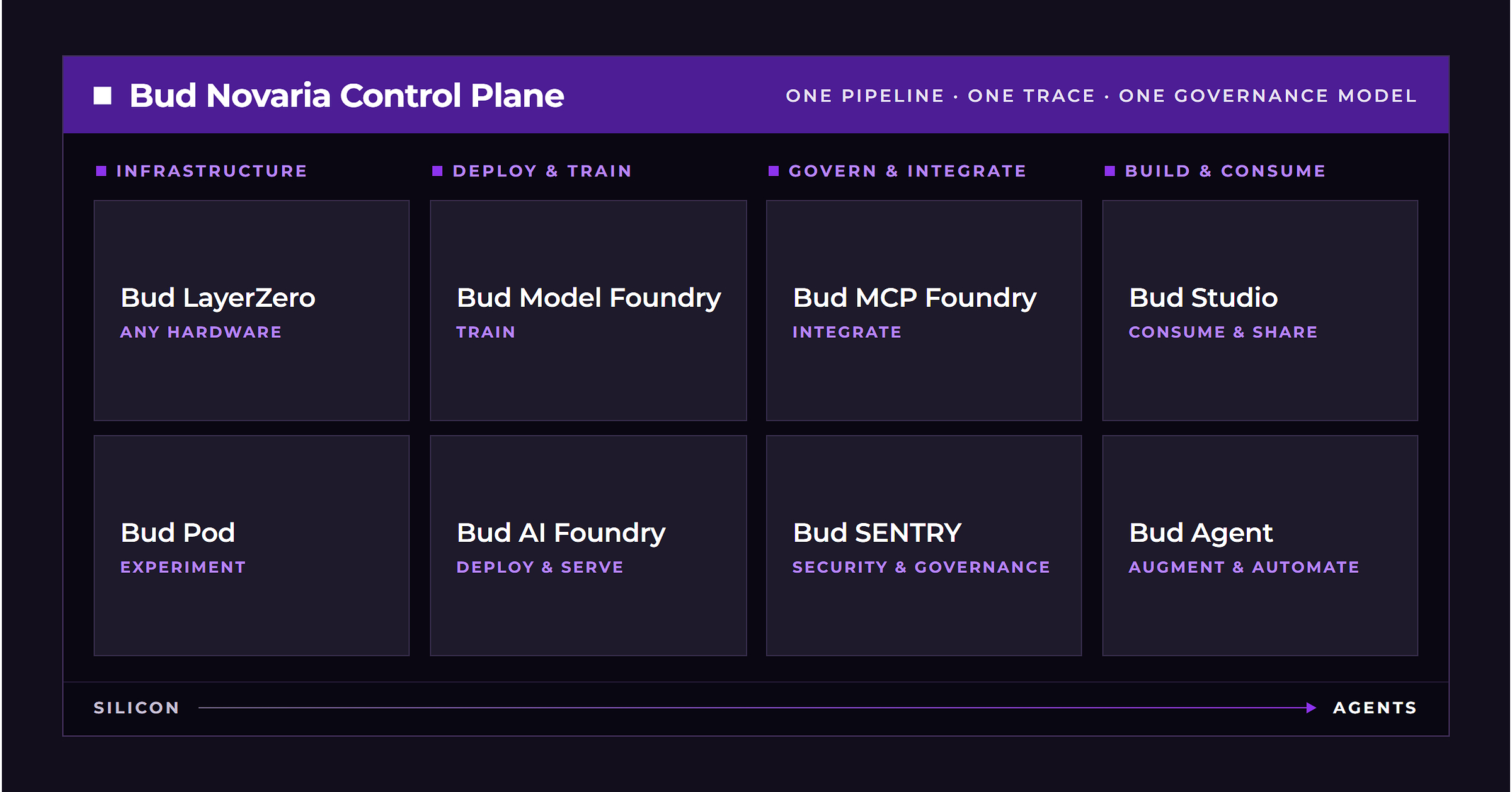
Bud Ecosystem launched Bud Novaria, a hardware-agnostic enterprise AI operating system spanning silicon through AI agents, with claimed AI run-rate savings of up to 80% at unchanged accuracy. In a production fashion-brand deployment, monthly AI costs reportedly fell 82% to $40,000 from $218,000 while accuracy remained 85.4%; a financial-services customer cut annual TCO to $768,000 from $2.4 million. The platform supports more than 600 hardware SKUs and targets enterprise and sovereign AI deployments across cloud, on-premise and air-gapped environments.
Analysis
The relevant mechanism is inference mix-shift, not a near-term revenue event for the named semiconductor vendors. If enterprises can route routine workloads to CPU- or lower-cost accelerator-hosted small models while maintaining acceptable task accuracy, incremental AI spend shifts from scarce premium GPUs toward installed Xeon/EPYC capacity and commodity server utilization. INTC has the highest narrative optionality because it is most leveraged to CPU-native inference; AMD benefits through EPYC and Instinct flexibility, while NVDA's risk is limited initially because training and high-value reasoning workloads remain GPU-intensive.
The company-supplied savings examples are not independently auditable and likely exclude migration, model-tuning, support and governance labor. The key 1-3 month catalyst is whether named OEM, cloud, or sovereign deployments disclose production volumes and hardware mix; absent those, this is insufficient to alter semiconductor estimates. A more material 6-18 month implication would be sustained enterprise evidence that smaller-model routing lowers GPU-hours per business workflow, pressuring the inference component of NVDA's growth expectations and improving CPU server replacement economics.
Consensus may be over-indexed to hardware-agnostic software as a direct threat to NVDA. Hardware abstraction can also enlarge total AI deployment by reducing procurement friction, with NVIDIA retaining premium workloads and benefiting if cheaper inference expands agentic request volumes. The investable signal is therefore relative: watch for CPU inference utilization gains and enterprise GPU-capex moderation, rather than extrapolating a private vendor's claimed cost reduction into an immediate demand collapse.
AllMind Terminal
AI-powered research, real-time alerts, and portfolio analytics for institutional investors.
Request TrialMarket Sentiment
Overall Sentiment
moderately positive
Sentiment Score
0.62
Ticker Sentiment
Key Decisions for Investors
- Maintain a 1-3 month watch, not a directional trade, until Bud or a third party discloses contracted ARR, deployment scale, or repeatable benchmark methodology; the current release does not establish material revenue exposure for AMD, INTC, MSFT, NVDA, or QCOM.
- Express the inference-mix thesis only after corroboration via a small long INTC / short NVDA relative position, sized for a 3-6 month horizon. Thesis: CPU-native inference and enterprise server refresh improve INTC relative earnings expectations; exit if enterprise GPU capex guidance remains above expectations or INTC data-center guidance fails to improve.
- Prefer AMD over INTC for diversified exposure if OEM deployments validate heterogeneous hardware demand: long AMD versus a semiconductor index hedge (SOXX) over 6-12 months. AMD captures both EPYC substitution and accelerator demand; falsify on weak EPYC server-share data or Instinct supply/demand commentary.
- Monitor MSFT Azure AI disclosures and NVDA inference commentary during earnings. A rising share of smaller-model or CPU-served workloads without corresponding total request-volume acceleration would be the first actionable signal for multiple risk to premium GPU inference assumptions.
More News
- This AI-picked stock jumps 18% on Amazon’s $8 billion power deal
- Crusoe raises $3.9B to build massive data centers and small modular “AI factories”
- Jensen Huang says Nvidia will sell twice as many chips next year
- Warsh says AI’s hyperscalers are part of why your borrowing costs are rising: ‘The competition for capital is real’
- AI coding agents' 0-click RCE flaw could hand attackers keys to the kingdom
- What an Oscar-winning movie can teach us about investing through the AI slowdown debate