
Kallas Urges EU to Bolster Red Sea Mission Against Houthi Threat
Source: Bloomberg
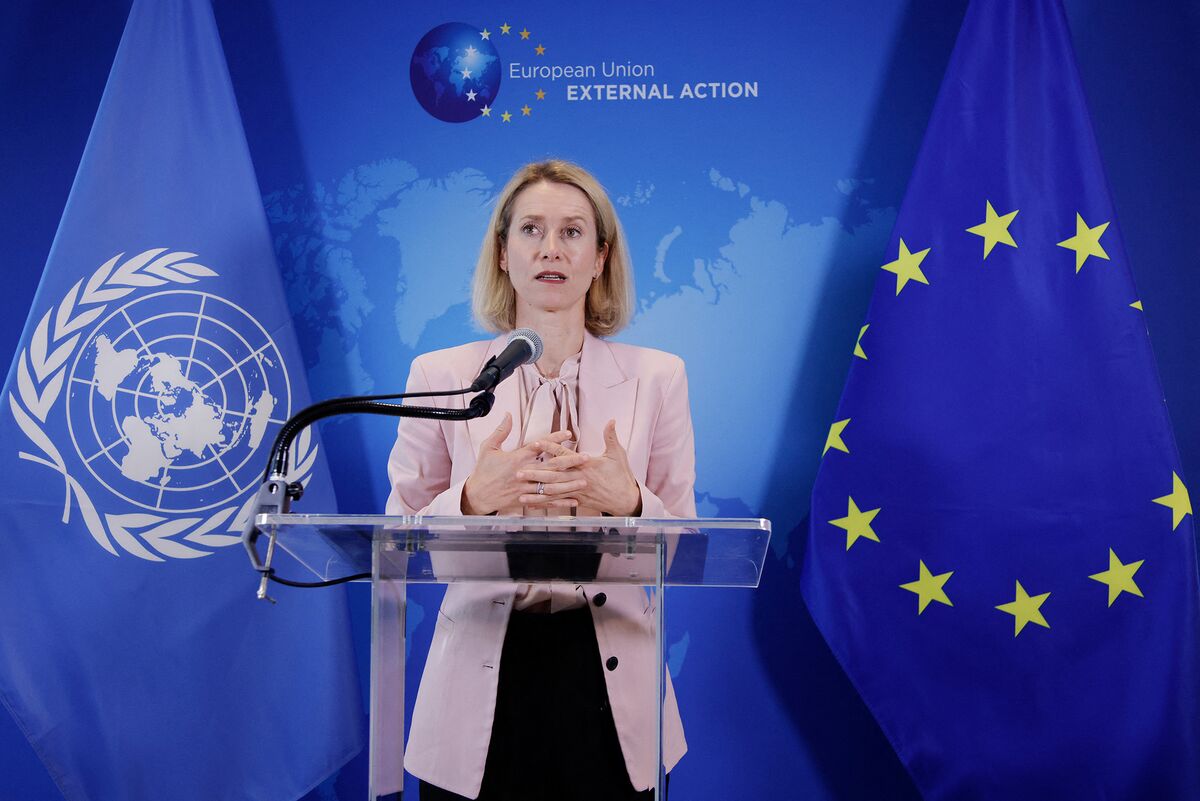
EU foreign policy chief Kaja Kallas urged member states to contribute more naval vessels to Operation Aspides, the EU mission protecting commercial shipping in the Red Sea. The request reflects persistent Houthi threats to vessels transiting the Bab el-Mandeb Strait, a key global trade chokepoint, raising continued risks of shipping disruption, higher freight costs and supply-chain delays.
Analysis
The investable transmission is not naval procurement; it is the persistence of a longer effective Asia-Europe voyage. If carriers maintain Cape routing, each loop absorbs incremental vessel-days, tightening usable container capacity and supporting spot freight rates even without an improvement in end-demand. The highest operating leverage sits with Hapag-Lloyd (HLAG.DE) and ZIM (ZIM), but ZIM's balance-sheet and contract-rate exposure make it materially higher beta; product tanker operators such as Scorpio Tankers (STNG) and Frontline (FRO) benefit only if disruption broadens into sustained dislocation of refined-product flows.
A larger European escort presence may perversely cap shipping equities in the near term: markets could interpret it as raising the probability of route normalization, while an insufficient force merely increases defense spending without restoring commercial insurer confidence. The key 1-3 month indicators are container spot rates versus bunker costs, carrier announcements on Suez transits, and war-risk insurance premiums. A meaningful return of major liner services to the route would release effective capacity quickly and pressure freight-rate-sensitive equities.
The more durable second-order beneficiary is European defense, where naval deployments accelerate consumption of interceptors, radar availability, maintenance hours and replenishment requirements rather than producing a one-off hull-order windfall. Rheinmetall (RHM.DE), Hensoldt (HAG.DE), Thales (HO.PA), and BAE Systems (BA.L) have better exposure to replenishment and air-defense budget reprioritization than broad defense ETFs. This is a 6-18 month budget and order-book thesis, not a trading response to a diplomatic request; it is falsified if European governments meet the mission through asset redeployment without incremental munitions procurement or defense appropriations.
AllMind Terminal
AI-powered research, real-time alerts, and portfolio analytics for institutional investors.
Request TrialMarket Sentiment
Overall Sentiment
mildly negative
Sentiment Score
-0.30
Key Decisions for Investors
- Maintain a 1-3 month tactical long in HLAG.DE versus a short in a broad European industrial proxy (EXH1.DE or XLI) only after Asia-Europe spot freight rates rise for two consecutive weekly observations; target 10-15% relative upside, with a stop if carriers announce broad Suez-route normalization.
- Use ZIM only as a defined-risk expression of persistent disruption: buy 3-6 month call spreads rather than common equity, sized small. The upside requires spot-rate strength to persist into the next contract reset; exit if freight rates soften while bunker costs rise, which would compress the margin benefit.
- Accumulate RHM.DE, HAG.DE, or HO.PA on weakness for a 6-18 month horizon, favoring HAG.DE/HO.PA for sensor and air-defense replenishment exposure. Reassess after EU budget announcements and quarterly order intake; reduce if backlog conversion or munitions guidance fails to improve.
- Avoid a broad long in STNG or FRO solely on this development. Establish an alert instead: reconsider only if refined-product freight spreads and tanker utilization rise concurrently, confirming that disruption has extended beyond container routing.
More News
- Latest Oil Market News and Analysis for Sept. 22
- World Leaders Converge on United Nations General Assembly
- Oil Settles Near $100 as Hormuz Flows Stunt Rally
- Intel surges 12% as CPU stocks rally. Here's what's driving the move
- US Diesel Tops Record as Global Crunch Feeds Inflation
- Oil Drops Below $100 With Focus on Hormuz Flows, Diplomacy
From AllMind Research
- Anthropic IPO Preview: Valuation, Timing, and What to Watch
- Shein After the IPO: Venue, Valuation, and What Must Be Proved
- What AI Research Tools Should a Small Hedge Fund Buy First?
- Weekly Update: Adding Live MBO Level 3 Data - Liquidity Heatmap, OFI Charts, and More
- Alternative Data Due Diligence for Institutional Investors