
Beat the Heat, Cut Energy Costs: SUNON Brings Smarter Industrial Cooling to the Workplace
Source: PR Newswire
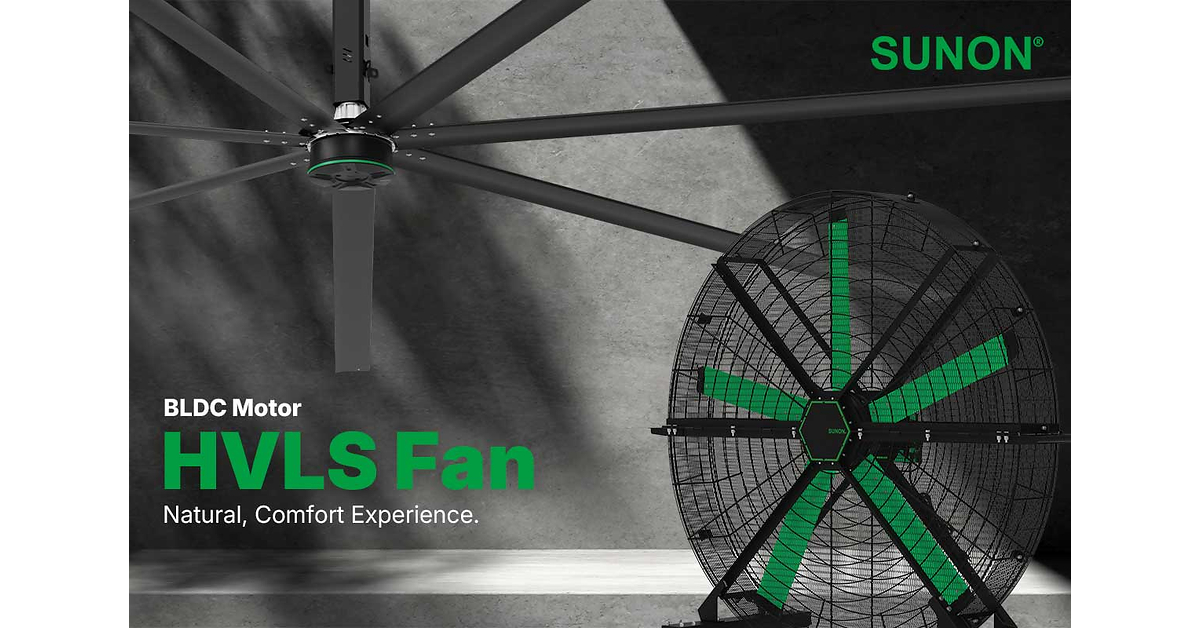
SUNON announced bionic HVLS ceiling fans and ultra-mobile industrial fans designed to cut workplace cooling energy use, citing a 5–8°C perceived temperature drop in summer and over 90% BLDC motor efficiency. The design emphasizes low-speed, broad airflow with reduced noise, plus year-round energy savings via reverse mode. The release also highlights IP55 waterproofing and a 2026 Taiwan Excellence Award, but provides no financial figures—implying limited near-term market impact.
Analysis
This is not a direct equity catalyst; it is a small but useful signal that payback-driven efficiency retrofits are still finding budget approval in industrial real estate. The economic mechanism matters more than the product: when operators are under pressure from power bills and labor conditions, they buy anything that improves comfort without adding meaningful opex, which tends to favor incumbent building-systems vendors with distribution and service depth over pure hardware brands.
Second-order, the likely winners are the broader HVAC/controls stack rather than the fan category itself: JCI, TT, CARR, and HON benefit if this is part of a wider retrofit cycle in warehouses, food processing, and light manufacturing. The losers are commodity fan suppliers and any legacy equipment sold primarily on upfront price, because procurement decisions shift toward lifecycle cost and maintenance intensity. The power-system impact is small at the company level, but aggregated adoption can shave peak-load demand in heat-sensitive regions, which is supportive for customers facing demand charges and can modestly improve retrofit ROI.
The consensus risk is over-claiming the sustainability angle. Realized savings depend on ceiling height, occupancy, duty cycle, and local electricity tariffs; if the payback stretches beyond 18-24 months, adoption slows quickly. This should be treated as a months-to-years channel check, not a days-long trading event; the near-term falsifier is whether industrial/warehouse retrofit commentary from public peers actually improves in upcoming earnings calls.
Bottom line: positive for the energy-efficiency theme, but too incremental to justify forcing a standalone trade today. The cleaner expression is to watch for confirmation in public HVAC/controls order trends rather than to chase the press release itself.
AllMind Terminal
AI-powered research, real-time alerts, and portfolio analytics for institutional investors.
Request TrialMarket Sentiment
Overall Sentiment
mildly positive
Sentiment Score
0.18
Key Decisions for Investors
- No direct trade in SUNON; treat this as a low-signal industry datapoint, not an earnings catalyst.
- Watch JCI, TT, CARR, and HON for evidence of faster industrial/warehouse retrofit demand over the next 1-3 earnings cycles; enter only if management cites backlog conversion or energy-efficiency mix improvement.
- If channel checks confirm stronger retrofit spending, buy a JCI/TT basket on 5-8% pullbacks for a 6-12 month hold; thesis is modest multiple support plus incremental revenue growth, with downside if industrial capex budgets soften.
- Consider a small call-spread expression in JCI or CARR only if summer power prices and cooling-degree days rise materially; the trade works best when high electricity costs force faster payback decisions.
- Do not short utilities or broad industrials on this news; the demand reduction at the system level is too small to move regulated earnings or sector multiples.
More News
- Brian Sullivan: Why the 'real' price of oil is likely $30-$40 higher than where it is now
- Treasuries Soar as Tech Slump Threatens Growth
- Latest Oil Market News and Analysis for Oct. 16
- Blackstone President Jon Gray Bets Big on AI Boom
- Suddenly, Wall Street is worried that the U.S. economy is more ‘vulnerable’ than it looks
- Ukraine to resume strikes on Russian refineries, shattering hopes of an 'energy ceasefire'