
California home sales pull back in September as higher borrowing costs and affordability challenges constrain buyer demand, C.A.R. reports
Source: PR Newswire
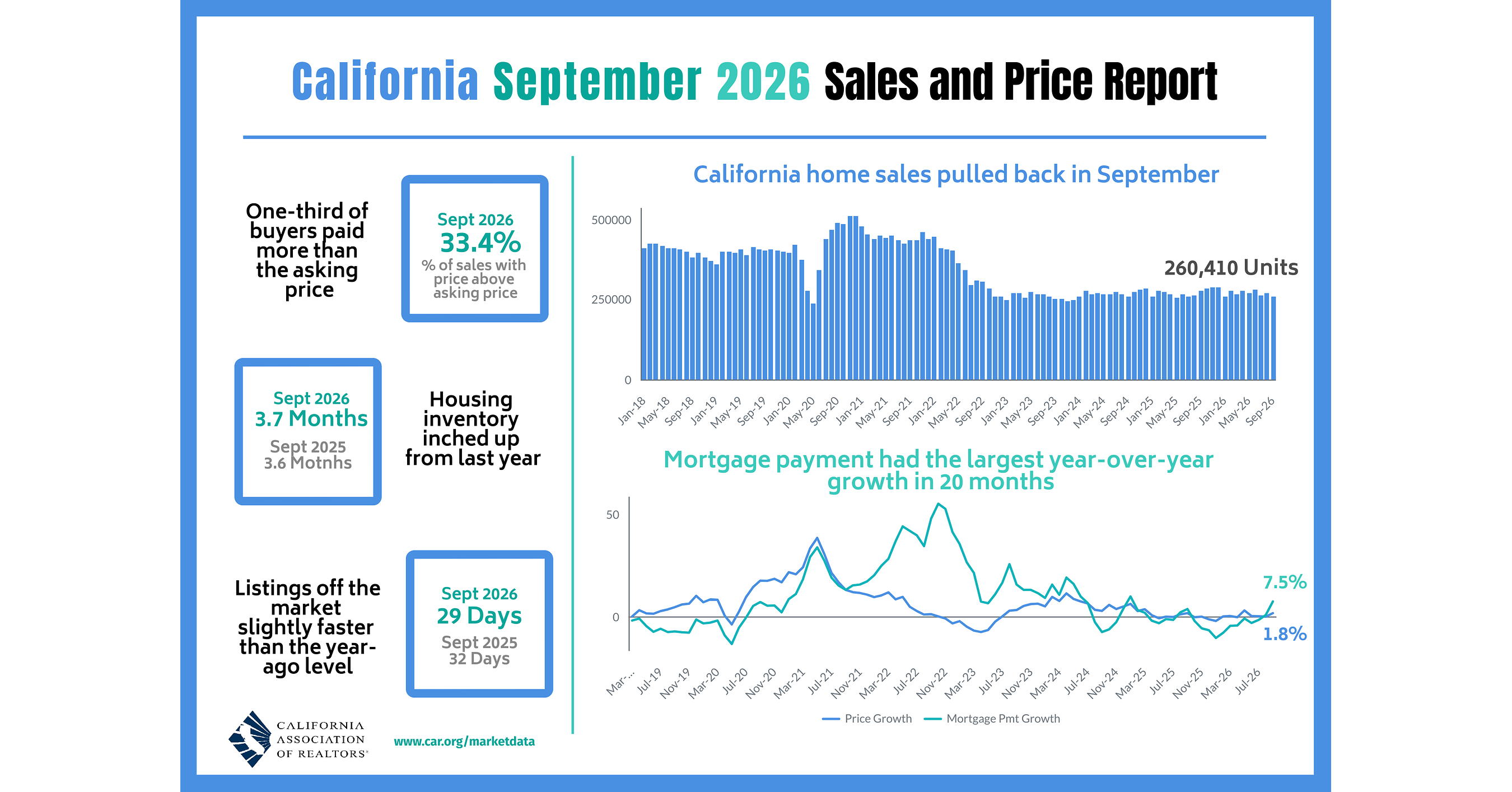
California existing single-family home sales fell 3.4% month over month to a seasonally adjusted annualized 260,410 in September, down 6.5% from a year earlier and below 300,000 for the 48th consecutive month. The statewide median price edged down 0.2% from August to $899,720 but remained up 1.7% year over year; 30-year mortgage rates averaged 6.86%, versus 6.67% in August. C.A.R. cited higher borrowing costs and affordability pressures for weaker demand, while limited listings may help cushion prices.
Analysis
The signal is more negative for transaction throughput than for home values. A thin listing pipeline can keep medians and comparable-based collateral firm even as fewer deals close; that delays visible price stress while directly pressuring volume-linked brokerage, mortgage-origination, title and listing-ad businesses. This is therefore not, on its own, a clean short signal for housing credit or home prices.
The second-order share shift may favor builders able to offer rate buydowns and finished inventory over resale sellers who cannot match the monthly payment. But that advantage is conditional: elevated rates also constrain the buyer pool, and the data do not establish builder orders or incentives. Regional exposure matters: weakening Southern California activity and rising Inland Empire inventory look more vulnerable than tight Bay Area supply, where transactions can remain resilient despite affordability strain.
Near term (days), treat this as a modest negative for housing-linked sentiment, not a standalone macro catalyst. Over 1–3 months, falling pending sales could translate into weaker closings and revenue guidance for transaction-sensitive firms; watch mortgage rates, new listings, pending sales and company disclosures on California exposure. Over 6–18 months, persistent lock-in may sustain prices while suppressing turnover, but a meaningful rise in listings or employment deterioration would expose price downside. The contrarian point: stable statewide prices are partly a low-turnover/composition outcome, not proof of demand strength. Conversely, one report does not establish a broad housing downturn.
AllMind Terminal
AI-powered research, real-time alerts, and portfolio analytics for institutional investors.
Request TrialMarket Sentiment
Overall Sentiment
mildly negative
Sentiment Score
-0.28
Key Decisions for Investors
- Prefer a relative-value stance over a broad housing short: underweight transaction-volume-sensitive brokerage, mortgage-origination and title exposure versus builders that can compete with financing incentives. Confirm California revenue sensitivity and incentive trends before sizing; absent that disclosure, keep this as a watchlist trade rather than a single-name recommendation.
- Do not interpret the median-price resilience as a buy signal for California housing exposure. Track pending sales and new listings alongside prices; a sustained inventory build would make the downside thesis materially stronger.
- Catalyst window: reassess over the next 1–3 months as pending transactions convert to closings and housing-related earnings guidance arrives. Falsifiers include a sustained decline in mortgage rates paired with improving pending sales, or evidence that active listings are rising mainly through new seller supply rather than slower absorption.
More News
- Walmart’s Flipkart is quietly building a food delivery challenger in India
- Credit stress is threatening to unwind the AI bull. All eyes are on Oracle to hold the line
- LightStream stops accepting loan applications. Try these 6 lenders instead
- French unrest compounds debt crisis fears. Paris-listed stocks, bonds and the euro fall
- MTR Bets $5 Billion on a Hong Kong City That Doesn’t Exist Yet
- Up 10% in the Last Two Weeks, Is Airbnb the Perfect Stock for Today's Market?