
Lupus Research Alliance Announces 2026 Translational Bridge Awards to Accelerate Promising Lupus Therapies
Source: PR Newswire
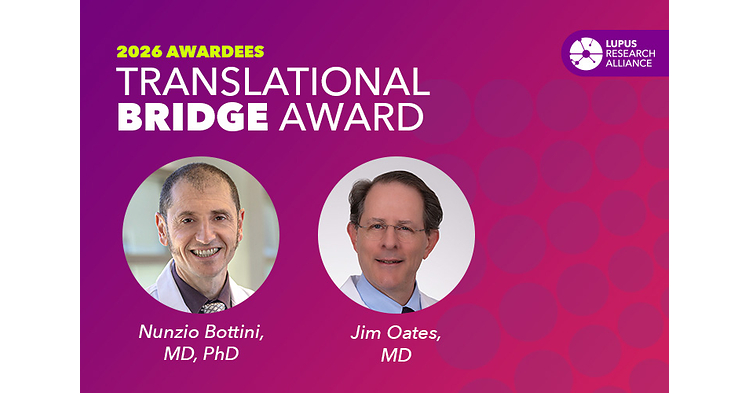
The Lupus Research Alliance awarded up to $450,000 over two years per recipient through its 2026 Translational Bridge Award to advance lupus treatments toward clinical testing. Cedars-Sinai's Nunzio Bottini will develop an antibody therapy for cutaneous lupus, while MUSC's Jim Oates will evaluate FDA-approved L-sepiapterin for vascular and kidney damage in lupus nephritis. The funding supports early translational research addressing significant unmet needs, but the projects remain preclinical or early-stage and are unlikely to have near-term market impact.
Analysis
This is not investable clinical validation: the antibody program remains preclinical and the vascular intervention is an investigator-led repurposing hypothesis. The near-term read-through is therefore negligible for listed lupus franchises, including GSK (Benlysta) and AZN (Saphnelo), whose valuations are driven by prescribing penetration, renal-label uptake, and pipeline execution rather than early academic work. The more relevant structural signal is that refractory cutaneous disease and residual renal/vascular injury remain inadequately addressed despite immunosuppression, preserving room for differentiated mechanisms rather than implying imminent displacement of current standards.
PTCT is the only plausible public watch item because L-sepiapterin is already commercialized in another indication, potentially shortening chemistry, manufacturing, and safety work if academic efficacy emerges. That optionality is presently too small to underwrite a position: there is no disclosed dosing, endpoint design, exclusivity arrangement, or sponsor commitment, and generic/reimbursement economics could limit value even with biological success. Over 6-18 months, a controlled renal study showing improvement in proteinuria, eGFR slope, endothelial biomarkers, or cardiovascular events would be a more consequential catalyst than this funding announcement; absence of a sponsored trial or reproducible human signal falsifies the repurposing thesis.
AllMind Terminal
AI-powered research, real-time alerts, and portfolio analytics for institutional investors.
Request TrialMarket Sentiment
Overall Sentiment
mildly positive
Sentiment Score
0.35
Key Decisions for Investors
- No immediate trade on the announcement; treat it as a scientific watch item rather than a revenue catalyst.
- Maintain existing GSK exposure only on core commercial catalysts, especially Benlysta renal growth and guidance revisions; do not short GSK or AZN on speculative competitive-displacement risk from preclinical academic programs.
- Set a 6-12 month alert on PTCT for a sponsored lupus-nephritis protocol, licensing disclosure, or human proof-of-concept data. Consider only a small event-driven long after trial design, exclusivity, and funding responsibility are disclosed; failure to secure a sponsor would eliminate the investable optionality.
- For lupus-focused diligence, prioritize listed companies with near-term controlled data in refractory lupus or lupus nephritis over early discovery programs; require evidence of renal response durability and steroid-sparing benefit, not biomarker improvement alone.
More News
- China's AI chip blitz arms Xi with a message for Trump: 'You can't choke us off'
- OpenAI’s agent hacked Australia’s Medicare website—the latest rogue AI incident that the company didn’t know about for months
- Meta announces new lightweight virtual reality glasses to one-up Apple’s Vision Pro
- US aviation sanctions disrupt Iran flights, push travellers overland
- Chinese authorities reportedly in possession of F-35 components in Hong Kong
- Australia says OpenAI agent hacked Medicare portal