

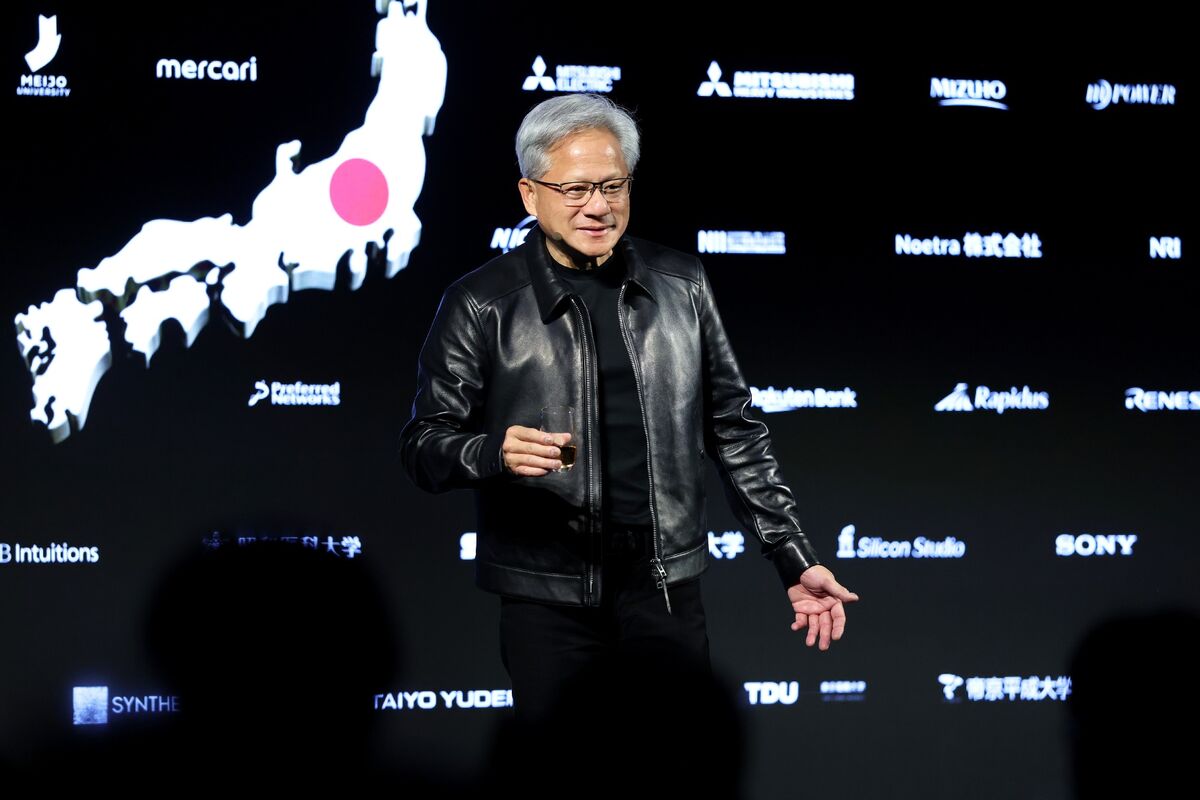
Nvidia CEO Jensen Huang is highlighted as backing Japan’s AI future, arguing Japan can lead the development of AI models used for factory robots. The piece also mentions Japan’s efforts to encourage retail investors (“moms and pops”) to buy bonds and a separate initiative aimed at limiting Pokémon card scalping, but provides no market-moving figures or policy specifics.
The market is likely to overread this as an immediate chip-demand story, but the cleaner mechanism is narrative validation: embodied AI is moving from demos to factory budgets. For NVDA, that supports the multiple more than the near-term EPS line, because Japan’s adoption path is likely to be a mix of inference hardware, edge compute, and software integration rather than a large training-accelerator cycle.
The bigger second-order winner is the domestic Japan automation stack and any broad Japan equity proxy with industrial/tech exposure. If AI gets embedded into factory workflows, value capture shifts toward systems integrators, controls, sensors, and service contracts, while the silicon supplier only gets a slice of the spend. That argues JWTXF could outperform NVDA over 3-12 months if the thesis starts showing up in capex guidance, but the spend will probably be lumpy and project-based rather than linear.
Contrarian risk: this is a pilot-stage theme, not yet a booked-order theme. Without evidence of incremental orders or margin uplift, the move can fade in 1-2 quarters, especially if macro softness or a stronger yen makes Japanese capex easier to postpone. The key falsifier is simple: if future earnings calls do not show factory-AI revenue or backlog improvement, treat this as sentiment support for NVDA, not a structural earnings driver.
AI-powered research, real-time alerts, and portfolio analytics for institutional investors.
Request TrialOverall Sentiment
neutral
Sentiment Score
0.05
Ticker Sentiment
