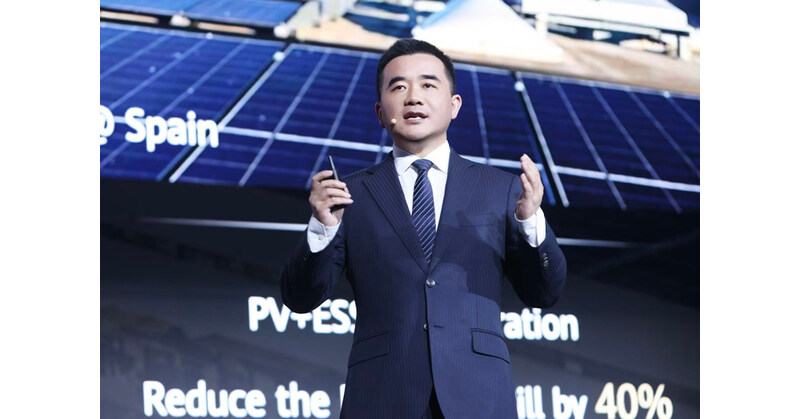
Huawei’s Steven Zhou says the company’s strategy at The Smarter E 2026 is to scale grid-forming, integrated PV+BESS solutions to strengthen grid stability as Europe targets wind/solar reaching 64% by 2030. The article cites project outcomes—AHS in Germany reported +10% revenue after two years, while a Carrefour site in Spain saw electricity bills down ~40% with a ~5-year payback. Overall message is a shift from energy-only arbitrage toward broader grid-support services, implying incremental support for grid-forming BESS adoption rather than an immediate financial catalyst.
The investable takeaway is not Huawei’s brand story; it’s that European grid spending is shifting from passive hardware procurement to a controls-and-software arms race. That structurally favors power-electronics, switchgear, and system-integration vendors with authenticated grid-forming capability, while commoditized module suppliers and vanilla inverter names face a mix shift toward lower-margin, more regulated project work. The bigger second-order effect is that revenue pools are migrating away from pure energy arbitrage toward contracted ancillary services, which should improve cash-flow visibility for the best-integrated storage players and compress economics for merchants that cannot provide inertia/black-start support.
The catalyst path is medium-term, not immediate: utility procurement cycles and grid-code adoption usually take 12-24 months to filter into revenue, so the first market reaction may be too cute. In the next 1-3 months, watch for European tender awards, TSO rule updates, and backlog commentary from ABB, Schneider Electric, Eaton, Siemens Energy, and Fluence; those are the first verifiable signs that the narrative is turning into orders. A key risk is that grid-forming becomes table stakes, eroding pricing power as more OEMs claim compliance and forcing margin pressure back onto the hardware stack.
Contrarian view: the market may be overestimating how quickly this becomes monetizable. Demonstrations and marketing language do not equal bankable IRRs, and if ancillary service prices normalize or power prices weaken, the payback story for hybrid PV-BESS can slip materially. This is also a regulatory/security risk channel: European buyers may prefer non-Chinese suppliers for critical grid infrastructure, which could create share gains for domestic incumbents but also slow deployment if procurement becomes politically constrained.
AI-powered research, real-time alerts, and portfolio analytics for institutional investors.
Request TrialOverall Sentiment
mildly positive
Sentiment Score
0.15
