
Traders and Central Bankers at Odds on ECB Rate-Hike Predictions in Europe
Source: Bloomberg
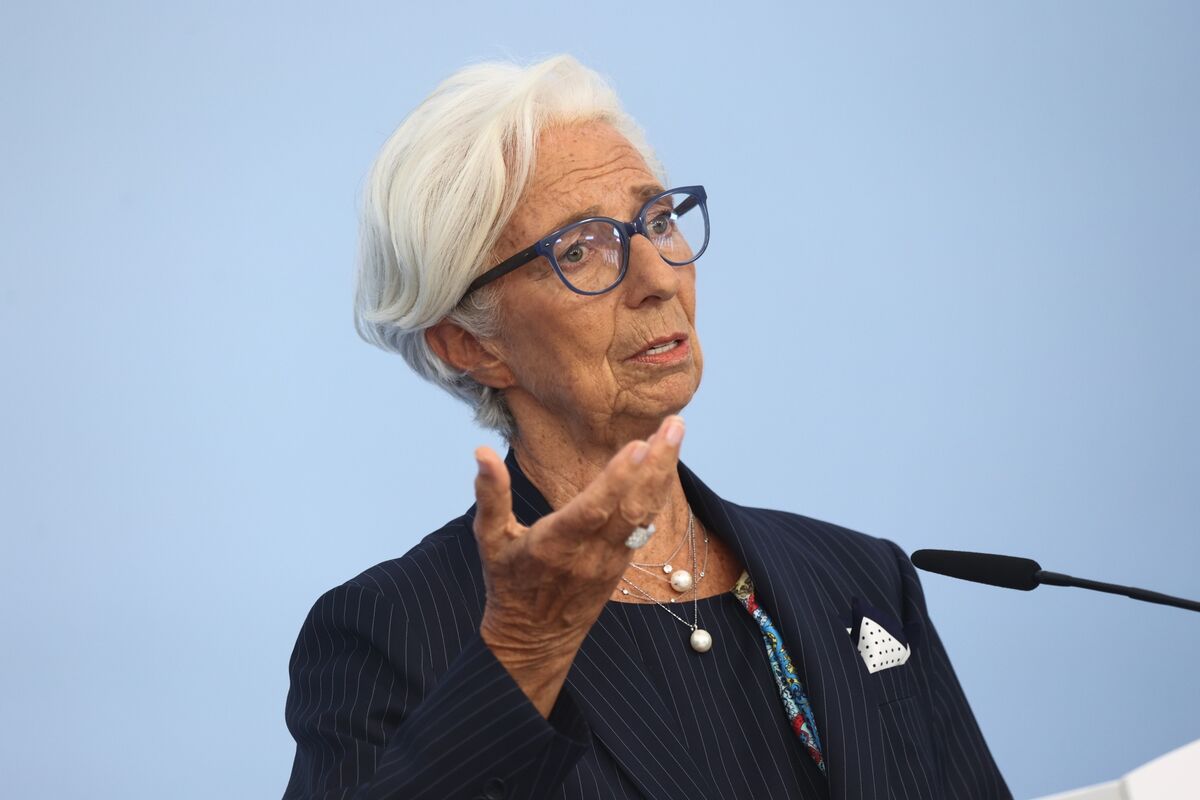
Money markets now price in four additional 25bp ECB rate hikes over the next 12 months and five 25bp increases from the Bank of England as higher energy prices reignite inflation concerns. This is materially more hawkish than policymakers' messaging: the ECB has declined to pre-commit after its second hike since the Iran war began, while economists expect only one or two additional moves. The widening gap raises the risk of rate-market repricing and volatility across European bonds, currencies and rate-sensitive assets.
Analysis
The key mispricing is treating an energy-led inflation impulse as equivalent to a demand-driven wage-price spiral. The ECB can tolerate a temporary headline overshoot if forward growth indicators, credit creation and corporate pricing power deteriorate; a restrictive real-rate path into a supply shock would widen peripheral spreads and tighten bank lending before it materially reduces energy inflation. That makes the front end vulnerable to a dovish repricing over the next 1-3 months, even if near-term CPI surprises remain elevated.
European banks are not a clean beneficiary of higher terminal rates at this stage. A further bear-flattening in the curve and rising defaults can erode the incremental net-interest-income benefit, particularly for domestic lenders with commercial-real-estate and SME exposure; EUFN/SX7E upside requires nominal growth to hold, not merely policy rates to rise. Conversely, long-duration European quality equities should outperform if the market removes even 50-75bp of expected tightening, with software, staples and regulated infrastructure the most direct multiple-expansion beneficiaries.
The contrarian risk is that energy prices feed into negotiated wages and inflation expectations, forcing the ECB to validate market pricing despite weaker activity. Watch euro-area negotiated-wage data, core services inflation and the Italy-Germany 10-year spread: sustained wage acceleration or a spread widening above roughly 200bp would shift the policy trade from a growth scare to a credibility-defense regime. The immediate catalyst is the next inflation and activity data cycle; the 6-18 month outcome depends on whether energy costs become embedded in labor contracts.
AllMind Terminal
AI-powered research, real-time alerts, and portfolio analytics for institutional investors.
Request TrialMarket Sentiment
Overall Sentiment
mixed
Sentiment Score
-0.15
Key Decisions for Investors
- Initiate a tactical long June-2027 German Schatz futures / receive 1-year EUR €STR swaps, sized for a 50-75bp reduction in expected ECB tightening over 1-3 months. Exit if core services inflation reaccelerates for two consecutive prints or negotiated wages surprise materially above expectations.
- Pair trade: long iShares MSCI EMU ETF (EZU) or selected European duration assets versus short EUFN, with a 3-6 month horizon. The thesis is that falling front-end yields expand equity multiples while bank earnings expectations face curve flattening and credit-cost risk; stop if euro-area PMIs recover decisively and the 2s10s curve steepens.
- For UK exposure, avoid outright long UK banks until mortgage-reset and arrears data confirm credit losses remain contained. A cleaner expression of an over-priced Bank of England path is long UK gilt duration through gilts or receive SONIA, with risk capped via payer swaptions if energy-driven wage pass-through accelerates.
- Add a conditional alert rather than a position in European utilities: regulated networks can benefit from lower discount rates, but merchant power exposure remains vulnerable to volatile gas inputs. Reassess only after gas-price stabilization and visibility on tariff-recovery mechanisms.
More News
- The Fed has to walk a fine line Wednesday. How the stock market may react, according to JPMorgan
- MBS and Saudi Arabia Face Crisis With Key Oil Pipeline Shut for Weeks
- Is the two-decade era of low interest rates over? The Fed has to decide.
- US 10-Year Yield Rises to Highest Since 2007 as Fed Looms
- Saudi Arabia faces high-stakes choices as war with Houthis escalates
- Saudi pipeline closure is a brief interruption that will last days, U.S. Energy Secretary tells CNBC