
Mapping How South America’s Right-Wing Shift Has Reached Brazil
Source: Bloomberg
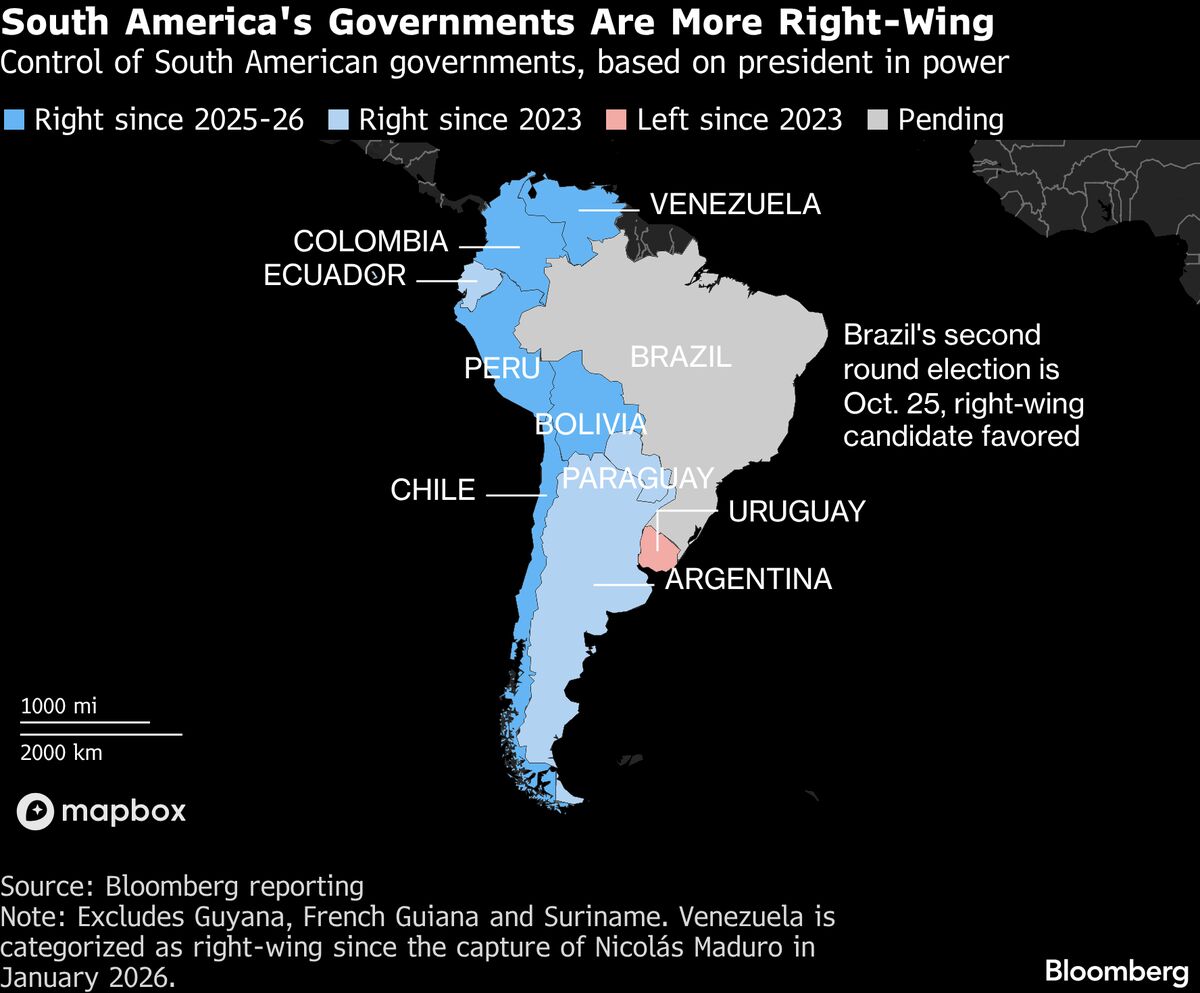
Conservative Flávio Bolsonaro is favored to defeat leftist President Luiz Inácio Lula da Silva in Brazil’s Oct. 25 presidential runoff. A Bolsonaro victory could consolidate the right’s gains in South America and bring Brazil, Latin America’s largest economy, into closer alignment with regional governments and the US; the article reports no market reaction.
Analysis
The tradable variable is fiscal credibility, not a regional ideological label. A transition could lower Brazil’s risk premium only if the winner secures congressional backing and presents a credible spending and debt path; without that, an initial relief rally is vulnerable to reversal. In the near term, polling and coalition signals can move the real, local rates and equities before policy is clear. Over 1–3 months, cabinet choices and budget proposals matter more than diplomatic rhetoric. Over 6–18 months, closer alignment with Washington could improve some bilateral commercial opportunities but also constrain Brazil’s ability to balance ties with China, creating a potential downside for commodity and agricultural exporters if trade frictions follow. Regional governments are not a uniform bloc, so do not price a synchronized policy shift across Latin America. The contrarian risk is that markets overpay for an assumed fiscal reset before seeing legislative capacity; the upside is that a credible, executable program could produce more durable currency and duration gains than the headline election reaction. No company-level earnings impact is established by the article.
AllMind Terminal
AI-powered research, real-time alerts, and portfolio analytics for institutional investors.
Request TrialMarket Sentiment
Overall Sentiment
neutral
Sentiment Score
0.00
Key Decisions for Investors
- Avoid adding broad Brazil political-beta exposure solely on election headlines. Reassess after the result alongside coalition arithmetic, cabinet appointments and a costed fiscal plan.
- Conditional trade: if the winner demonstrates congressional support and credible fiscal restraint, consider a measured long BRL versus USD or receive-fixed exposure in Brazilian rates. Define risk against a material reversal in the fiscal proposal or a renewed rise in local inflation expectations.
- Keep a 1–3 month alert on trade-policy signals toward China and the US. A deterioration in access for Brazilian commodity or agricultural exports would weaken the case for treating closer US ties as an unambiguous positive.
- Falsification: unwind the constructive scenario if post-election proposals weaken the debt trajectory, governing support proves insufficient, or the real and local yields fail to improve despite credible fiscal commitments; those outcomes would indicate the political premium is not translating into investable policy.
More News
- US stock market hits all-time high as investors bet big on AI
- Oman evacuates injured crew from attacked tanker in Strait of Hormuz
- Oil rises as concerns over Houthi attacks on Saudi Arabia eclipse supply recovery
- Diesel Price Surge Hits Farmers, Raising Food Inflation Risk
- Rebounding oil exports through Strait of Hormuz are vulnerable to stepped-up Iranian tanker attacks
- UBS CEO warns ‘hard measures’ are needed to tackle French debt crisis, as turmoil worsens
From AllMind Research
- Anthropic IPO Preview: Valuation, Timing, and What to Watch
- Shein After the IPO: Venue, Valuation, and What Must Be Proved
- What AI Research Tools Should a Small Hedge Fund Buy First?
- Can ChatGPT or Claude Replace a Research Platform?
- How the 2026 Milan-Cortina Winter Olympics Will Reshape Company Revenues and Stock Performance