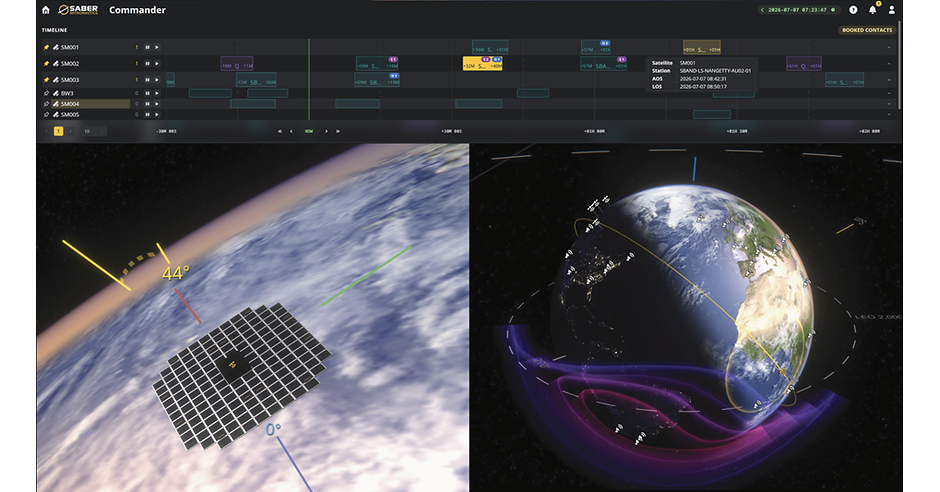
Saber Astronautics launched Saber Commander, new spacecraft and constellation operations software that builds on its PIGI digital-twin and machine-learning diagnostic heritage. The company says Commander adds automation and decision support to handle larger fleets and congested orbits, with Saber currently operating hardware in orbit totaling 36 tonnes. The announcement is more product/strategy focused than financial, suggesting limited near-term market impact.
This is more signal than substance for public markets: a product launch from a private vendor only matters if it converts into repeatable software revenue or displaces incumbent ground-segment spend. The real mechanism is that constellation operators are trying to collapse labor-heavy mission ops into a thinner layer of automation; if that works, the spend pool shifts away from bespoke integration and headcount-driven services toward recurring software, analytics, and digital-twin workflows. That is structurally favorable for vendors with sticky software embedded in operator workflows, and less so for pure service shops whose margin depends on manual monitoring.
The first-order beneficiaries in public markets are likely the defense/space primes and integrators with mission-software franchises and existing Space Force relationships, but the second-order winner may be the operator rather than the vendor: better automation reduces opex per satellite and improves fleet economics, which matters more as LEO fleets scale. The loser set is more subtle: smaller ground-station and mission-ops providers that sell labor, not software, could face pricing pressure if customers internalize control functions or standardize on a platform layer. This is a longer-cycle story; the market should not overreact on day one, but it could show up over 6-18 months in procurement mix and margin structure.
The contrarian view is that this is mostly branding around capabilities the market already assumes are in the pipeline for space ops software. Without disclosed ARR, backlog, or named awards, the thesis is unproven; the burden is on Saber to show it can monetize operator heritage into scalable sales, not just technical differentiation. The catalyst to watch is whether this software appears in new Space Force or allied procurements, because that would validate budget reallocation from hardware-centric contracts into mission software. Absent that, the right stance is watchful skepticism, not a directional bet.
AI-powered research, real-time alerts, and portfolio analytics for institutional investors.
Request TrialOverall Sentiment
mildly positive
Sentiment Score
0.15
