
A New Paradigm for Long-Term Weight Management: Once-Monthly Bofanglutide Maintenance Therapy Delivers Positive Results in Weight Control and Maintenance Over 24 Weeks -- Gan & Lee Pharmaceuticals' GRADUAL-3 Study Meets Its Primary Endpoint
Source: PR Newswire
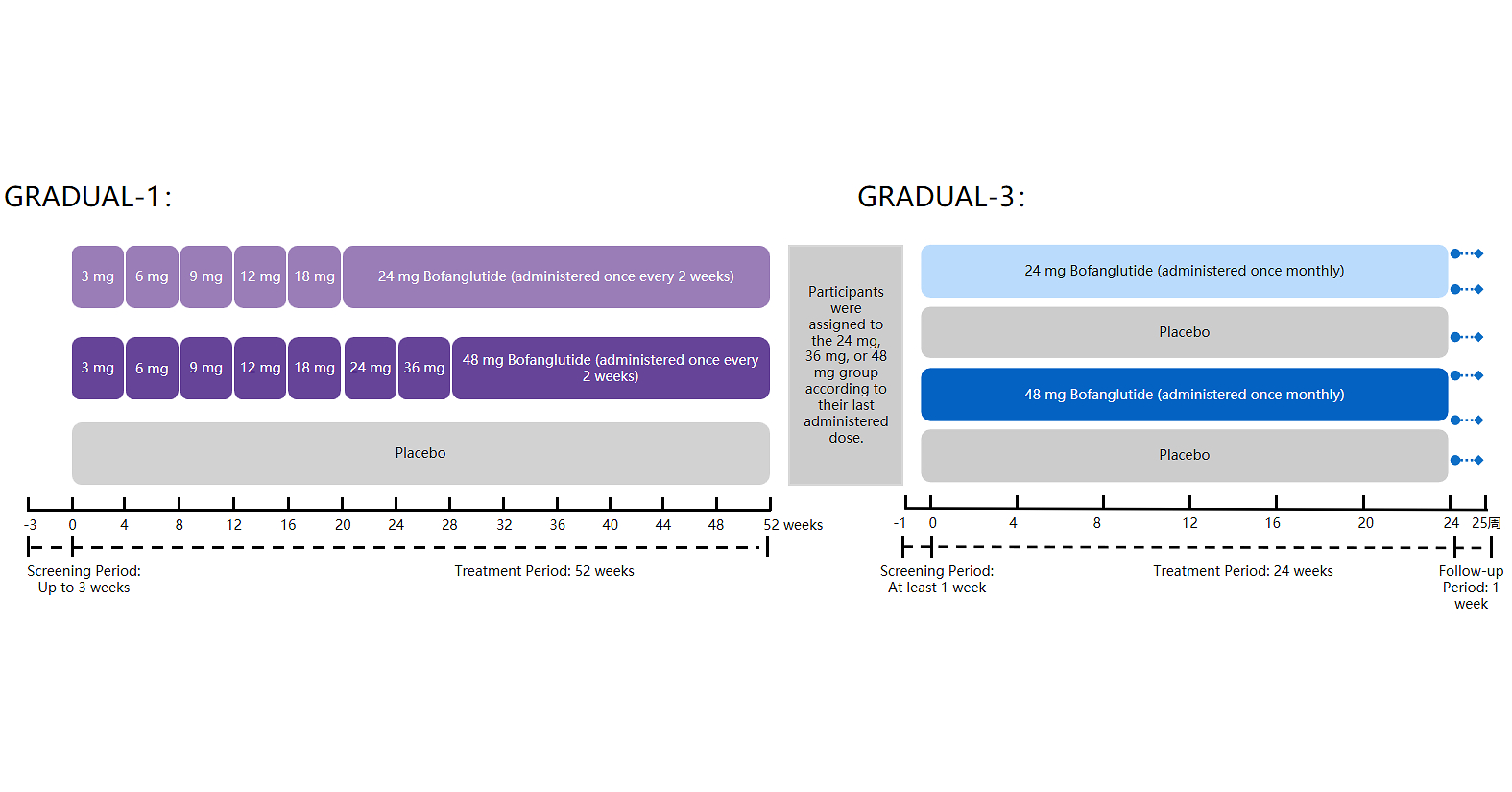
Gan & Lee Pharmaceuticals said its Phase IIIb GRADUAL-3 study met its primary endpoint: after switching from 52 weeks of twice-monthly bofanglutide to once-monthly treatment, mean body-weight changes over 24 weeks were 0.41% and −0.12% in the 24 mg and 48 mg groups, versus 8.52% with placebo (both P<0.0001). The company reported maintained cardiometabolic improvements and no new safety signals; detailed results are planned for future scientific conferences and peer-reviewed publication.
Analysis
The investable signal is a possible lower-frequency maintenance option—not proof that bofanglutide can initiate weight loss monthly or that patients can stop therapy. The trial’s completer design selects for people who tolerated and responded to a year of intensive treatment; the result may not generalize to new patients, less adherent patients, or longer-term maintenance. The placebo comparison supports a maintenance effect in that selected population, but topline data do not establish the dose, persistence, safety, or commercial economics needed for a label or broad adoption.
If confirmed, monthly dosing could improve persistence and make long-term treatment more acceptable, expanding the addressable treated population. The countervailing effect is fewer injections and potentially lower drug volume per maintained patient; net revenue depends on price, duration on therapy, and whether convenience improves retention enough to offset lower dosing frequency. This is a modest competitive proof point for Gan & Lee Pharmaceuticals, not yet evidence of an advantage over established offerings from Eli Lilly or Novo Nordisk: there is no head-to-head comparison, and the study does not test monthly initiation.
Near term, the main risk is over-reading an optimistic company release before full data and regulatory clarity. Over 1–3 months, scrutinize conference or journal data for regain distribution, subgroup results, discontinuations, adverse events, and dose-specific detail. Over 6–18 months, the thesis hinges on approval, pricing, supply, and real-world persistence. The maintenance thesis weakens if full data show substantial regain in meaningful subgroups, safety concerns, or regulators do not support the proposed regimen.
AllMind Terminal
AI-powered research, real-time alerts, and portfolio analytics for institutional investors.
Request TrialMarket Sentiment
Overall Sentiment
moderately positive
Sentiment Score
0.65
Key Decisions for Investors
- No directional position on the topline release alone; avoid chasing a sharp pre-open move absent full data, regulatory status, and valuation context.
- Put Gan & Lee Pharmaceuticals on a catalyst watch for the full GRADUAL-3 dataset and regulatory filings. Verify regain distributions, discontinuation rates, safety by dose, and whether the proposed monthly regimen is actually included in any filing.
- Treat monthly dosing as a potential adherence and market-expansion lever, not automatically as higher revenue per patient. Reassess only when pricing, dosing, supply capacity, and persistence data clarify whether added duration offsets reduced injection frequency.
- For a relative-competitive thesis versus Eli Lilly or Novo Nordisk, wait for evidence of comparable efficacy, tolerability, and commercial access; this trial is not a head-to-head result. Falsify the maintenance thesis if detailed results materially weaken the topline finding or regulatory review rejects the regimen.
More News
- NextDC shares surge 43% after Goodman, Digital Realty stake purchases
- Snap shares fall over 10% on third-quarter earnings miss
- Softbank’s $5.4 bln takeover of ABB robotics unit blocked by China- FT
- Qualcomm issues disappointing earnings forecast as memory shortage weighs on smartphone sales
- Drone Attacks Spawn New Insurance Market in Baltics, Poland
- REA Group shares rally on strong Q1 revenue