
TJX Falls 17.4% in the Past Month as Strong Results Meet Key Risks
Source: zacks.com
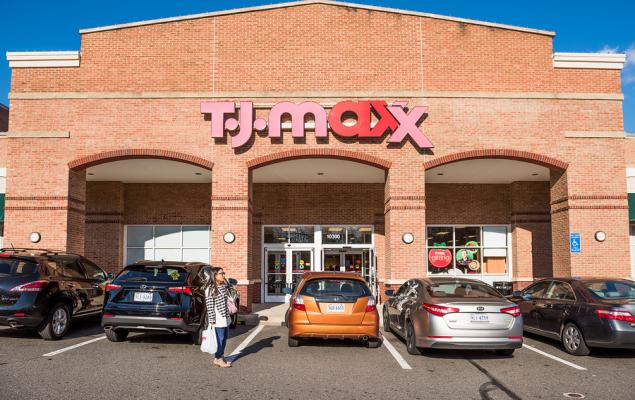
TJX shares have fallen 17.4% over the past month despite fiscal Q2 2027 adjusted EPS of $1.22, ahead of the $1.18 consensus estimate, and raised full-year adjusted EPS guidance of $5.15-$5.20. Q2 net sales rose 5% to $15.18 billion and consolidated comparable sales grew 4%, but Marmaxx comps increased only 1% amid merchandise-mix execution issues and lower transactions. Higher wages lifted adjusted SG&A by 20bps to 19.7% of sales, while Q3 gross margin is expected to decline 40-50bps to 32.1%-32.2% due primarily to fuel costs. Valuation remains demanding at 2.06x forward sales versus a 1.58x sub-industry average, leaving limited room for execution misses.
Analysis
The relevant signal is not category demand but TJX-specific inventory allocation: a transaction decline at Marmaxx while ROST materially outperformed implies share leakage rather than a broad off-price slowdown. If this persists through holiday receipts, TJX faces a double hit—lower unit productivity and greater markdown/transfer costs—while ROST gains leverage on fixed store and distribution expense. BURL is a more mixed read: its value-oriented customer base remains resilient, but its smaller scale leaves it more exposed to wage deleverage.
The near-term setup is a credibility test for management’s claimed improvement. Over the next 1-3 months, evidence of traffic recovery in Marmaxx and clean holiday inventory will matter more than a modest EPS beat; without it, consensus will likely reduce the probability assigned to the upper end of guidance and the valuation premium can compress further. Margin pressure also has asymmetric downside: wage inflation is structurally sticky, whereas fuel relief is cyclical and unlikely to solve weak store-level execution.
Contrarian case: the selloff may already discount a transient merchandising error, while off-price retailers can use industry excess inventory to rebuild traffic quickly during holiday. But that requires Marmaxx traffic—not simply average ticket—to turn positive. The article provides no independently verifiable weekly traffic, inventory-turn, or markdown data, so a directional outright position before those indicators emerge is premature.
AllMind Terminal
AI-powered research, real-time alerts, and portfolio analytics for institutional investors.
Request TrialMarket Sentiment
Overall Sentiment
mixed
Sentiment Score
-0.12
Ticker Sentiment
Key Decisions for Investors
- Initiate a 1-3 month pair: long ROST / short TJX in equal dollar amounts. ROST offers cleaner share-gain and operating-leverage exposure; TJX remains vulnerable to a guidance de-risking if Marmaxx traffic does not improve. Target 8-12% relative return; exit if TJX reports positive Marmaxx transactions and comp acceleration while ROST comp momentum decelerates materially.
- Keep BURL on watch rather than buy outright ahead of holiday. Add only if its traffic and merchandise-margin commentary confirm value-tier demand without incremental markdown risk; this is the higher-beta beneficiary if off-price demand broadens, but its lower scale makes wage pressure a key falsifier.
- For existing TJX longs, reduce exposure into the next quarterly update or hedge with a 2-3 month put spread. Re-add only after evidence that traffic, inventory turns, and markdown rates normalize; a further gross-margin guide-down or reduced fiscal-year EPS outlook invalidates the recovery thesis.
- Do not treat QBTS as related to this catalyst; it appears in the ticker feed but has no discernible operating linkage to the retail thesis.
More News
- Japan’s corporate leaders sound alarm over weak yen — even dollar-earners are voicing concerns
- Fed hikes again - an AI-Picked insurer is still cashing in
- Berkshire May Boost Japan Trading House Holdings, Itochu Says
- 'Science fiction': Transport companies — the backbone of economy — are sounding alarm on fuel prices
- What to know about US Federal Reserve’s first interest rate hike in 3 years
- Fed delivers its first hike in 3 years. Plus, what's moving Starbucks and GE Vernova
From AllMind Research
- Anthropic IPO Preview: Valuation, Timing, and What to Watch
- Shein After the IPO: Venue, Valuation, and What Must Be Proved
- What AI Research Tools Should a Small Hedge Fund Buy First?
- The $4.7 Trillion Bet: When Does AI Capex Become AI Revenue?
- Equity Research Automation Statistics: A 2026 Evidence Check