
First Canadian Graphite Completes Phase II Airborne Survey
Source: Newswire
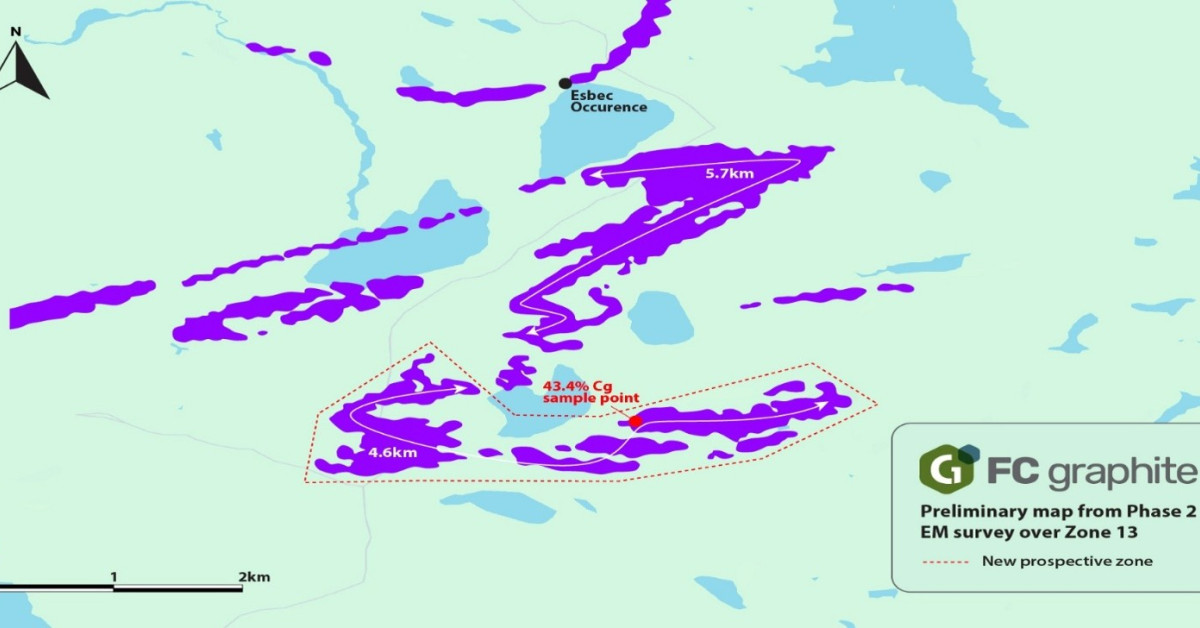
First Canadian Graphite completed a 1,269 line-km Phase II airborne Mag-EM survey that expanded Zone 13 into a multi-kilometre conductive system, identifying several priority drill targets. Previously reported surface samples included 14 of 46 above 20% graphitic carbon, with a peak grade of 43.4% Cg; Zone 13 has a confirmed 3.3 km strike length and widths exceeding 150 m. The company plans Phase III trenching, channel sampling and diamond drilling this fall, subject to exploration authorization, targeting an eventual NI 43-101-compliant mineral resource estimate and PEA.
Analysis
FCI's valuation remains driven by a binary conversion of geophysical conductivity and selective surface samples into drill-defined, continuous, recoverable graphite—not by the apparent scale of the anomaly. The next 1-3 month catalyst is permitting followed by channel/trench and initial drill assays; however, airborne EM has a high false-positive rate for economic graphite because conductive responses can reflect sulfides, moisture, or thin graphitic horizons. The key investable datapoints are true width, grade consistency, flake size/distribution, metallurgical recovery, strip ratio and the funding required to reach an updated compliant resource and PEA.
NOU is unlikely to see a material near-term fundamental benefit: a neighboring discovery can validate district prospectivity, but it may also compete for Québec labor, drilling capacity, infrastructure access and eventual offtake attention. Longer term, a credible second deposit could improve regional processing/infrastructure economics, but that requires FCI to demonstrate scale and battery-grade concentrate suitability—likely a 6-18 month process at minimum. Consensus may overvalue the adjacency narrative: geological proximity is not evidence of comparable economics, and the stated funding runway only through 2026 raises dilution risk before resource definition.
For FCI, the likely immediate share-price reaction is amplified by microcap liquidity rather than a change in NAV. A sustainable rerating requires drill intercepts that demonstrate broad, repeated mineralization across multiple targets and a clearly funded path through resource work; absent that, each exploration campaign is more likely to be financed at a discount. The thesis is falsified by delayed authorization, discontinuous/narrow drill intersections, poor beneficiation results, or an equity raise before sufficiently value-accretive assay results.
AllMind Terminal
AI-powered research, real-time alerts, and portfolio analytics for institutional investors.
Request TrialMarket Sentiment
Overall Sentiment
moderately positive
Sentiment Score
0.42
Ticker Sentiment
Key Decisions for Investors
- Do not establish a core FCI position on survey results alone; place on catalyst watch through the permitting decision and first drill-assay release over the next 1-3 months. Consider only a small, liquidity-adjusted speculative long after drill data show both meaningful true widths and repeatable graphite grades, with a hard exit on permitting slippage or an interim discounted financing.
- For any FCI entry, require confirmation of cash balance, monthly exploration burn and expected cost to complete drilling/resource work. If the funded runway does not extend through initial resource definition, treat a financing as the base case and wait for post-financing price discovery rather than underwriting headline geology.
- Maintain NOU independently of FCI unless evidence emerges that regional infrastructure, processing or customer qualification can be shared. The near-term read-through is immaterial; reassess only after FCI publishes drilling and metallurgy sufficient to establish that a second economically relevant deposit exists.
- Monitor graphite pricing, Chinese export-policy developments and North American anode-material offtake announcements over 6-18 months. Those factors can expand strategic-project multiples, but they cannot offset weak continuity, recovery or capital-intensity outcomes at FCI.
More News
- Oil falls on increased Gulf supply and hopes for US-Iran talks
- Asia stocks ride tech wave higher, oil stays subdued
- South Korean solar stocks jump as curbs on Chinese sector expected to remain in place
- Bank of America says Brent crude oil could top $150 a barrel if Iran war disruptions persist
- Latest Oil Market News and Analysis for Sept. 23
- Oil extends losses as Trump signals progress in U.S.-Iran talks