
Breadbasket States Ukraine and Russia Hammered by War and Heat
Source: Bloomberg
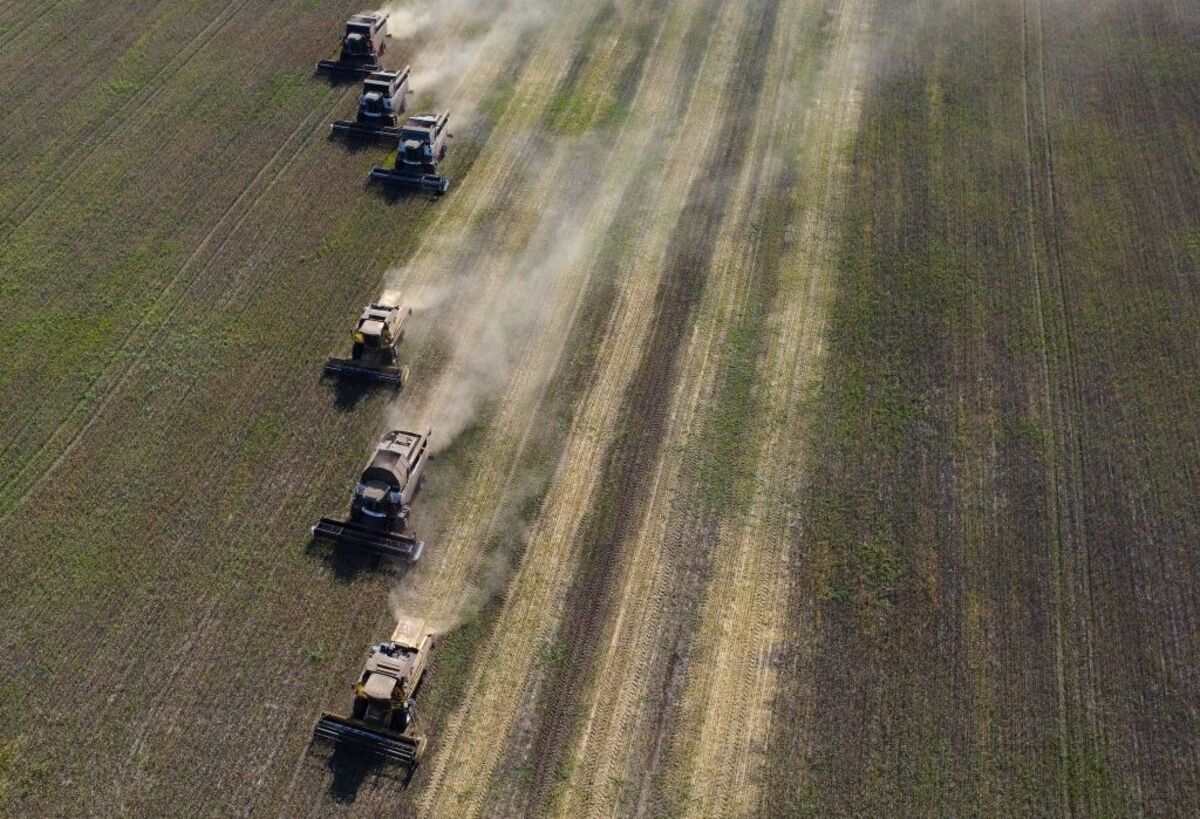
Corn and wheat prices are at multi-year highs, driven by war-related disruptions and extreme heat, raising food-security warnings. The article flags inflation risk as basic staples become more expensive, which can pressure household budgets and near-term consumer sentiment. Overall, the news is a negative macro impulse but more likely to impact specific commodity-linked equities and supply chains than the broad market immediately.
Analysis
The immediate market effect is a margin transfer, not just a headline on food inflation. Grain merchants and global origination books can monetize volatility and basis dislocations, while the real earnings damage shows up with a lag in input-intensive end markets that cannot reprice quickly: packaged foods, animal protein, and restaurant chains with limited hedging. In practice, the first beneficiaries are commodity-linked ETFs and merchandisers; the first losers are businesses where corn/wheat is a material cost and pricing power resets only quarterly.
The second-order macro effect is stickier core inflation, which can keep policy rates higher for longer even if energy softens. That matters for EM importers and subsidy-heavy governments: once breadbasket stress turns into FX pressure or export controls, you can get a self-reinforcing loop of food inflation, social pressure, and trade friction. For the U.S. equity market, the cleaner expression is relative value rather than an outright inflation beta because high grain prices eventually hit demand, but only after several quarters.
Contrarian view: this trade can be crowded fast, and the price response may already be ahead of the fundamental damage. If Black Sea logistics improve, weather normalizes, or regulators force export releases, grain prices can mean-revert before downstream inflation fully transmits. The structural fix is acreage response and substitution, which is a 6-18 month story; the near-term risk is a squeeze, but the medium-term risk is buying the top of a supply shock that reverses on policy or crop data.
AllMind Terminal
AI-powered research, real-time alerts, and portfolio analytics for institutional investors.
Request TrialMarket Sentiment
Overall Sentiment
mildly negative
Sentiment Score
-0.20
Key Decisions for Investors
- Long WEAT or CORN on 3-5% pullbacks for a 1-3 month horizon; use a tight risk limit because weather and export-policy headlines can unwind the move quickly.
- Pair trade: long BG / short TSN into the next 1-2 earnings cycles; BG should benefit from wider merchandising spreads while TSN is more exposed to feed-cost pressure and slower pass-through. Falsify if grain prices roll over materially or TSN guides to full pass-through without volume damage.
- Add a small inflation-hedge basket via DBA versus XLP if you want broader commodity upside; better risk/reward if food inflation starts to reaccelerate in the next CPI prints.
- Set an alert for any export-ban or corridor-normalization headline; that is the highest-probability catalyst for a sharp reversal and should trigger profit-taking on commodity longs.
- If using options, prefer call spreads on WEAT/DBA rather than outright calls to express upside while capping theta risk if the shock fades within weeks.
More News
- India unveils tough curbs on dollar demand to defend rupee
- Bank of America is bullish on these top stocks ahead of earnings
- Stocks were up this week. Here are the names that are now overbought
- Europe’s Indebted Nations Are Starting to Blink at Market Wrath
- How U.S. know-how is fracking Australia into a gas boom, from Texas oilmen to Trump’s energy secretary
- Trump struck a diesel deal with Putin just weeks after signing Russia sanctions. Zelenskyy calls it ‘a weak decision’
From AllMind Research
- Anthropic IPO Preview: Valuation, Timing, and What to Watch
- Shein After the IPO: Venue, Valuation, and What Must Be Proved
- What AI Research Tools Should a Small Hedge Fund Buy First?
- State of M&A and Private Markets, June 2026: A $4.9 Trillion Rebound, Underwritten on Money That Never Got Cheaper
- Run Cost-Controlled Financial Research in AllMind Agent Studio