
GEEKOM Returns to IFA 2026 with Distributed Local AI and Next-Generation PCs
Source: PR Newswire
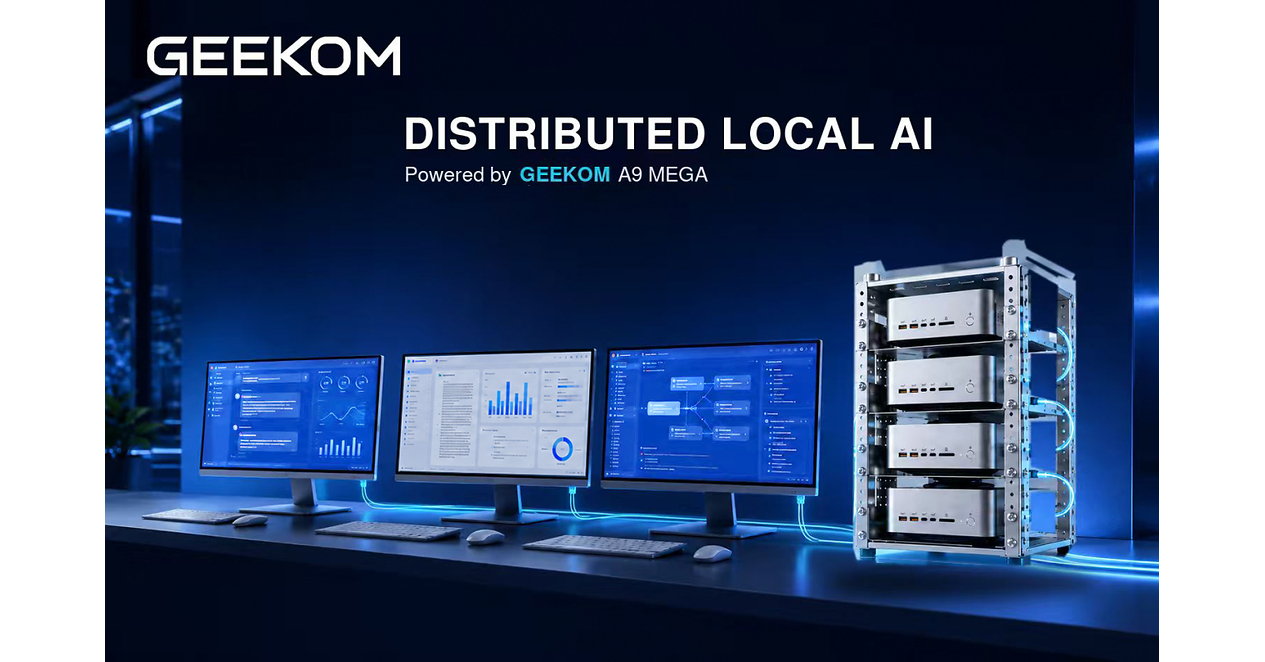
GEEKOM will return to IFA 2026 (Sept 4–8, Berlin) showcasing a distributed local AI setup using four GEEKOM A9 Mega Mini PCs (AMD Ryzen AI Max+ 395, Radeon 8060S) connected via USB4, enabling DeepSeek V4 Flash to run locally without a server rack. It also highlights the GeekBook X16 Pro (Ryzen AI 9 HX 470, Radeon 890M in a thin 16-inch magnesium-alloy chassis) plus new Mini PCs including the IT13 Mega (Intel Core Ultra X7 358H, dedicated NPU). The news is product-focused and supports a positive read-through for enterprise/private AI deployment, but it is unlikely to move markets broadly.
Analysis
This reads as a validation event for local-AI form factors, not a material demand inflection. The only economically relevant angle is that premium APUs with integrated GPU/NPU capability can support higher ASPs and better mix for AMD, while Intel’s inclusion looks more like table stakes than a share-taking win. If buyers start valuing on-device inference, the second-order beneficiaries are memory, SSD, and thermal/power-management vendors; the CPU itself may capture less of the economic upside than the marketing implies.
The near-term market impact should be limited because OEM demo activity rarely converts into meaningful shipment data without channel evidence. Over the next 1-3 months, watch for notebook/mini-PC sell-through commentary and whether “AI PC” units command a pricing premium; absent that, this is mostly narrative support. For INTC, the risk is that repeated product breadth announcements fail to change the client revenue trend, leaving the stock hostage to execution metrics rather than launch cadence.
The contrarian mistake is treating every local-AI demo as a broad TAM expansion. More likely, this is a niche upgrade cycle where users substitute some cloud inference with edge processing, modestly helping hardware complexity but not creating a broad-volume breakout. Falsifiers are simple: if AMD client revenue and average selling prices inflect over the next 2 quarters, or if Intel shows measurable notebook share gains, the market will have to reprice this as more than marketing.
AllMind Terminal
AI-powered research, real-time alerts, and portfolio analytics for institutional investors.
Request TrialMarket Sentiment
Overall Sentiment
mildly positive
Sentiment Score
0.20
Ticker Sentiment
Key Decisions for Investors
- Small relative-value long AMD / short INTC into the IFA window, 4-8 weeks: thesis is AMD has the cleaner premium-AI-PC mix while Intel’s inclusion is more defensive. Target is a modest 5-8% spread; stop if Intel commentary shows share gains or AMD client revenue disappoints.
- If trading single-name options, prefer a limited-risk AMD call spread into the post-IFA follow-up window rather than chasing spot equity. Risk/reward is better if the market starts assigning premium-APU optionality, but size should stay small because shipment impact is likely immaterial.
- Watchlist, not trade: wait for channel checks on AI PC sell-through before adding exposure to the PC complex. A confirmed ASP uplift would also be constructive for upstream memory/SSD names, but without that data the setup is narrative-only.
- If INTC rallies sharply on the announcement alone, fade strength rather than chase it; the falsifier is actual client revenue acceleration, not product headlines.
More News
- Nasdaq 100: Tech Stocks Find Buyers as Dow Holds Firm Premarket
- New data shows Starbucks turnaround is working, but Chipotle takeover report slams shares
- Trump presents national medal to Microsoft CEO after suspending its H-1B visas and alleging ‘foreign indentured servants’ replaced domestic workers
- TSMC taps GlobalFoundries to bolster US silicon interposer production in $2B deal
- Nvidia found $1B under the couch to help secure American scientific computing dominance
- S&P 500 futures are little changed after OpenAI's revenue report prompts tech sector turmoil: Live updates