
Velocys expands Fischer-Tropsch reactor roadmap with AlphaCore 800 for larger-scale SAF and e-fuels projects
Source: PR Newswire
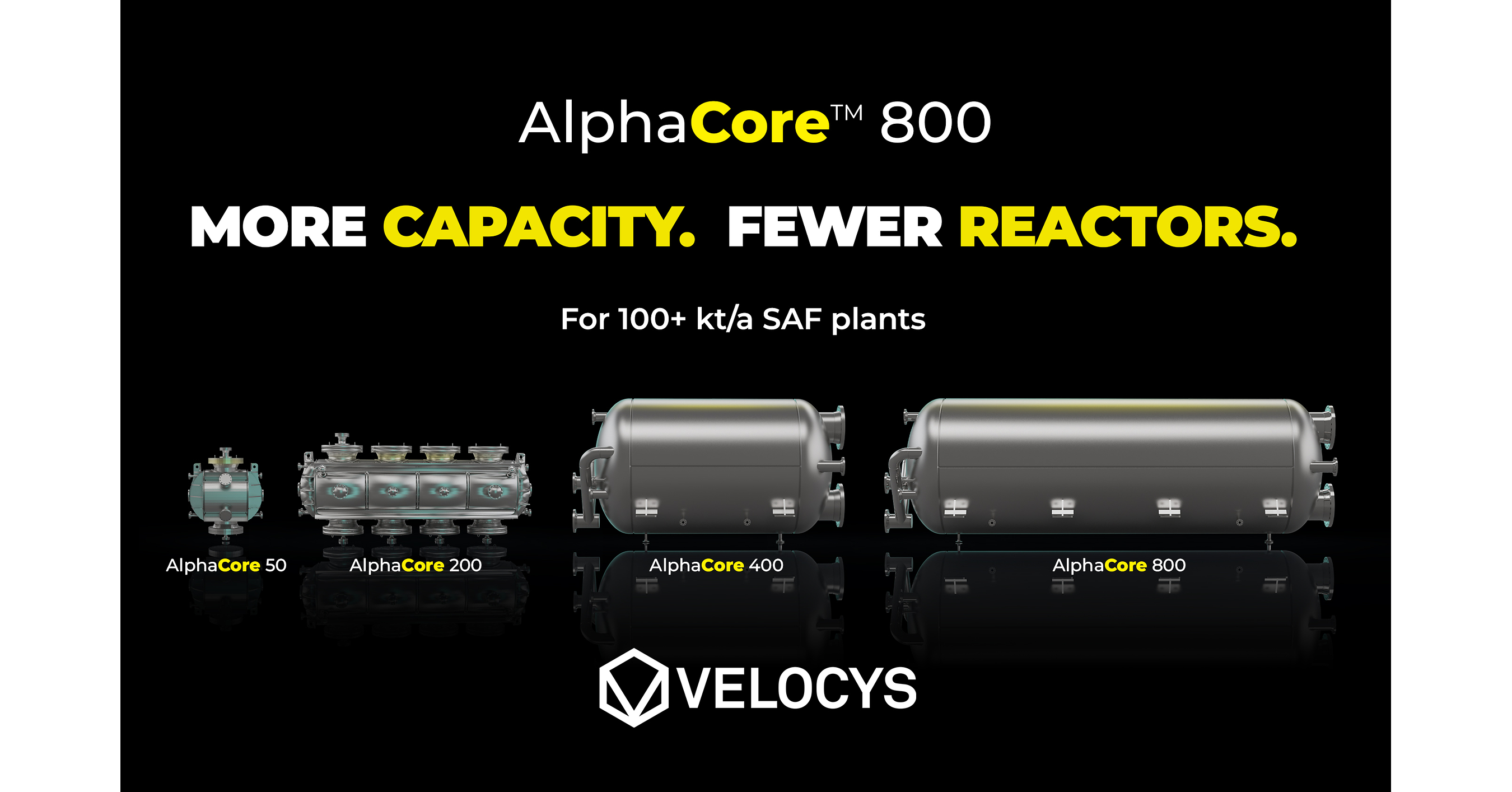
Velocys launched its AlphaCore 800 microchannel Fischer-Tropsch reactor, capable of producing up to 800 barrels per day or 30,000 tonnes per year of FT liquids, doubling the capacity of its AlphaCore 400. The reactor targets larger SAF and e-fuels facilities of roughly 100,000 tonnes per year or more, with a 60 kt/a plant requiring two AlphaCore 800 units versus eight AlphaCore 200 units—a 75% reduction in reactor count. The larger design is intended to reduce plant complexity, associated equipment needs and FT unit costs, strengthening the commercial case for scaled sustainable-fuels projects.
Analysis
The commercial relevance is not the nominal throughput increase but whether a larger module lowers installed cost and commissioning risk enough to move marginal e-fuels projects through final investment decision. At larger plant sizes, the FT island is unlikely to remain the dominant cost bottleneck: electrolyzer utilization, renewable-power sourcing, CO2/syngas availability, and SAF offtake economics will determine project returns. Consequently, a reactor-count reduction can improve EPC execution and spares inventory, but it does not by itself establish a material reduction in levelized fuel cost.
The key technical risk is scale-up rather than chemistry. Microchannel systems derive value from heat transfer and modular repeatability; increasing per-reactor capacity can expose manufacturing yield, catalyst-life, thermal-control, and single-train availability risks that are not visible in a product specification. A failed or delayed first commercial deployment would raise lender-required contingencies and could offset the proposed balance-of-plant savings, particularly for projects relying on project finance.
There is no obvious liquid, direct public-equity read-through and the announcement should not be treated as a sector-wide SAF demand catalyst. Listed process licensors such as Honeywell (HON) and Johnson Matthey (JMAT.L) could face modest competitive pressure only if independent project awards demonstrate lower installed cost and equivalent uptime; incumbent integration, warranties, and operating references remain the stronger purchasing criteria. For listed SAF producers such as Neste (NESTE.HE), the more relevant signal is whether new e-SAF capacity becomes financeable, which would be a medium-term supply risk rather than an immediate earnings benefit.
Contrarian view: the market may over-credit modular FT for solving e-fuels economics. The decisive validation is a bankable EPC quote and operating data at the new size, not a design roadmap. Over the next 6-18 months, monitor disclosed project awards, guaranteed availability, catalyst replacement intervals, and evidence that total installed cost per annual tonne falls after accounting for syngas generation and power infrastructure.
AllMind Terminal
AI-powered research, real-time alerts, and portfolio analytics for institutional investors.
Request TrialMarket Sentiment
Overall Sentiment
moderately positive
Sentiment Score
0.42
Key Decisions for Investors
- No immediate directional trade: there is no identified liquid public issuer with direct exposure, and the announced economics lack independently verified capex, uptime, or customer-order data.
- Create an event-driven watch on HON and JMAT.L for named 100kt+ SAF/e-fuels project awards using the larger architecture over the next 6-18 months. A disclosed award with lender-backed performance guarantees would be the threshold to reassess competitive-risk shorts; absent that, do not position against incumbents.
- For NESTE.HE, treat financed e-SAF project announcements as a 12-36 month supply-growth risk rather than a near-term catalyst. Consider reducing a structural long only if multiple projects reach FID with credible low-cost renewable-power and carbon-feedstock contracts; a reactor announcement alone does not falsify Neste's near-term scarcity value.
- Track project-finance terms as the key falsifier: if first deployments require materially higher contingency reserves, weaker availability guarantees, or repeated commissioning delays, the claimed unit-cost advantage is unlikely to translate into commercial adoption.
More News
- Taiwan benchmark Taiex rises to record intraday high as tech stocks advance
- AMD joins the $1 trillion club as chip rally surges - our AI Strategy saw it early
- Latest Oil Market News and Analysis for Sept. 22
- Oil Settles Near $100 as Hormuz Flows Stunt Rally
- Here's who we know is going to the Trump-Xi dinner so far
- How a Bangladeshi garment-maker is fighting the Middle East energy crunch
From AllMind Research
- Anthropic IPO Preview: Valuation, Timing, and What to Watch
- Shein After the IPO: Venue, Valuation, and What Must Be Proved
- What AI Research Tools Should a Small Hedge Fund Buy First?
- Weekly Update: Adding Live MBO Level 3 Data - Liquidity Heatmap, OFI Charts, and More
- Alternative Data Due Diligence for Institutional Investors