
LONGWELL EC FanWall Technology Reduces CRAH Fan Energy 38% for Next-Generation AI Data Centers
Source: PR Newswire
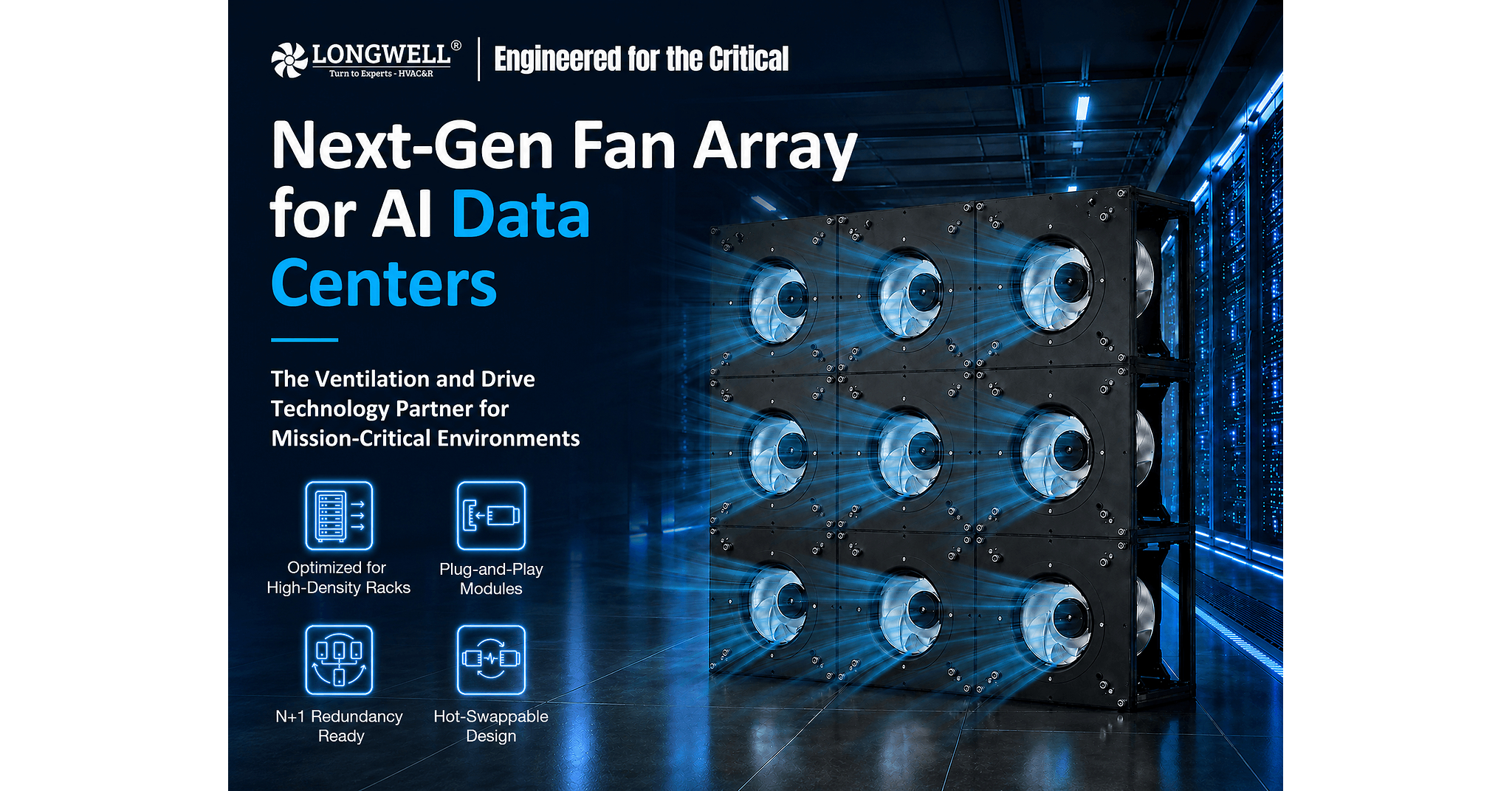
LONGWELL’s AI-Era Data Center Cooling Pack claims a 38% reduction in CRAH fan energy versus the replaced equipment, improving CRAH system PUE contribution from 1.42 to 1.28. The project also reports 6.5 dB(A) lower noise and zero field failures, with an accelerated timeline from spec lock to mass production in 90 days (vs 14 months plus a six-month ramp for an incumbent). Customer’s first PO is 1,500 units and 2025 deliveries are stated at 80,000 units under a 2025–2027 framework with a 60,000-unit annual minimum.
Analysis
This is less a one-off product announcement than evidence that cooling is becoming a competitive lever in AI infrastructure. If a vendor can cut fan energy materially while compressing validation cycles, the economics shift toward retrofit-heavy deployments: hyperscalers and colocation operators get more compute per constrained megawatt, while older cooling designs face faster obsolescence. The first-order winner is the data center operator; the second-order winner is any vendor selling controls, monitoring, and modular thermal systems rather than commodity airflow hardware.
The more interesting market effect is on the capex mix. Better thermal efficiency does not reduce demand for AI buildouts; it changes where the spend goes, favoring integrated power/cooling stacks and away from legacy CRAC/CRAH replacement cycles with slower qualification. That is constructive for vertically integrated infrastructure names, but mildly negative for HVAC names with limited AI exposure and for European incumbents that compete primarily on installed-base inertia. For TGT specifically, there is no direct read-through.
The contrarian risk is that investors may over-translate a single duty-point win into a broad sector margin story. The financial impact depends on actual ASPs, attach rates, and whether this becomes a platform standard or remains a project-specific win. The catalyst path is 1-3 months of purchase orders and design wins; the structural test is whether this shows up in customer power-density specs and 2027 budget cycles. Falsifier: if follow-on orders fail to expand beyond one framework, the thesis is just marketing noise.
AllMind Terminal
AI-powered research, real-time alerts, and portfolio analytics for institutional investors.
Request TrialMarket Sentiment
Overall Sentiment
mildly positive
Sentiment Score
0.25
Key Decisions for Investors
- No direct trade in TGT; keep it off the book unless there is a separate retail catalyst.
- Watchlist: long VRT or ETN on any AI-infrastructure pullback if follow-on orders confirm broader adoption of high-density cooling; thesis only works if order momentum shows up within 1-3 months.
- Relative-value idea: long VRT / short CARR for 1-3 months if the market starts rewarding data-center-specific thermal exposure over diversified HVAC; risk is that the news remains too niche to move multiples.
- Set an alert on EQIX and DLR capex commentary into next earnings season; if cooling efficiency is real, the market may underwrite higher rack density and extend asset lives, which is bullish for utilization but can delay some replacement spend.
- If the next 1-2 customer disclosures do not show multi-site rollout, fade the announcement and avoid chasing the theme; the upside then becomes a supply-chain anecdote rather than a sector change.
More News
- CoreWeave credit default swaps hit distress levels as investors sour on AI debt
- Brian Sullivan: Why the 'real' price of oil is likely $30-$40 higher than where it is now
- Treasuries Soar as Tech Slump Threatens Growth
- Penske Automotive agrees to be taken private by Penske, Mitsui
- Faraday Copper completes acquisition of BHP’s San Manuel project
- Latest Oil Market News and Analysis for Oct. 16