
Branchenbericht zeigt: 64 % der Führungskräfte im Life-Sciences-Bereich ergreifen Maßnahmen zur Etablierung einer KI-Governance
Source: PR Newswire
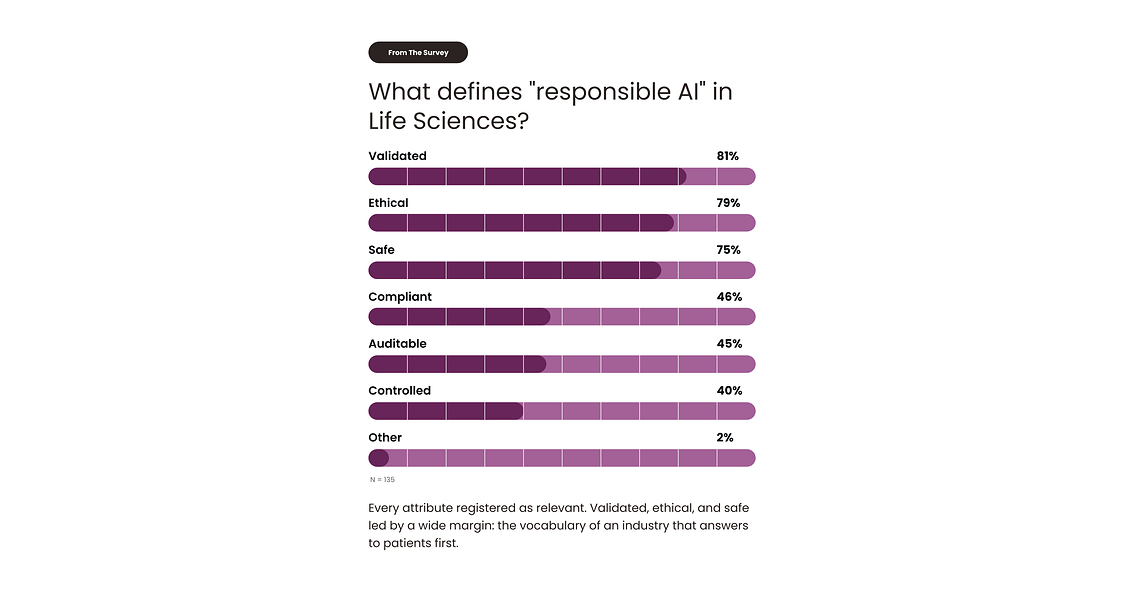
ACTO’s 2026 Responsible AI in Life Sciences report, based on 135 executive survey responses and eight roundtables, finds trust and governance are key constraints on scaling agentic AI. While 64% say their organization has an AI governance process established or in development, 36% lack defined governance or rely on one-time approval; 58% say the industry lacks clear responsible-AI standards, and 54% worry about AI use in their organizations. Regulatory, legal or compliance concerns were the top internal scaling barrier at 21%, versus 9% for technical readiness; ACTO introduced the RAIL score as a framework for evaluating AI systems.
Analysis
The investable signal is a shift in life-sciences AI procurement from model performance toward permissioning, auditability and human accountability. That favors vendors already embedded in regulated workflows and able to prove controls—but it also raises the bar for standalone agent layers. Veeva Systems is an indirect beneficiary candidate: ACTO is identified as a Veeva Gold Product Partner, which may support ecosystem distribution, but the report provides no evidence of Veeva customer adoption, revenue contribution or a formal role in the RAIL framework. Do not capitalize the partnership as material without verification.
The survey is a vendor-sponsored snapshot of 135 senior leaders, not evidence of realized spending or a binding industry standard. Its RAIL rubric could help procurement teams compare products, but adoption and independent validation matter more than the launch of a scorecard. Near term (days), this is unlikely to change earnings estimates. Over 1–3 months, watch for RFP language, customer rollout plans and vendors publishing independently verifiable controls. Over 6–18 months, governance requirements could consolidate spend toward validated platforms and integrated workflow vendors; conversely, agents that execute across systems could weaken incumbent software’s control of user interfaces or seat economics. Veeva’s net exposure is therefore not unambiguously positive.
Contrarian read: reported enthusiasm for outcomes over cost savings may support adoption, but organizational change—not technical readiness—is the limiting factor. Human review requirements could keep the most consequential workflows from scaling quickly, delaying monetization. Falsify the constructive Veeva read if customers favor independent orchestration layers, Veeva’s AI attach/adoption indicators fail to improve, or regulated deployments remain limited to low-risk administrative tasks.
AllMind Terminal
AI-powered research, real-time alerts, and portfolio analytics for institutional investors.
Request TrialMarket Sentiment
Overall Sentiment
mixed
Sentiment Score
0.00
Key Decisions for Investors
- No immediate trade on this press release: the survey is narrow, vendor-sponsored, and contains no quantified spending, deployment or revenue evidence.
- Keep Veeva on a conditional beneficiary watchlist, not as a direct RAIL winner. Verify the scope and commercial substance of the ACTO partnership, Veeva customer uptake, and whether governance capabilities are influencing procurement.
- Over the next 1–3 months, monitor life-sciences software vendor disclosures and customer commentary for agentic-AI deployments that include audit trails, access controls, human escalation and cross-system orchestration—not pilot counts alone.
- Reassess the Veeva thesis if evidence shows agent layers bypassing incumbent interfaces and reducing seat or workflow control; a constructive thesis requires measurable AI adoption without erosion of core platform economics.
More News
- Analysts react as Binance freezes assets after $6.3 billion security breach
- Stocks slump, bonds leap as AI giants’ spending spooks investors
- Alphabet Erases $500 Billion as ChatGPT, Google AI Cut into Search
- Alphabet just had its worst day as a public company. BofA now values Google search at a lower multiple than fossil fuel stocks
- Alphabet’s stock has worst day in over 20 years, dragging the S&P 500 to first loss in four days
- Warren urges DOJ criminal probe of Bank of America over anti-money-laundering violations