
The National Police Association Endorses the 287(g) Expansion Act
Source: PR Newswire
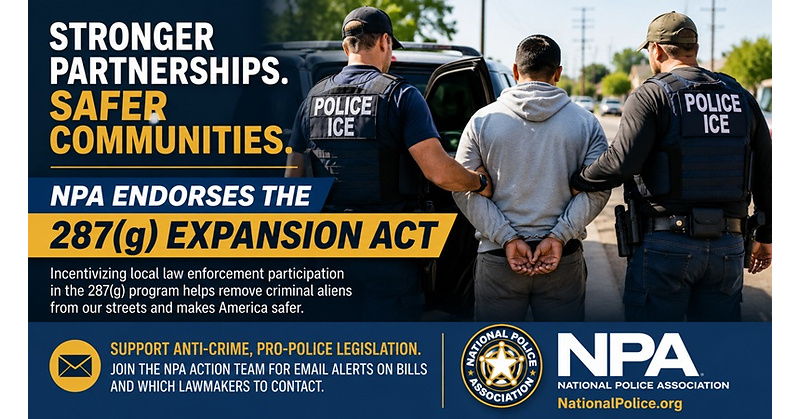
The National Police Association endorsed Sen. Marsha Blackburn’s 287(g) Expansion Act (S. 4405), which would set aside $20M per fiscal year from 2027-2033 for expanded ICE-state/local partnership grants funded through the Edward Byrne Memorial JAG program. Qualifying jurisdictions could receive up to a 10% increase in annual JAG allocations. The article is advocacy-focused and cites program growth from ~135 agreements in early 2025 to 2,365 across 39 states, but it does not provide direct financial-market figures or immediate economic impact.
Analysis
This is a marginal funding lever, not an immediate sector re-rating. The economic impact is too small to move aggregate public-safety budgets, so the first-order market reaction should be limited unless the bill becomes a vehicle for broader immigration enforcement appropriations. The real sensitivity is whether the funding incentive raises 287(g) adoption in politically aligned states enough to increase arrest processing and detention throughput; that is a 6-18 month operating issue, not a same-day catalyst.
The clearest public-market beneficiaries are GEO and CXW, but only if higher local participation feeds into sustained ICE bed demand and longer average length of stay. If the federal system remains bed-constrained, the benefit leaks into local agencies rather than private operators, and the trade becomes a narrative-only bid. A second-order winner could be jail-tech / case-management vendors, but grant money is fungible and often displaces other spend, so incremental revenue capture is likely shallow.
The main tail risk is legislative failure: committee bottlenecks, appropriations friction, or a change in federal enforcement priorities would unwind any “policy premium” quickly. The contrarian miss is that investors may overestimate how much a funding nudge changes on-the-ground enforcement; adoption can rise while monetization lags if ICE transport, detention, and court backlogs do not expand in parallel. The thesis is falsified if 287(g) counts keep rising but ICE detention population and facility utilization stay flat over the next 1-2 quarters.
For now, this looks like a watchlist event rather than a high-conviction trade. Any position should be conditioned on bill advancement plus confirmatory operational data, not on the endorsement itself.
AllMind Terminal
AI-powered research, real-time alerts, and portfolio analytics for institutional investors.
Request TrialMarket Sentiment
Overall Sentiment
neutral
Sentiment Score
0.05
Key Decisions for Investors
- No immediate trade: wait for Judiciary Committee markup or measurable co-sponsor momentum before assigning a policy premium to GEO/CXW; otherwise the signal is too small to justify risk.
- Conditional long GEO / CXW via 3-6 month call spreads only if the bill advances beyond committee and ICE detention utilization trends up; target asymmetry is 2-3x premium if utilization data confirms the policy shift.
- If headlines drive GEO/CXW higher without follow-through in ICE bed counts, fade the move with a short-term mean-reversion trade or put spread; the catalyst is weak without operating data.
- Set an alert on quarterly ICE detention population and average daily census: if those metrics do not inflect within 1-2 quarters, exit any policy-driven long, as the funding likely stays local rather than flowing to private operators.
More News
- The IEA wants to empty its oil reserves faster. A federal watchdog says the US isn’t ready for what comes next
- Take Five: Bangkok blues
- Deadly Houthi Attacks on Saudi Arabia; EU Caps Chinese Hybrid Car Imports
- ‘If nothing is done, it’s almost inevitable’: Ukraine’s Yuriy Ryzhenkov on why steelmaking is on the brink of collapse as Russian bombing intensifies
- Saudi Arabia says 1 dead, 11 injured in latest attack on Riyadh airport
- Why is SK Hynix stock sliding today?