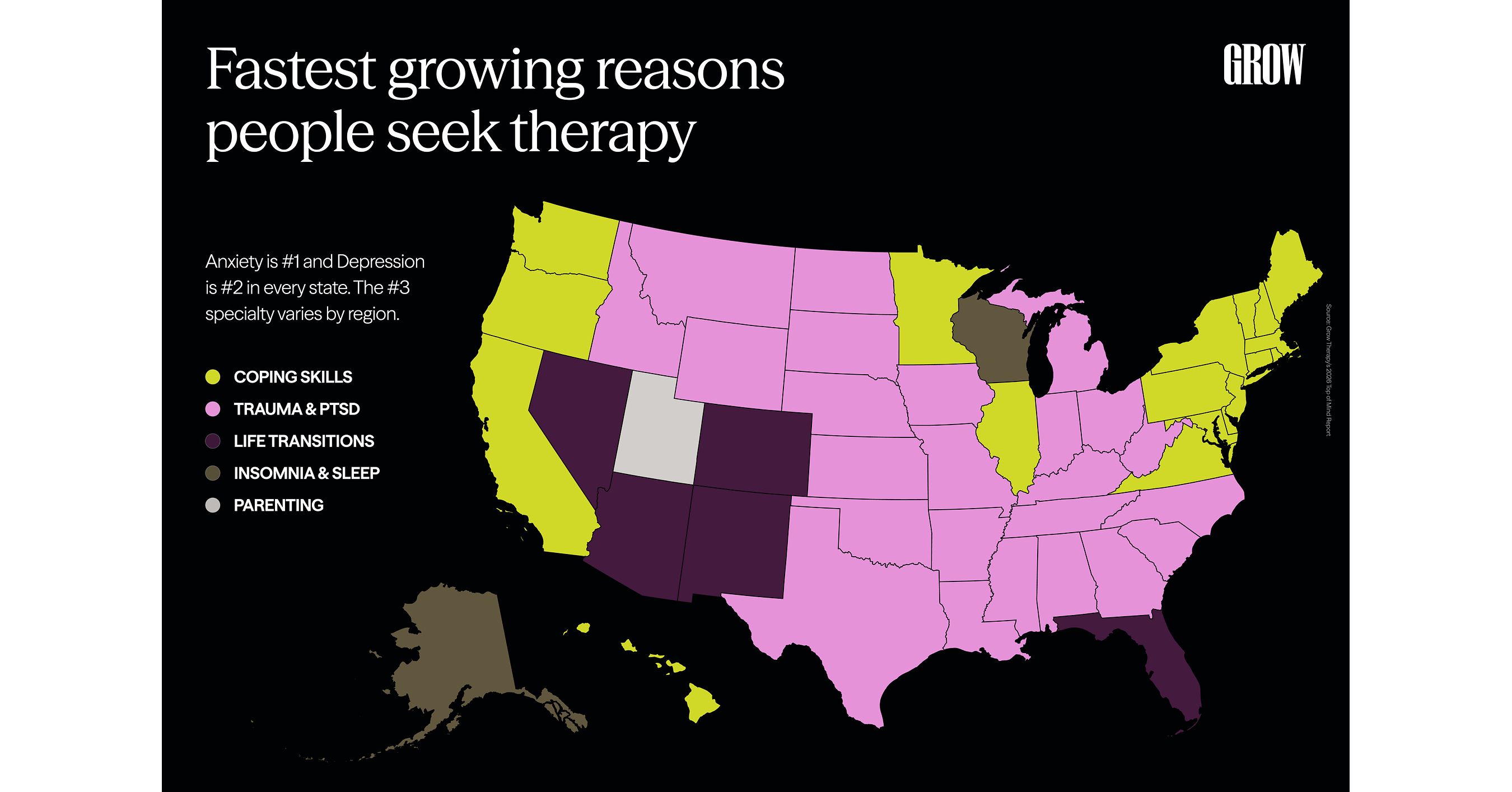
Grow Therapy reports that therapy demand is broadening beyond crises: life transitions are the fastest-growing reason for therapy at +168% YoY, followed by coping skills (+152%) and trauma/PTSD (+152%). Reported benefits are improvement within the first nine sessions (with 28% improving within four sessions) and a high-uptake shift toward everyday access (39% joining virtual sessions from bed). Access appears to be improving with a median 2-day wait for a first session on Grow (vs. 48 days nationally) and an average session cost of $21 with insurance, while only 2% of non-users cite stigma as the barrier.
This reads less like a one-off consumer sentiment note and more like evidence that behavioral health is shifting from discretionary spend to a repeat-utilization category. That is structurally positive for platforms with low-friction intake, dense clinician supply, and payer integration, but the first-order monetization likely accrues to distribution owners rather than the brand that published the data. In public markets, the cleaner read-through is to behavioral-health-enabled telehealth and to payers that can route members to lower-acuity care, though that benefit is likely offset near term by higher claims intensity before any downstream medical-cost savings show up.
The immediate market reaction should be muted unless independent data confirm it, because company-sponsored usage surveys often overstate TAM and understate price pressure. The real 1-3 month catalyst is whether large employers and insurers normalize therapy as a covered, recurring benefit in upcoming renewals; the main risk is not demand disappearing but clinician capacity, reimbursement compression, or members churning once the novelty fades. If session economics deteriorate or wait times widen, the thesis flips quickly.
Contrarian view: the consensus may be missing that "more therapy" does not automatically mean more profitable therapy. The report suggests commoditization: low wait times, low out-of-pocket cost, and easy access all point to a service that can scale volume while weakening pricing power. Over 6-18 months, the winner is likely the platform or payer that owns distribution and can direct members to the cheapest appropriate setting, not the highest-growth brand.
AI-powered research, real-time alerts, and portfolio analytics for institutional investors.
Request TrialOverall Sentiment
mildly positive
Sentiment Score
0.25
Ticker Sentiment
