
US and China Hail Constructive Talks on AI, Trade Before Summit
Source: Bloomberg
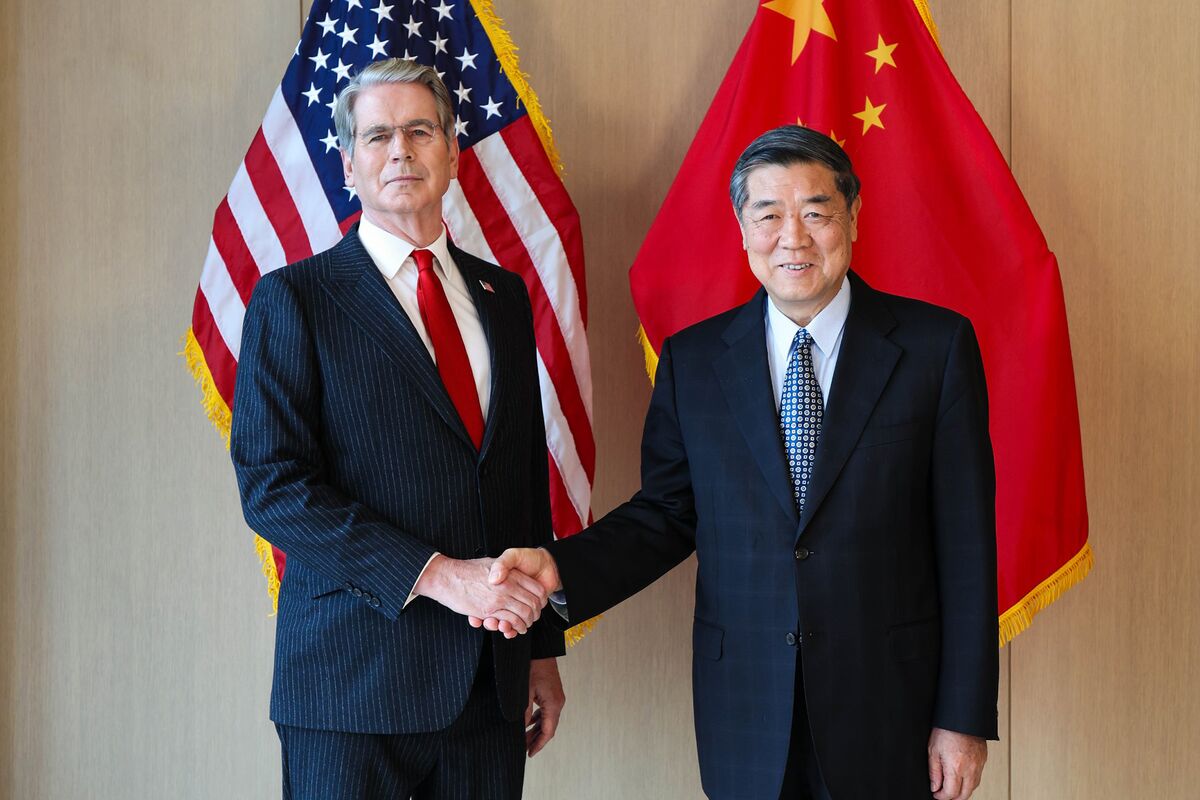
US and Chinese officials characterized pre-summit discussions on artificial intelligence and trade as constructive, signaling a potentially less confrontational backdrop for this week's leaders' meeting. The article provides no specific agreements, tariff changes, or policy commitments, leaving the market implications dependent on outcomes from the summit.
Analysis
The near-term market implication is a modest compression in the geopolitical risk premium embedded in China-sensitive technology and semiconductor supply chains, not a change in underlying earnings power. KWEB, BABA, BIDU and QCOM would likely outperform on any summit language that reduces retaliation risk; however, NVDA, AMD, ASML and MU require concrete licensing or export-control changes before consensus revenue estimates should move. The more important second-order effect is lower customer inventory hedging: reduced fear of abrupt restrictions could normalize procurement cycles, which is mildly negative for distributors and equipment makers that have benefited from precautionary orders.
Over the next 1-3 months, rhetoric can support a tactical risk-on rotation into Chinese internet and global semis, but the asymmetry is unfavorable after an initial relief rally because implementation remains political and reversible. The key falsifier is not summit tone but evidence in company guidance: China revenue assumptions, license approvals, lead times, and capex commitments. Over 6-18 months, a durable détente would reduce incentives for duplicated AI supply chains, pressuring relative winners in non-China manufacturing hubs while supporting firms with material China end-market exposure; absent that, localization spending and parallel supply chains remain the base case.
Contrarian view: broad AI equities may not be the cleanest expression of improved bilateral dialogue. Hyperscaler AI capex is driven primarily by monetization and power availability, while the clearest valuation sensitivity sits in assets carrying a China-policy discount. Treat any broad SMH rally as an opportunity to rotate toward China-exposed software, internet and communications names only if policy language is followed by verifiable administrative action.
AllMind Terminal
AI-powered research, real-time alerts, and portfolio analytics for institutional investors.
Request TrialMarket Sentiment
Overall Sentiment
mildly positive
Sentiment Score
0.25
Key Decisions for Investors
- No directional position ahead of the summit on headlines alone; use a 24-48 hour post-event window to assess whether policy deliverables, rather than diplomatic language, emerge.
- If KWEB underperforms SMH by more than 5% into the event, initiate a 1-3 month tactical long KWEB / short SMH pair at equal dollar exposure; the thesis is risk-premium compression in China internet versus already-capex-supported semiconductor valuations. Exit if no follow-through on administrative or trade measures within two weeks.
- Maintain a watchlist for QCOM and MU as higher-beta beneficiaries of reduced China supply-chain friction, but require management commentary indicating improved China demand visibility or licensing before adding exposure; absent that evidence, the rally is likely multiple expansion without earnings support.
- Use any broad semiconductor relief rally to tighten stops on NVDA, AMD and ASML longs rather than add. A renewed export-control action, adverse licensing decision, or China-specific guidance reduction would reverse the geopolitical premium quickly; a 5-7% relative underperformance versus SMH is a practical thesis-failure trigger.
- Monitor Taiwan- and Southeast Asia-focused manufacturing proxies for relative weakness over 6-18 months if formal de-escalation reduces supply-chain duplication incentives; this is an alert, not a trade, until customer capex plans show reduced localization spending.
More News
- How a US Diesel Export Ban Can Impact Prices, Oil Market
- How oil, gas losses have shrunk Iran’s GDP by 10 percent during war
- There’s $33 Trillion in Stock Gains Riding on the Future of AI
- Wall St futures rise as AI stocks rally, crude prices fall
- Fed’s Goolsbee: Strong demand may be adding to US inflation, ’no ambiguity’ how Fed would react
- US LNG Producers Eye Bonanza If Trump and Xi Can Ease Tariffs