
TriageLogic's MedMessage Automate Frees Up Over 37 Hours of Staff Time in the First Three Business Days
Source: Newswire
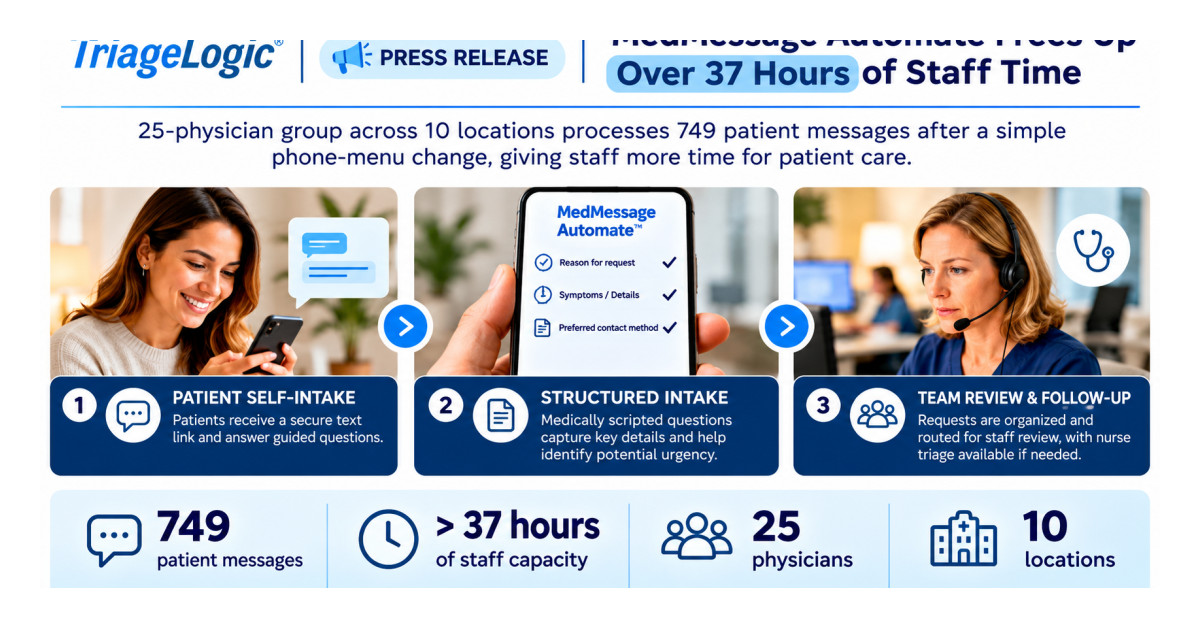
TriageLogic said MedMessage Automate processed 749 patient messages in its first three business days for an unnamed group of 25 physicians across 10 locations, with 748 messages originating from patient self-intake. The company estimates this could free more than 37 hours of staff capacity, based on an assumed three minutes saved per message—not measured time. The early result is a positive operational signal, but outcomes may vary by practice and the article does not identify the customer.
Analysis
The investable signal is workflow adoption, not proof of labor savings: the reported 37 hours applies a company-selected three-minute assumption, and does not establish measured time saved, reduced headcount, or improved access. The key economic test is whether structured intake removes work end-to-end—or simply shifts it to clinician review, follow-up, and escalation. Patient self-intake may also displace phone volume rather than create net-new capacity.
For TriageLogic, repeatable onboarding through an existing phone-menu change could lower implementation friction and support distribution across its installed base. But one unnamed practice’s early usage is not evidence of retention, willingness to pay, or scalable unit economics. The broader potential beneficiaries are workflow and patient-communication vendors that can demonstrate measurable labor productivity; traditional call-handling capacity could face pressure only if adoption translates into lower purchased labor, not merely redeployment.
Near term, expect limited market impact absent a disclosed public-company exposure. Over 1–3 months, watch for independent time-motion results, conversion to paid deployments, repeat usage, and customer references. Over 6–18 months, the structural upside depends on integration and clinical safety: human review and escalation remain necessary, while a missed urgent symptom could raise liability concerns and slow adoption. The contrarian point is that high message volume may be a utilization proof point, but not yet an ROI proof point.
AllMind Terminal
AI-powered research, real-time alerts, and portfolio analytics for institutional investors.
Request TrialMarket Sentiment
Overall Sentiment
mildly positive
Sentiment Score
0.25
Key Decisions for Investors
- No direct trade: TriageLogic has no ticker in the supplied data, and this single-company announcement does not establish a material catalyst for a public security.
- Add healthcare workflow automation vendors to a watchlist, but require verified paid customer growth, retention, and measured labor savings before expressing a sector long; do not equate estimated staff capacity with cash cost reduction.
- Monitor for independent time-motion data, deployment-to-paid conversion, clinician-review burden, and safety/escalation outcomes. These are the missing inputs needed to underwrite adoption and liability risk.
- Falsification: repeated deployments fail to show measured reductions in total staff handling time, or evidence emerges that review and follow-up offset intake savings; conversely, independently validated ROI and repeatable paid rollouts would strengthen the adoption thesis.
More News
- What Wall Street billionaires are saying about Democrats' midterm sweep
- NextDC shares surge 43% after Goodman, Digital Realty stake purchases
- Qualcomm issues disappointing earnings forecast as memory shortage weighs on smartphone sales
- China Blocks SoftBank Acquisition of ABB Robot Unit, FT Says
- After the midterms, a bigger clash over data centers could be coming
- Softbank’s $5.4 bln takeover of ABB robotics unit blocked by China- FT