
Zhou Jianjun van Huawei: Een netinteractieve AIDC-oplossing bouwen om het aantal tokens per watt te maximaliseren
Source: PR Newswire
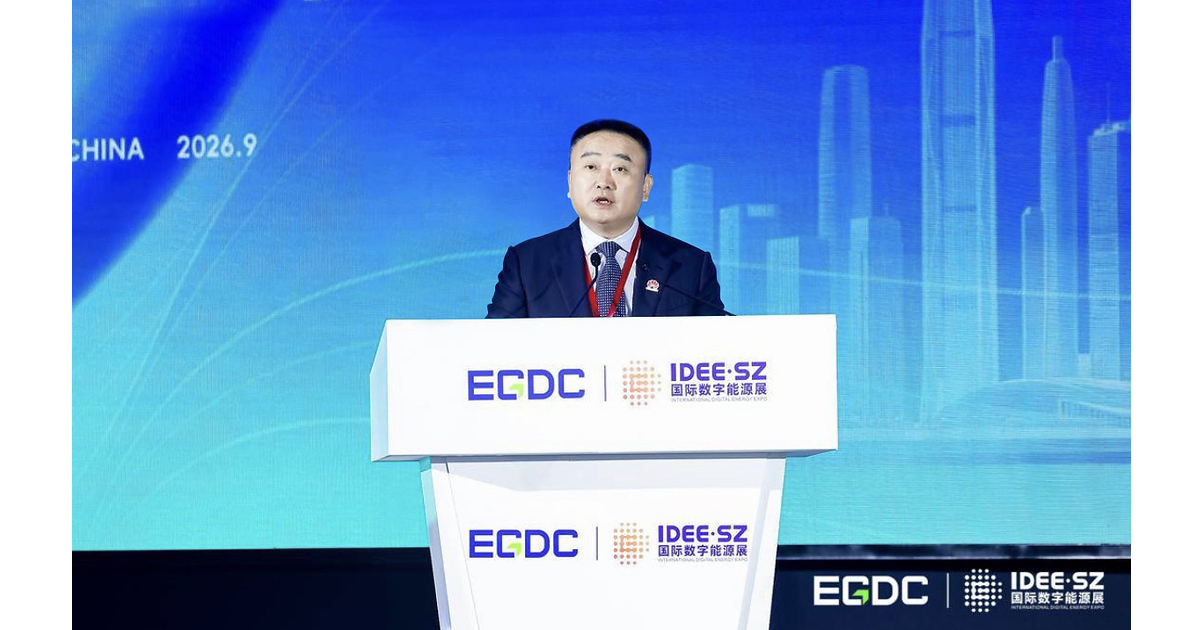
Huawei unveiled a grid-interactive AI data center (AIDC) solution designed to maximize tokens per watt as AI campuses scale from megawatts toward hundreds of megawatts and gigawatt capacity. The end-to-end "3+1" architecture integrates grid-forming power systems and energy storage, high-density liquid cooling, AI-enabled operations, and prefabricated deployment to improve resilience, efficiency and construction speed. Huawei positions AIDCs as grid-supporting assets able to operate through weaker grids and volatile renewable-energy supply, but the announcement provides no financial targets, customer contracts or revenue outlook.
Analysis
The investable implication is less about Huawei and more about a bottleneck shift: as AI campuses move toward utility-scale loads, interconnection queues, power-quality compliance and cooling-water/thermal design can constrain deployed GPUs more than semiconductor availability. This favors vertically integrated data-center power and thermal vendors—ETN, VRT and PWR—whose value proposition is shortening commissioning timelines and protecting utilization, rather than simply selling commodity electrical equipment. Utilities with large, firm generation footprints and established transmission rights—CEG, VST and NRG—also gain negotiating leverage where hyperscalers need power delivery certainty.
Near term (1-3 months), this is not independently verifiable enough to support a Huawei-specific signal; it is a promotional product announcement and Huawei is not directly investable in U.S. public markets. The actionable read-through is that grid-forming storage and liquid cooling become increasingly bundled into AI capex, raising content per MW but potentially pressuring standalone UPS and conventional HVAC suppliers without credible high-density roadmaps. Watch AI data-center project announcements for disclosed MW, interconnection dates and on-site generation/storage commitments: these are better indicators of revenue conversion than token-efficiency claims.
Contrarian risk: markets may overcapitalize suppliers before projects clear utility studies and financing. If grid constraints delay energization, VRT/ETN equipment backlog can extend but revenue recognition slips; power producers may also face regulatory scrutiny over preferential contracts and retail-rate impacts. The thesis is falsified if hyperscalers materially reduce capex, if liquid-cooling attach rates fail to rise in vendor order commentary, or if utility interconnection timelines stop lengthening despite accelerating announced AI capacity.
AllMind Terminal
AI-powered research, real-time alerts, and portfolio analytics for institutional investors.
Request TrialMarket Sentiment
Overall Sentiment
moderately positive
Sentiment Score
0.42
Key Decisions for Investors
- Maintain a 6-18 month overweight in VRT and ETN versus a broad industrial proxy (short XLI) on rising electrical-distribution and thermal-management content per AI MW; enter on 8-12% pullbacks rather than chase announcement-driven strength. Exit the relative trade if either company cuts data-center backlog/conversion guidance or hyperscaler capex guidance turns down.
- Build a basket long CEG/VST with a 12-month horizon, sized modestly against regulatory risk, as firm-power scarcity should improve contract economics for AI loads. Prefer names disclosing incremental contracted load, duration and price floors; avoid treating announced campus MW as contracted demand.
- Use PWR as a watch-list long rather than an immediate recommendation: initiate only after evidence that transmission/interconnection work is converting to awarded projects, not merely utility planning. A meaningful rise in working-capital needs without corresponding backlog conversion would invalidate the timing thesis.
- Avoid a directional trade in Huawei-linked claims. Set an alert for major U.S. UPS/HVAC vendors reporting lost high-density share or falling conventional-product margins; that would create a potential short opportunity only with company-specific order and margin evidence.
More News
- Bank of Japan raises interest rates to 31-year high, flags concerns over inflation
- Italy to deploy warships to protect shipping through Bab al-Mandeb
- Oil prices fall as Saudi supply hopes outweigh fresh Houthi strikes
- Oil prices fall for 3rd day as supply concerns ease, diplomacy in focus
- Oil Traders Stymied by Iran War Stalemate: Evening Briefing Americas
- Saudi Pivots Oil Routes After Pipeline Attack