
JAGUAR URANIUM REPORTS RARE EARTH OXIDES ASSOCIATED WITH URANIUM-PHOSPHATE-VANADIUM MINERALIZATION AT THE BERLIN ASSET IN COLOMBIA
Source: PR Newswire
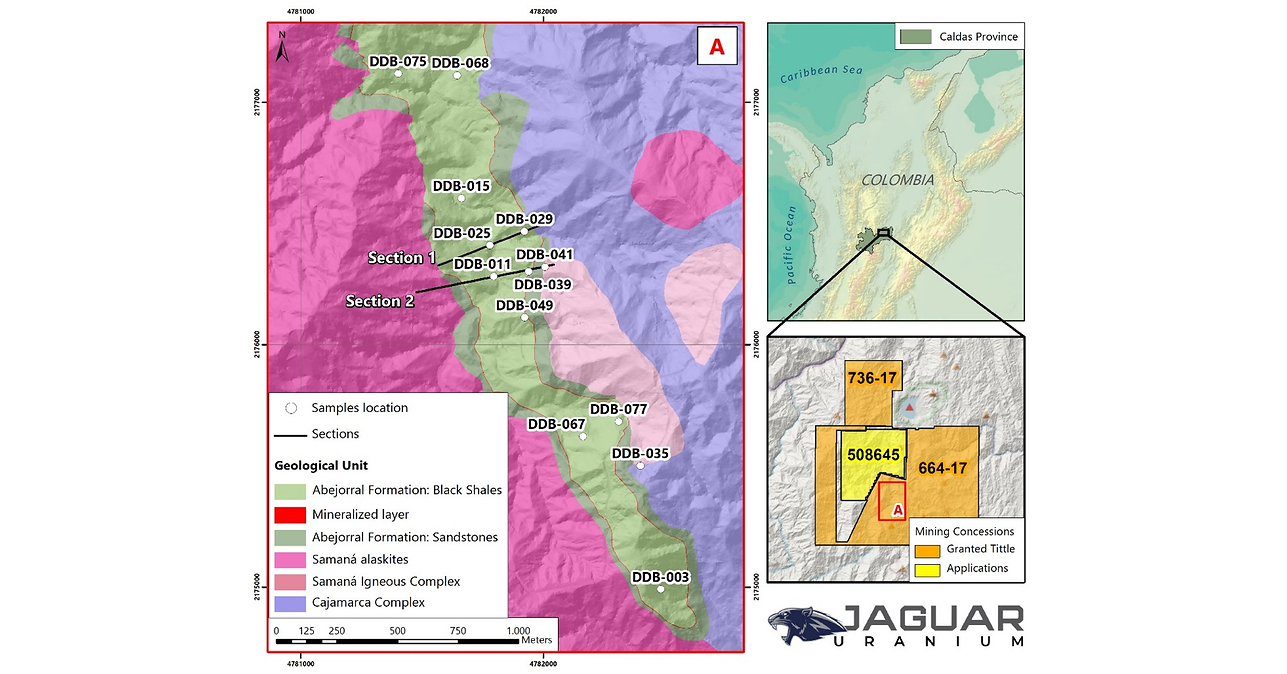
Jaguar Uranium reported selected historical-core resampling assays at its Berlin project in Colombia of up to 3,570 ppm TREO (0.357%) and 607 ppm magnet rare earth oxides over 0.63 m, alongside uranium, vanadium and phosphate mineralization. Other selected intervals included 2,267 ppm TREO over 1.53 m and 2,532 ppm over 0.50 m, supporting the project's polymetallic critical-minerals potential. The results remain early-stage exploration data—not a resource or reserve—with true widths, continuity, recovery and economic viability yet to be established; Jaguar plans further drilling, trenching and geophysics.
Analysis
JAGU’s likely near-term move is promotional rather than NAV-driven: the data are selectively sampled, narrow, lack true-width and continuity evidence, and do not establish recoveries or a resource. A polymetallic assemblage can reduce value rather than add it if uranium/vanadium/phosphate create complex separation, radioactive-tailings, permitting, and capex burdens; magnet-REE content only carries strategic value if metallurgy produces a saleable separated product. The relevant valuation inflection is not assay grade but a systematic drill program demonstrating thickness/continuity plus bench-scale recovery and a credible financing path.
The U.S.-Colombia framework may improve the probability of grant, DFC/EXIM, or strategic-partner interest over 6-18 months, but it does not compress the usual exploration-to-development timeline. Colombia jurisdiction adds a material discount through permitting, community/social-license, infrastructure, and policy risk; this makes JAGU a higher-beta expression of uranium/critical-mineral sentiment than a clean rare-earth substitute. Established Western ex-China supply-chain beneficiaries—MP, UUUU, and LYSCF—retain the scarcity premium because they are materially closer to separations or production economics.
Contrarian view: a sharp retail re-rating in JAGU could be self-limiting. Adding multiple commodities may broaden the investor audience, but investors may ultimately apply a conglomerate discount absent evidence that co-products can be recovered economically; uranium is the only commodity with a potentially established project pathway. SGSN has negligible read-through: laboratory validation supports analytical credibility but creates no meaningful earnings sensitivity.
Over the next days, monitor volume, financing disclosures, and whether management specifies systematic follow-up drilling rather than additional selected-core releases. Over 1-3 months, the key catalyst is a funded program with disclosed meterage, assay cadence, metallurgy, and resource timeline; absent this, the stock is vulnerable to a fade after the initial thematic reaction. Thesis is falsified positively by broad, continuous intercepts and recoveries supporting a defined concentrate/separation route; negatively by a discounted equity raise, weak step-out results, or permitting/access delays.
AllMind Terminal
AI-powered research, real-time alerts, and portfolio analytics for institutional investors.
Request TrialMarket Sentiment
Overall Sentiment
mildly positive
Sentiment Score
0.32
Ticker Sentiment
Key Decisions for Investors
- Do not initiate a fundamental long in JAGU on this release alone; treat any 1-5 trading-day liquidity-driven spike as a watch-for-fade event unless management simultaneously discloses funded systematic drilling and metallurgy. Exploration-stage dilution risk is the dominant downside.
- For critical-minerals exposure over 6-18 months, prefer MP or UUUU over JAGU: both offer clearer U.S. strategic-supply-chain optionality and materially more identifiable operating catalysts. Reassess relative value if JAGU publishes continuity, recovery, capex, and permitting milestones.
- For a high-risk catalyst sleeve only, consider a small JAGU position after financing terms and drill-plan scope are known, sized as venture exploration capital; exit on a material discounted financing or if follow-up drilling fails to show mineable thickness/continuity. Target risk/reward should require at least 3:1 given binary technical and jurisdictional risks.
- Set alerts for: a resource-estimate timeline, independent metallurgical testwork, U.S./Colombian funding or offtake commitments, and cash runway. None of the strategic-policy narrative should be capitalized into NAV until one of these converts into project funding or de-risking.
More News
- Oil prices jump after Yemen’s Houthis claim attacks on Saudi facilities
- Saudi, Turkish, Pakistani chiefs plan urgent talks amid Yemen fighting
- US 30-Year Yield Hits Highest Since 2004
- Oil falls amid optimism over potential diplomatic solution to the Iran conflict
- Japan approval, a 27% surge: the diagnostics stock our models picked in September
- Trump Versus Xi: How Their High-Stakes Summits Compare
From AllMind Research
- Anthropic IPO Preview: Valuation, Timing, and What to Watch
- Shein After the IPO: Venue, Valuation, and What Must Be Proved
- What AI Research Tools Should a Small Hedge Fund Buy First?
- Capital IQ Alternatives for Research and Deal Work
- Research Workflows, Report Format Selection, and Interactive Synthesis