
DTEN D7X AI Board Achieves Microsoft Teams Certification, Bringing Room-Aware AI to Hybrid Meetings
Source: PR Newswire
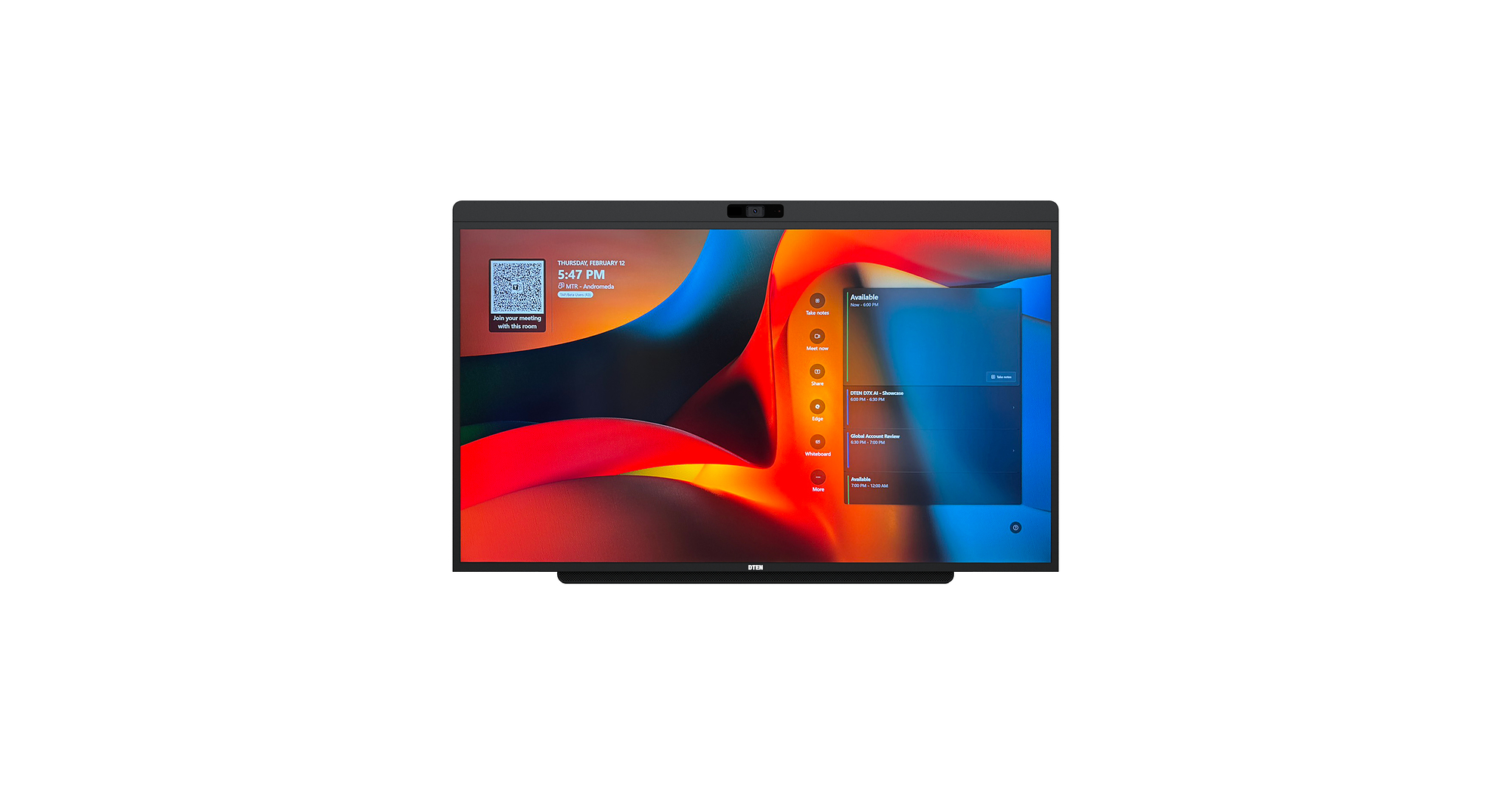
DTEN launched its 55-inch D7X AI Board worldwide with Microsoft Teams Rooms on Windows certification, integrating on-device room-aware AI for individual participant framing, 3D room mapping, and speaker-focused audio. The device includes a 48MP camera, dual depth sensors, a 15-element beamforming microphone array and a 4K touch display, while supporting Microsoft Intune, Autopilot and DTEN Orbit management tools. The 75-inch model's Teams certification is expected to follow; pricing was not disclosed.
Analysis
This is strategically supportive of Microsoft’s Teams Rooms ecosystem but immaterial to MSFT revenue or near-term estimates. The more relevant mechanism is endpoint quality: improved speaker attribution and transcription can raise realized utility of Copilot/Teams AI, potentially reducing seat-level churn and supporting premium SKU attach in meeting-heavy enterprise accounts. That benefit will be diffuse across a fragmented hardware base, not attributable to a single device vendor.
The competitive read-through is modestly negative for incumbent Teams-room hardware vendors whose differentiation rests on basic camera/microphone specifications rather than certified AI software integration—most notably Logitech (LOGI), HP (HPQ/Poly), and Yealink’s private-channel equivalents. However, certification is a distribution prerequisite, not evidence of enterprise demand; procurement cycles, channel inventory, and total installed-base replacement budgets matter far more than feature claims over the next 1-3 months.
Consensus may overstate the hardware refresh implication from AI meeting features. Enterprises can obtain much of the perceived value through software updates, add-on cameras, or existing Teams-certified devices, while full-board replacements remain constrained by workplace-utilization uncertainty and IT capital budgets. A durable upgrade cycle requires evidence that AI-enabled rooms improve meeting outcomes enough to unlock incremental Copilot licenses, rather than simply cannibalizing spend within collaboration hardware.
For MSFT, monitor Teams Rooms device activations, Copilot commercial seat growth, and Copilot ARPU commentary over the next two earnings cycles. The thesis strengthens only if management identifies meeting workflows as a measurable driver of Copilot adoption; it is falsified if Copilot growth remains concentrated in developer and desktop productivity use cases while collaboration-device demand stays promotional.
AllMind Terminal
AI-powered research, real-time alerts, and portfolio analytics for institutional investors.
Request TrialMarket Sentiment
Overall Sentiment
mildly positive
Sentiment Score
0.35
Ticker Sentiment
Key Decisions for Investors
- No standalone MSFT trade on this release; retain existing MSFT exposure only. Treat this as a qualitative confirmation of ecosystem breadth, not an earnings catalyst, over the next 1-3 months.
- Watch LOGI relative to MSFT and the broader hardware basket through the next two quarters: consider a tactical short only if management cites Teams-room pricing pressure, channel inventory growth, or gross-margin compression. Without those data points, certification-driven disruption is insufficient.
- Set an earnings-call alert for MSFT disclosures linking Teams meeting AI to incremental Copilot Commercial seats or higher ARPU. A verifiable acceleration in Copilot attach would support adding to MSFT on post-results weakness; absent that disclosure, avoid assigning a valuation premium to room-hardware AI.
- For a broader enterprise-AI expression, prefer MSFT over pure collaboration-hardware exposure on a 6-18 month horizon: software monetization has materially better gross-margin and recurring-revenue economics, while endpoint vendors bear replacement-cycle and component-cost risk.
More News
- Crusoe raises $3.9B to build massive data centers and small modular “AI factories”
- Warsh says AI’s hyperscalers are part of why your borrowing costs are rising: ‘The competition for capital is real’
- AI coding agents' 0-click RCE flaw could hand attackers keys to the kingdom
- Goldman’s top strategist just added hard numbers to his earnings-bubble warning
- OpenAI, Microsoft executives’ quotes on AI training threaten copyright defense, news outlets argue
- One cybersecurity stock has lagged of late. Jay Woods says the charts are now turning bullish
From AllMind Research
- Anthropic IPO Preview: Valuation, Timing, and What to Watch
- Shein After the IPO: Venue, Valuation, and What Must Be Proved
- What AI Research Tools Should a Small Hedge Fund Buy First?
- Index and ETF Holdings Data for AI Research
- Capital Intensity as Gravity: The AI Trade Enters Its Industrial Era (Looking at Q3 2025 Earnings in Tech)