
HUMAIN Unveils humain-m3, a Frontier Arabic Language Model Developed by MiniMax, in Research Preview on HUMAIN Node
Source: PR Newswire
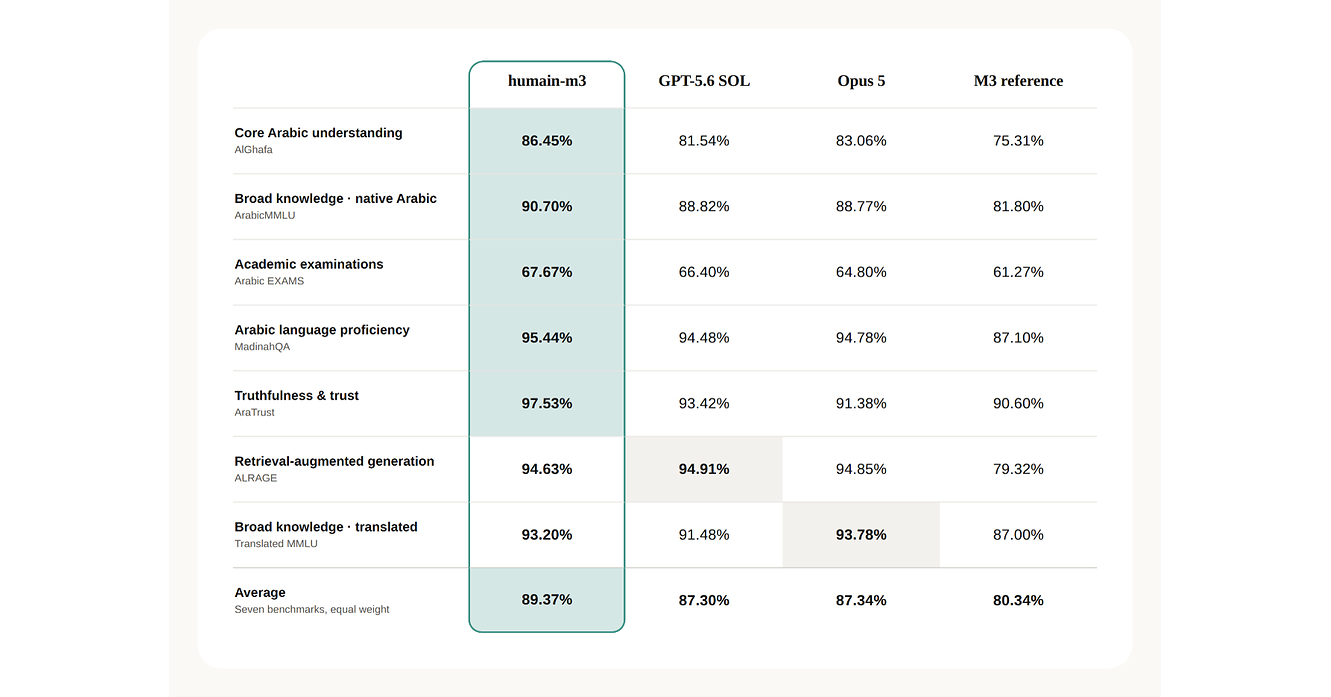
HUMAIN (PIF) launched humain-m3, a 428B-parameter mixture-of-experts frontier Arabic-language model, built on MiniMax-M3 and further pre-trained on 1T+ Arabic tokens. In evaluations across seven public Arabic benchmarks, it reported the highest average score among tested frontier models. The model is available today in research preview via HUMAIN Node, with a planned open-weight release next month after safety training and alignment.
Analysis
This reads more like a strategic signaling event than a near-term earnings catalyst. The economic value is not the model itself; it is whether HUMAIN Node can become a gated distribution layer that captures enterprise inference, identity, and workflow spend in Arabic markets. If that happens, the beneficiaries are less the model vendors and more the infrastructure stack behind them: connectivity, cloud, data-center power, and GPU supply.
The second-order implication is competitive localization pressure. A sovereign-backed Arabic model can lower switching costs for government and regulated-enterprise buyers in the Gulf, which may marginally displace generic frontier APIs in language-specific workloads. But the open-weight path also weakens the moat: once weights are released, differentiation shifts from benchmark scores to integration, latency, and compliance, where U.S. hyperscalers and incumbents still have an advantage.
Near term, the move is mostly narrative-positive for AI sentiment in the MENA region, but financially unproven. Over 1-3 months, the key catalyst is whether HUMAIN discloses enterprise adoption, Node traffic, or a broader procurement framework; without that, this is just a capability demo. Over 6-18 months, the real tell will be whether Saudi AI capex expands into sustained procurement of compute, networking, and power infrastructure, or whether local-model launches remain branding exercises.
The contrarian view is that consensus may be overestimating product launch significance and underestimating monetization friction. Arabic-language performance wins do not automatically convert into recurring revenue, and the addressable market is narrower than broad enterprise AI narratives suggest. The thesis would be falsified if Node adoption remains shallow, the open-weight release creates rapid commoditization, or public-sector budgets do not translate into follow-on infrastructure spend.
AllMind Terminal
AI-powered research, real-time alerts, and portfolio analytics for institutional investors.
Request TrialMarket Sentiment
Overall Sentiment
moderately positive
Sentiment Score
0.35
Key Decisions for Investors
- No direct trade in WWRL/HUMAIN from this release alone; treat as a watch item until there is evidence of paid Node usage, not benchmark leadership.
- Set an alert on NVDA, ANET, and VRT for any follow-on Saudi/Gulf capex announcements over the next 1-3 months; buy only if this turns into measurable compute procurement, not PR.
- For AI-exposure baskets, favor long hyperscaler/infrastructure exposure on any MENA AI-capex confirmation versus pure model/theme names; the monetization is more likely in pipes than in the model layer.
- If HUMAIN announces enterprise conversion metrics or a sovereign procurement framework, consider a short-dated bullish basket trade in AI infra on the premise that regional demand can extend into 2H26 capex plans.
- Falsifier: if no commercial rollout metrics appear by the expected open-weight release next month, fade the event as a marketing catalyst and avoid chasing the AI headline trade.
More News
- AI stocks plunge. Inflation heats up. Where we're still finding opportunities
- Bending Spoons wants to revive software castoffs. Berkshire is backing the plan
- AI rapidly improving, could vastly boost U.S. GDP, Anthropic's Clark tells policymakers
- ‘How many canaries have we killed in the coal mine?’ — Wall Street debates if the latest AI bubble warnings are another head fake or the real thing
- Semiconductor market to remain solid ‘at least through next year,’ South Korea finance minister says
- Nasdaq Index: AI Selloff Deepens as Chips and CoreWeave Break
From AllMind Research
- Anthropic IPO Preview: Valuation, Timing, and What to Watch
- Shein After the IPO: Venue, Valuation, and What Must Be Proved
- What AI Research Tools Should a Small Hedge Fund Buy First?
- What Exactly Does Post-Training in LLMs and Finance-Focused AI Actually Mean for Asset Managers?
- What Is a Financial Ontology?