
Pudu Robotics präsentiert die PUDU GT-Serie und intelligente Lösungen für die Grünflächenpflege auf der GaLaBau 2026
Source: PR Newswire
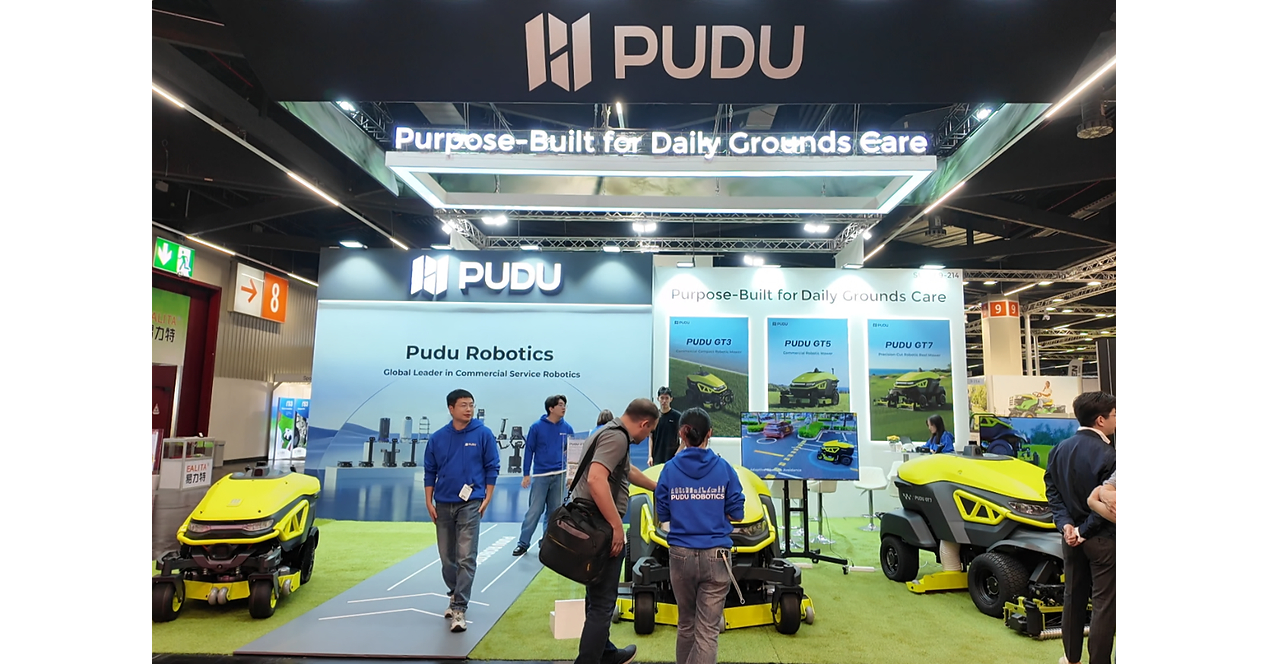
Pudu Robotics showcased its newly launched PUDU GT commercial autonomous lawnmower series at GaLaBau 2026, marking the product line's first in-person global debut. The three-model range targets compact sites (GT3), large commercial lawns with a 60-inch/152cm cutting width (GT5), and precision turf such as golf and sports fields with a 62-inch/160cm reel system (GT7). The launch expands Pudu's service-robotics portfolio into commercial outdoor maintenance, with the next international display planned for Australia's ISSA Cleaning & Hygiene Expo in October.
Analysis
This is not yet a revenue-revision event for public equities: Pudu is private, and a trade-show launch provides no evidence on unit economics, channel commitments, pricing, or fleet reliability. The relevant public read-through is modestly negative for established professional-turf OEMs—Toro (TTC), Deere (DE), Husqvarna (HUSQ-B.ST), and Kubota (6326.T)—because autonomy shifts value from hardware replacement cycles toward software, remote fleet management, and service-network uptime. The most exposed category is premium commercial mowing, where labor scarcity allows autonomous systems to command a payback-based price rather than a conventional equipment multiple.
Near term, the likely effect is competitive narrative pressure rather than share loss. Over 1-3 months, watch whether distributors and grounds-management contractors disclose pilot orders, particularly in Europe and Australia; meaningful adoption would require evidence that autonomous operations reduce labor cost after supervision, insurance, maintenance, and site-mapping expenses. Over 6-18 months, TTC and HUSQ-B.ST face the greater strategic risk if low-cost Asian robotics vendors establish dealer service capacity, while DE is comparatively insulated by its broader precision-agriculture ecosystem and financing relationships.
The contrarian view is that commercial outdoor autonomy has materially harder operating conditions than indoor cleaning or delivery robotics: uneven terrain, weather, theft, debris, safety liability, and fragmented work sites can make claimed labor savings non-transferable. Incumbents retain an advantage where fleet uptime and local parts availability matter more than initial machine cost. The thesis turns more negative for incumbents only if Pudu or peers publish independently verifiable multi-site utilization data, recurring software revenue, and distributor-backed service coverage rather than demonstrations.
AllMind Terminal
AI-powered research, real-time alerts, and portfolio analytics for institutional investors.
Request TrialMarket Sentiment
Overall Sentiment
mildly positive
Sentiment Score
0.32
Key Decisions for Investors
- No immediate directional trade: treat this as a competitive-intelligence alert, not a catalyst, because there are no disclosed prices, orders, margins, or public-company revenue exposure.
- Monitor TTC and HUSQ-B.ST through the next two earnings cycles for autonomous-equipment order commentary, commercial-turf gross-margin pressure, or incremental dealer incentives. A confirmed guidance cut tied to robotic competition would support a 3-6 month short bias; absent that, valuation risk is not sufficiently isolated.
- Maintain DE as the relative-quality hedge within outdoor automation exposure: if commercial autonomy adoption broadens, favor long DE versus short HUSQ-B.ST only after evidence of contractor adoption, since DE's precision platform, dealer network, and financing franchise should support a higher resilience multiple.
- Set a diligence trigger for disclosed fleet economics: pursue a bearish incumbent basket only if third-party data show sub-24-month customer payback and sustained autonomous utilization above 70% across seasons. Failure to demonstrate these metrics by the 2027 mowing season would falsify the near-term disruption case.
More News
- Taiwan benchmark Taiex rises to record intraday high as tech stocks advance
- AMD joins the $1 trillion club as chip rally surges - our AI Strategy saw it early
- Jamie Dimon says hyperscaler AI spending could hit $1 trillion next year
- Factbox-Key issues for this week’s Trump-Xi summit in Washington
- Latest Oil Market News and Analysis for Sept. 22
- Oil Settles Near $100 as Hormuz Flows Stunt Rally