
New Book Introduces "Operational Modernization," a Management Discipline for the AI Era
Source: PR Newswire
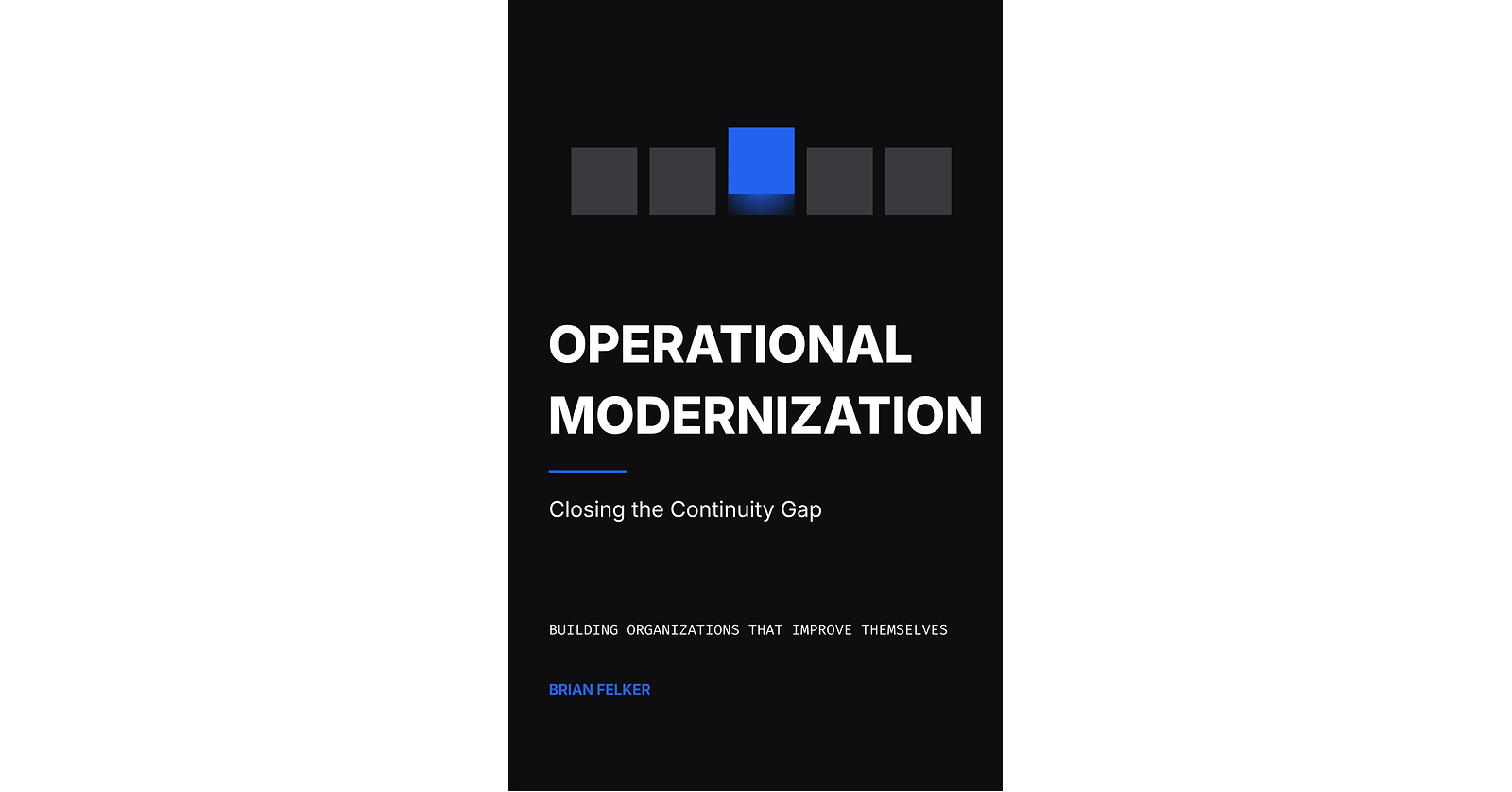
Brian Felker (The Growth Nerd) announced publication of Operational Modernization: Closing the Continuity Gap, arguing AI exposes cross-functional “Continuity Gap” issues where ownership and information fragment across functions. The book proposes a management discipline extending Kaizen/Lean/Six Sigma/Agile to digital, cross-functional work and introduces concepts like “Human Middleware” and “Operational Debt.” No financial results or policy actions are reported, suggesting limited near-term market impact.
Analysis
This is more of a narrative catalyst than a tradable event: it reinforces a theme the market already partially owns, namely that enterprise AI monetization will be bottlenecked by workflow integration rather than model quality. In the near term, that is mildly supportive for horizontal workflow and orchestration vendors like NOW, WDAY, CRM, and ACN/EPAM-style implementation spend, because the first budget dollars tend to go to cleaning up process sprawl before firms can scale agents. The second-order effect is less favorable for “AI demo” vendors that rely on top-down enthusiasm without proving measurable cycle-time or headcount savings.
The real economic signal would be in procurement behavior over the next 1-3 quarters: if management teams start framing AI as an operating-model redesign problem, consulting and systems integrators should see longer deal cycles but larger multi-year transformations. That creates a better revenue mix for vendors embedded in systems of record and ticket/workflow layers, while pure-play point solutions risk being squeezed if CIOs demand proof that automation removes work rather than accelerates broken work. AMZN is essentially noise here except for trivial Kindle/media distribution.
Contrarian view: the market may be over-indexing on AI spend intensity and underpricing the organizational friction required to capture ROI. If the thesis is right, the winners are not the biggest model owners but the firms that reduce "human middleware" and operational debt—yet that benefit likely accrues gradually over 6-18 months, not on this press cycle. What would falsify it is continued evidence that enterprises are buying copilots without reengineering processes, or any slowdown in workflow/software budgets despite AI pilots proliferating.
AllMind Terminal
AI-powered research, real-time alerts, and portfolio analytics for institutional investors.
Request TrialMarket Sentiment
Overall Sentiment
neutral
Sentiment Score
0.05
Key Decisions for Investors
- No immediate trade in AMZN or AERA; this is not a revenue-bearing catalyst. Treat as a watch item only unless Amazon AI/workflow commentary on the next earnings call shows measurable attach-rate improvement.
- Build a small long basket in workflow/integration names like NOW and WDAY versus short-duration AI hype exposure over 1-3 months. Risk/reward: limited downside if enterprise spend stays steady; upside if CIOs shift from pilots to process redesign.
- Pair long ACN/EPAM against short a basket of low-moat AI point-solution proxies over 3-6 months. Thesis: the first monetization wave goes to implementation and systems integration, not standalone AI wrappers.
- Set an alert for NOW/CRM/WDAY earnings language around 'automation,' 'agentic workflow,' and 'process redesign.' If those themes fail to convert into bookings or net retention improvement, fade the trade.
- If you want a lower-risk expression, wait for 1-2 quarterly data points before buying any secular AI workflow exposure; the catalyst path here is slow and the article itself is not a sentiment shock.
More News
- TSMC chip capacity is ‘fierce’ battleground for AI customers, amid record quarter
- Nvidia’s European spending spree is about much more than Europe
- Here's our monthly update on our 32 stocks, including 2 more names to buy
- AWS, Anthropic race to deploy army of specialized engineers key to proving AI spending will pay off
- Cost of AI default insurance spikes as data centre confidence wobbles
- Skydance’s merger exposes a gap between what pays for media and what democracy needs