
PepsiCo plans to raise prices on sodas, chips and dip — and that has Wall Street worried
Source: MarketWatch
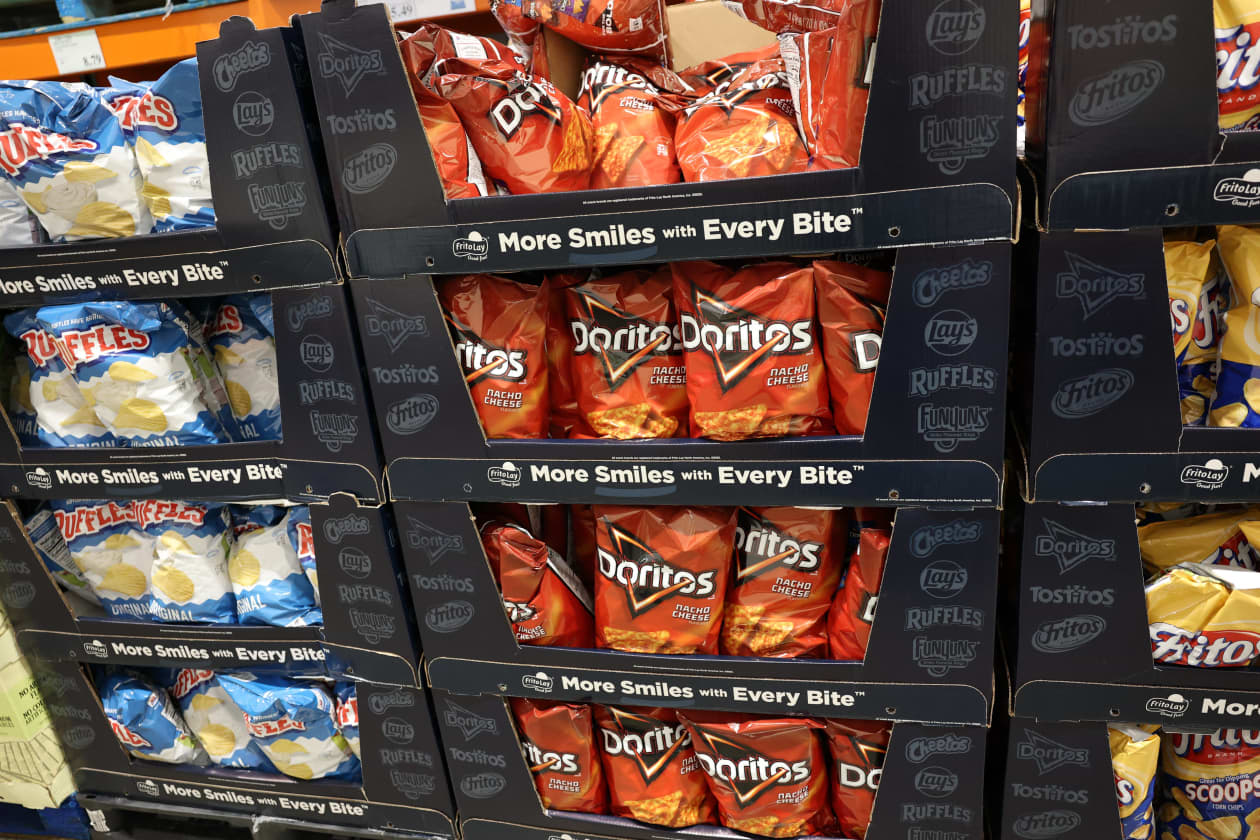
PepsiCo plans to raise prices on selected sodas, chips and dips after cutting prices earlier in the year, prompting analyst concerns that its shifting affordability strategy could pressure consumer demand. Deutsche Bank downgraded PEP to Hold and lowered its price target, while TD Cowen reduced its 2026 and 2027 profit estimates. The development is a negative for PepsiCo’s near-term earnings outlook and likely investor sentiment toward the stock.
Analysis
The investable issue is not a single pricing action but evidence that PEP lacks a stable price/volume algorithm in its mature North American categories. Repeated changes to affordability architecture can train consumers and retailers to delay purchases or demand promotional support, raising the probability that net price realization falls below list-price increases. That would pressure both organic-sales credibility and gross-margin leverage over the next 1-3 quarters, while investors are unlikely to reward a defensive-staples multiple for revenue growth perceived as price-led but volume-fragile.
Second-order risk sits with retailer negotiations and private-label substitution. Walmart (WMT), Costco (COST), and grocery channels have greater leverage when branded suppliers need to restore elasticity-sensitive volumes; the likely outcome is more trade spend, unfavorable pack mix, or shelf-space concessions rather than clean realization. Competitors with comparatively stronger value positioning or less exposure to discretionary snacking, including Kellanova (K) and Mondelez (MDLZ), could gain share at the margin, although the category-wide signal is also a warning that consumer packaged-goods pricing power is normalizing.
Near term, estimate cuts and a reduced willingness to underwrite a volume recovery are the primary downside catalysts; the next earnings release must show volume/mix stabilization without a material step-up in promotional expense. Over 6-18 months, PEP can still defend cash flow through productivity and its beverage/snack distribution system, but the structural risk is that affordability investments become permanent, reducing the margin floor investors have assumed. The contrarian case is that targeted pack-price changes improve mix rather than impair elasticity; that requires independently visible scanner-data improvement, not management commentary.
A deterioration in measured volume trends, increased retailer inventory, or guidance that relies more heavily on price would validate the bearish thesis. Conversely, two consecutive quarters of improved North American volume with stable gross margin would falsify it and justify covering a relative short.
AllMind Terminal
AI-powered research, real-time alerts, and portfolio analytics for institutional investors.
Request TrialMarket Sentiment
Overall Sentiment
moderately negative
Sentiment Score
-0.42
Ticker Sentiment
Key Decisions for Investors
- Initiate a 1-3 month relative-value position: short PEP / long XLP, sized modestly. This isolates PEP-specific execution and estimate-revision risk from broad staples defensiveness; cover if PEP reports volume stabilization with no gross-margin giveback.
- For a more fundamental pair, short PEP / long MDLZ over 3-6 months, subject to confirming relative valuation and North American scanner data. The thesis is that PEP's snack-price elasticity and promotional risk are greater; principal risk is a broad packaged-food demand rebound that lifts PEP disproportionately.
- Avoid treating the downgrade cycle as sufficient reason to short DB; the available information creates no direct earnings mechanism for the bank. No standalone DB trade is indicated.
- Set an event watch on PEP's next earnings release: add to the relative short only if North American convenient-food volume remains negative while price/mix and promotional spending rise. If volume improves and gross margin holds, close the position rather than averaging down.
More News
- Nvidia says it can keep AI models under control — plus, what to do about Boeing's dip
- Bank of America says to scoop up shares of this cruise line operator at a discount
- Apple, Microsoft, and Meta prove stock picking for individuals is not a fool's errand
- Jim Cramer's top 10 things to watch in the stock market Monday
- Boeing 737 Max 10 certification delayed by software issue, FAA says
- Apple ordered to pay $5.7bn in patent infringement case