
Proprioceptive AI Outlines Roadmap for Model Interpretability and Targeted Adaptation
Source: PR Newswire
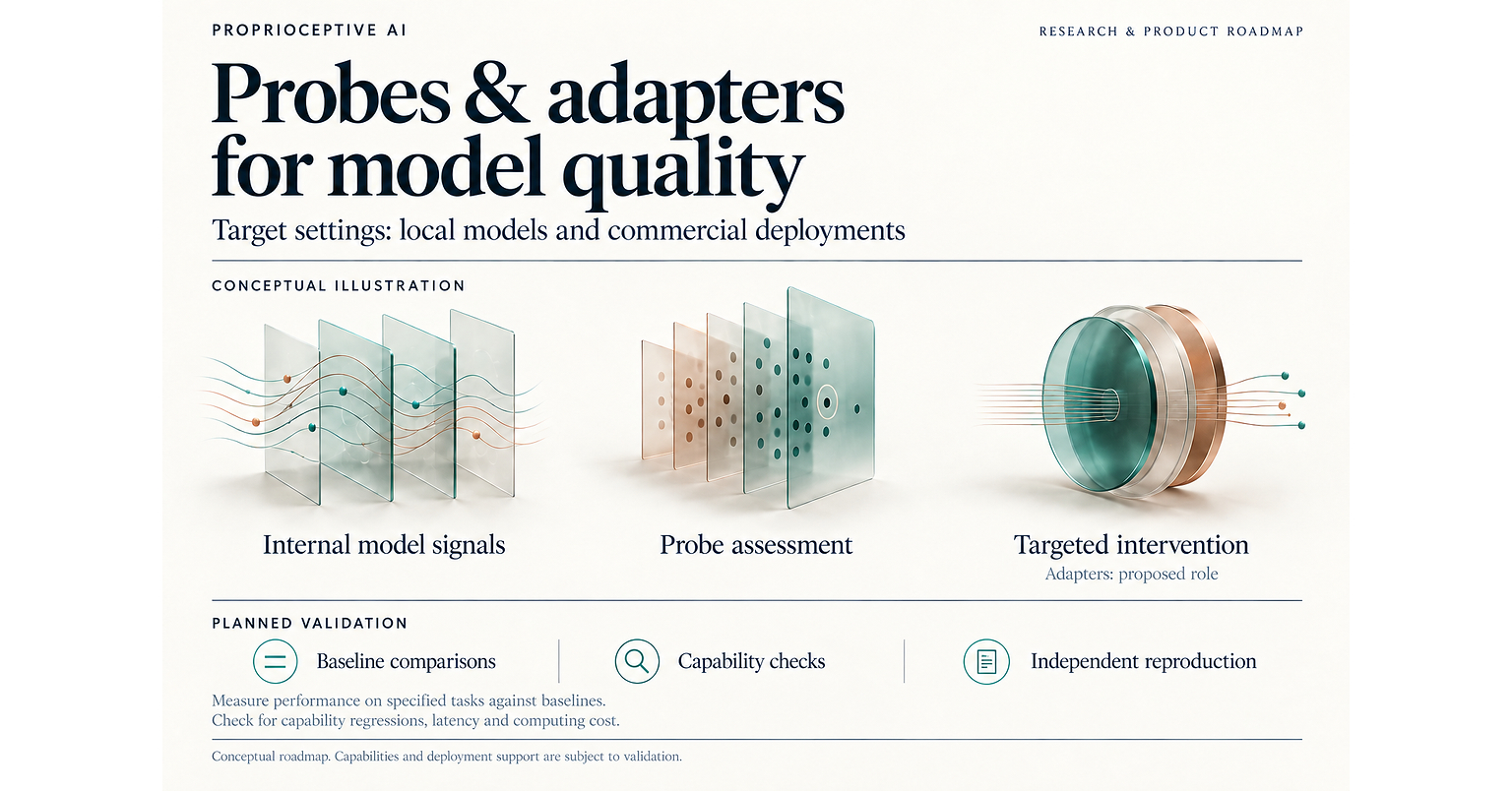
Proprioceptive AI said its operational V1 system reduced confident-but-wrong model outputs by 85.8% in defined internal tests, supporting its push toward independent scientific validation and commercial deployment. The company is developing model-state probes and targeted adaptation tools for local-model users and commercial AI clients, while pursuing patent prosecution and investor preparation with Castle Placement. The result remains internally reported and requires external reproduction and broader evaluation before commercial performance can be validated.
Analysis
This is not investable public-market information today: the claimed performance improvement lacks an external benchmark, model mix, baseline methodology, error taxonomy, and evidence that interventions generalize across architectures or persist after model updates. The principal near-term valuation effect is therefore confined to private fundraising optionality, not to listed AI infrastructure, software, or hyperscaler earnings.
If independently replicated, the economic value would be greatest where model errors create costly human-review loops: regulated enterprise deployments, customer support automation, coding agents, and local-model inference. A tool that repairs behavior without repeated full fine-tuning could reduce compute and annotation expense, modestly benefiting enterprises deploying open-weight models while potentially weakening the premium attached to proprietary-model quality differentiation at hosted-model vendors. That is a 6-18 month possibility, not a current earnings catalyst.
The key second-order risk is that interpretability workflows become a bundled feature of model platforms rather than a standalone software category. GOOGL, META, MSFT, and AMZN have distribution, model-access, and internal telemetry advantages that could commoditize an independent vendor's probes/adapters; patent filings alone do not establish defensibility, particularly if claims are architecture-specific or vulnerable to prior art. Consensus should treat the announcement as an unverified technical claim rather than evidence of a new AI-safety revenue pool.
AllMind Terminal
AI-powered research, real-time alerts, and portfolio analytics for institutional investors.
Request TrialMarket Sentiment
Overall Sentiment
mildly positive
Sentiment Score
0.30
Key Decisions for Investors
- No new public-equity position on this development; keep it on the private-market watchlist until an independent evaluation discloses model families, benchmark design, false-positive/false-negative tradeoffs, latency, and cost per corrected output.
- For existing long exposure to enterprise AI software, monitor whether major platforms such as MSFT, GOOGL, AMZN, or META introduce native model-diagnostics and targeted-adaptation tooling over the next 6-12 months; broad platform bundling would be more investable than a standalone interpretability vendor.
- Do not short AI application software or buy AI-safety optionality on the premise of disruption. The thesis is falsified as a market mechanism unless external results show reproducible error reduction on commercially relevant workloads and named design partners convert diagnostics into paid deployments.
- Set a diligence alert for patent publication, third-party replication, and a disclosed commercial pilot. A validated reduction in human-review expense or fine-tuning compute of at least 20-30% would justify reassessing beneficiaries among open-model deployment vendors and cloud AI platforms.
More News
- Trump Versus Xi: How Their High-Stakes Summits Compare
- SEBI Allows Portfolio Managers to Invest Overseas, Short Equity Options
- Trump, Xi Address AI, Taiwan During State Visit
- Oracle Japan shares surge 7% after record fiscal first quarter, bucking selloff of U.S. parent
- China's Xi urges U.S. to cooperate on AI
- Akamai secures $11.6B cloud deal with Anthropic for AI workloads