
Kigen Automotive eSIM first to achieve GSMA eSA certification, bringing latest SGP.32 security to connected vehicle OEMs for long-life fleets
Source: PR Newswire
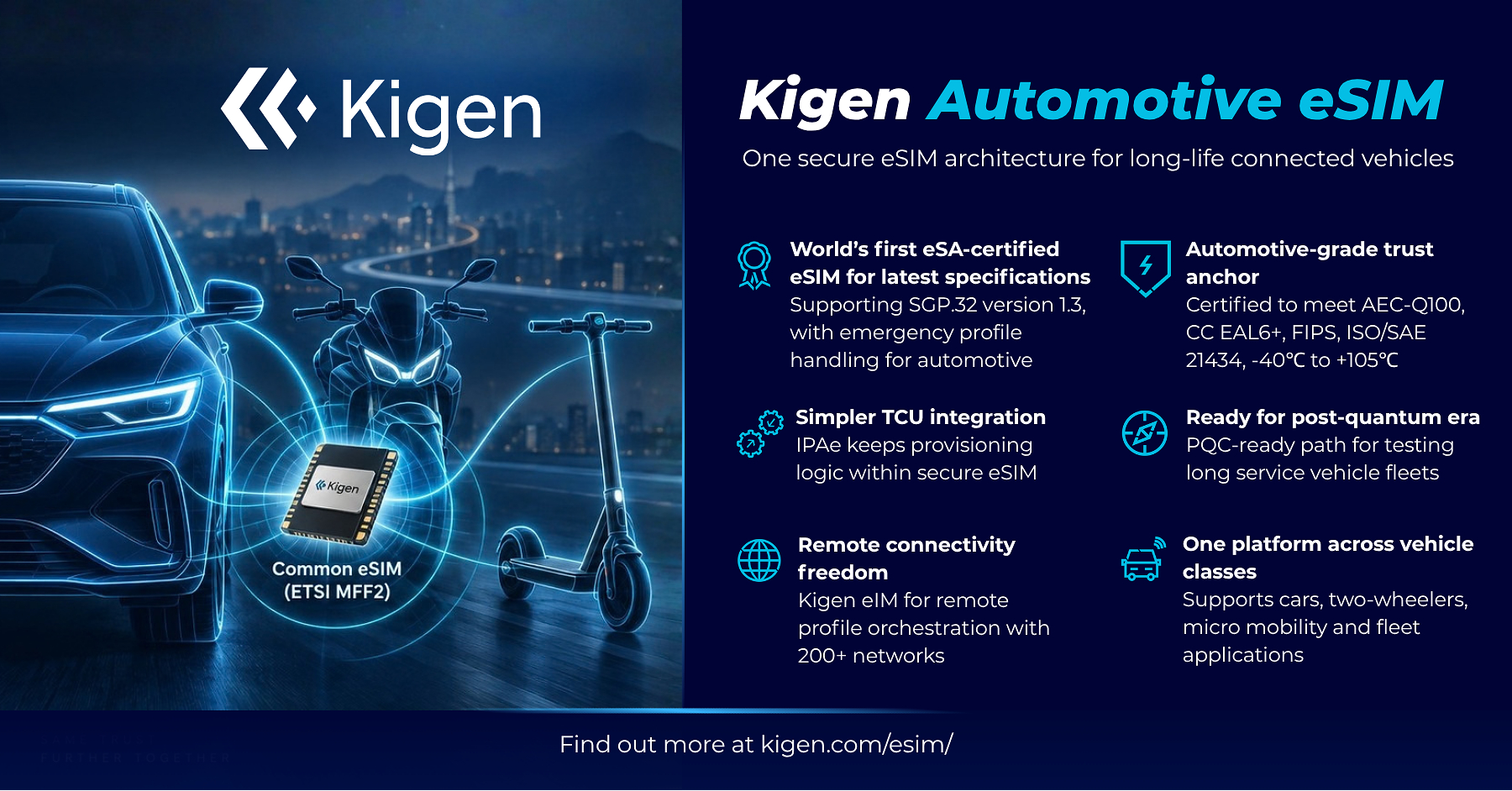
Kigen became the first provider to receive GSMA eSA certification for an automotive eSIM supporting the latest SGP.32 v1.3 IoT specification, using Infineon's TEGRION SLI22 security controller. The platform is designed for connected-vehicle fleets with service lives exceeding 10 years, adding capabilities such as digital activation codes, emergency profiles and optional hybrid post-quantum cryptography testing. Automotive eSIM samples in ETSI MFF2 packaging will be available to OEMs from October 2026, supported by interoperability with more than 20 network providers and 60-plus IoT modules.
Analysis
IFX is the only liquid public read-through, but the near-term revenue impact is likely immaterial: an automotive secure-element design win typically enters qualification cycles before meaningful vehicle production volumes. The strategic value is higher than the initial sales contribution because a common SLI22-based platform across automotive, consumer and industrial products can improve utilization, software/tooling attach, and customer switching costs. If the platform becomes a reference design, IFX gains content exposure not only to telematics modules but potentially to recurring credential-management and security-update ecosystems.
The more consequential competitive pressure falls on secure-element rivals NXP (NXPI), STMicroelectronics (STM) and Thales (HO), whose automotive connectivity offerings must match the newest remote-SIM provisioning standard and long-life compliance posture. However, certification is a procurement gate rather than proof of OEM adoption; OEMs retain leverage through multi-sourcing and module vendors can substitute among qualified secure elements. Kigen is private, so the announcement is not itself a clean valuation catalyst for SBI; its stake is unlikely sufficiently material to alter SBI earnings or NAV.
Over the next 1-3 months, October interoperability results, disclosed module/OEM design wins, and evidence that Chinese OEM deployments convert from samples to nominations are the relevant validation points. The 6-18 month upside is tied to EU cyber-resilience implementation and rising software-defined-vehicle security requirements, which could shift automotive connectivity spend from lowest-cost SIM hardware toward certified lifecycle-management stacks. A delay in SGP.32 operator readiness, OEM preference for integrated modem/eSIM solutions, or a rival certification announcement would weaken any first-mover premium.
Contrarian view: market participants may overvalue the "first" label while underestimating the long automotive validation cycle and the fact that standards-based interoperability limits pricing power. The better signal would be a disclosed production program, module-unit forecast, or evidence of higher ASPs/recurring eIM revenue—not certification alone.
AllMind Terminal
AI-powered research, real-time alerts, and portfolio analytics for institutional investors.
Request TrialMarket Sentiment
Overall Sentiment
strongly positive
Sentiment Score
0.58
Ticker Sentiment
Key Decisions for Investors
- No standalone SBI trade: treat the private-company association as non-material absent disclosed ownership valuation, mark-to-market data, or a financing/liquidity event.
- Maintain IFX on a 3-6 month positive watchlist rather than buying on the release. Upgrade only if IFX identifies automotive design wins, increased secure-controller backlog, or a measurable automotive-security margin/ASP uplift; invalidate on weak automotive order commentary or rival SGP.32 certification.
- For existing IFX exposure, consider a modest IFX/NXPI relative-value long only after OEM nomination evidence emerges. Thesis: IFX captures incremental secure-element content while NXPI has broader auto-cycle sensitivity; exit if the relative spread fails to respond to a confirmed program win or IFX guides automotive inventory correction.
- Monitor October GSMA interoperability testing and the first 2027 OEM sampling-to-production conversions. Until those data arrive, avoid paying a multiple premium for a certification-driven narrative; the event is strategically constructive but not an earnings catalyst.
More News
- Astera Labs vs. Marvell Technology: Which Tech Stock Is a Better Buy in 2026?
- Oil prices jump after Yemen’s Houthis claim attacks on Saudi facilities
- Saudi, Turkish, Pakistani chiefs plan urgent talks amid Yemen fighting
- Oil falls amid optimism over potential diplomatic solution to the Iran conflict
- Trump, Xi Address AI, Taiwan During State Visit
- Japan approval, a 27% surge: the diagnostics stock our models picked in September