
Yealink Brings Global Industry Leaders Together to Shape the Future of AI-Powered Workplaces
Source: PR Newswire
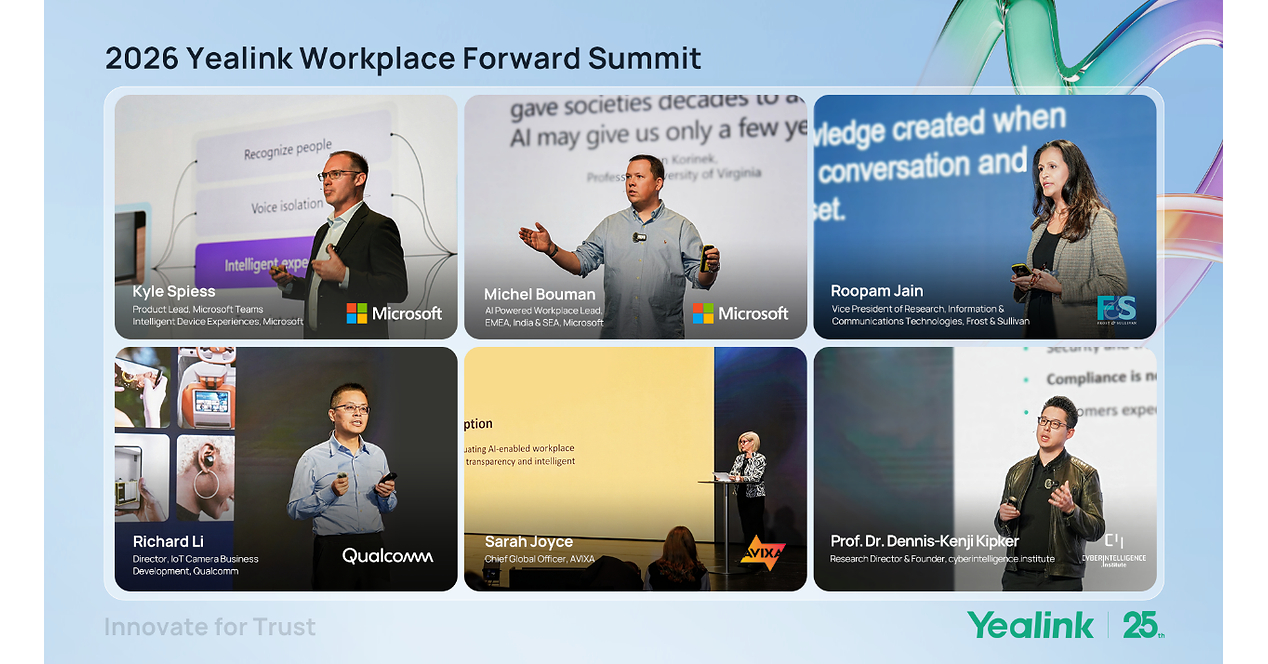
Yealink hosted its Workplace Forward Summit in Munich with 400 participants, showcasing AI-powered workplace solutions and discussing AI agents across room design, deployment, use and maintenance. Frost & Sullivan cited room video device growth of around 15% in the first half of the year. Yealink said revenue CAGR exceeded 19% over the past five years, four times the market average; the article reports no share-price reaction.
Analysis
This is ecosystem positioning, not evidence of a new commercial commitment: Microsoft’s and Qualcomm’s participation does not establish incremental bookings, exclusivity, or product integration. For MSFT, the strategic upside is indirect—if workplace AI is adopted through a managed collaboration platform, control of identity, administration, and workflow could deepen Teams’ enterprise value. The counterweight is that interoperable room hardware makes switching among platform and device vendors easier, limiting any one vendor’s capture. For QCOM, on-device inference could raise silicon content in conferencing devices, but only if workloads migrate onto endpoints at meaningful scale; the article offers no design-win or shipment evidence.
The more exposed economic layer may be standalone room-hardware vendors and labor-intensive integrators: unified deployment and remote management could reduce configuration and service hours per room, while increasing demand for complex integration where legacy estates persist. Yealink’s growth and market-momentum claims are company- and analyst-attributed, not audited evidence of durable share gains or AI monetization. Near term, the event itself is unlikely to change MSFT or QCOM earnings. Over 1–3 months, watch for named product integrations, customer deployments, and guidance or design-win disclosures. Over 6–18 months, the key test is whether AI features support paid upgrades and device refreshes without raising security friction or commoditizing hardware. A slowdown in enterprise room refreshes, weak paid-feature attachment, or security incidents would undermine the adoption thesis.
AllMind Terminal
AI-powered research, real-time alerts, and portfolio analytics for institutional investors.
Request TrialMarket Sentiment
Overall Sentiment
mildly positive
Sentiment Score
0.25
Key Decisions for Investors
- No immediate MSFT or QCOM trade: treat the announcement as ecosystem validation, not a revenue catalyst. Do not infer a partnership or incremental financial contribution without product, contract, or customer evidence.
- Watch MSFT for disclosed Teams Rooms deployments, paid AI-feature adoption, and enterprise collaboration guidance over the next 1–3 months; absent measurable adoption, avoid paying for this event as an AI-growth signal.
- Track QCOM for conferencing-device design wins and evidence that on-device AI increases silicon content. If future disclosures show workloads remaining cloud-hosted or no incremental device demand, the endpoint-AI read-through is falsified.
- Monitor room-device refresh activity and integrator commentary over 6–18 months. A shift toward turnkey management could pressure service-intensive integrators and undifferentiated hardware, while security failures or delayed enterprise budgets could reverse adoption; verify before expressing a sector pair.
More News
- Tech stocks are suffering their biggest selloff since Covid, as investors see premature end to AI datacenter boom
- Wall Street’s best post-midterm rally in 44 years lasted just one day—then $3 trillion vanished as chip stocks plunged over AI fears
- How Wall Street's postelection rally got obliterated — and what's next
- Qualcomm slides 9% after earnings, leading post-election chip stock sell-off
- U.S. stock futures rise after AI rout batters Wall St; payrolls data in focus
- CNBC's experts on whether the AI trade is ending and what investors should do next