
Trump Gives Xi a Grand Welcome While Expectations Stay Low
Source: Bloomberg
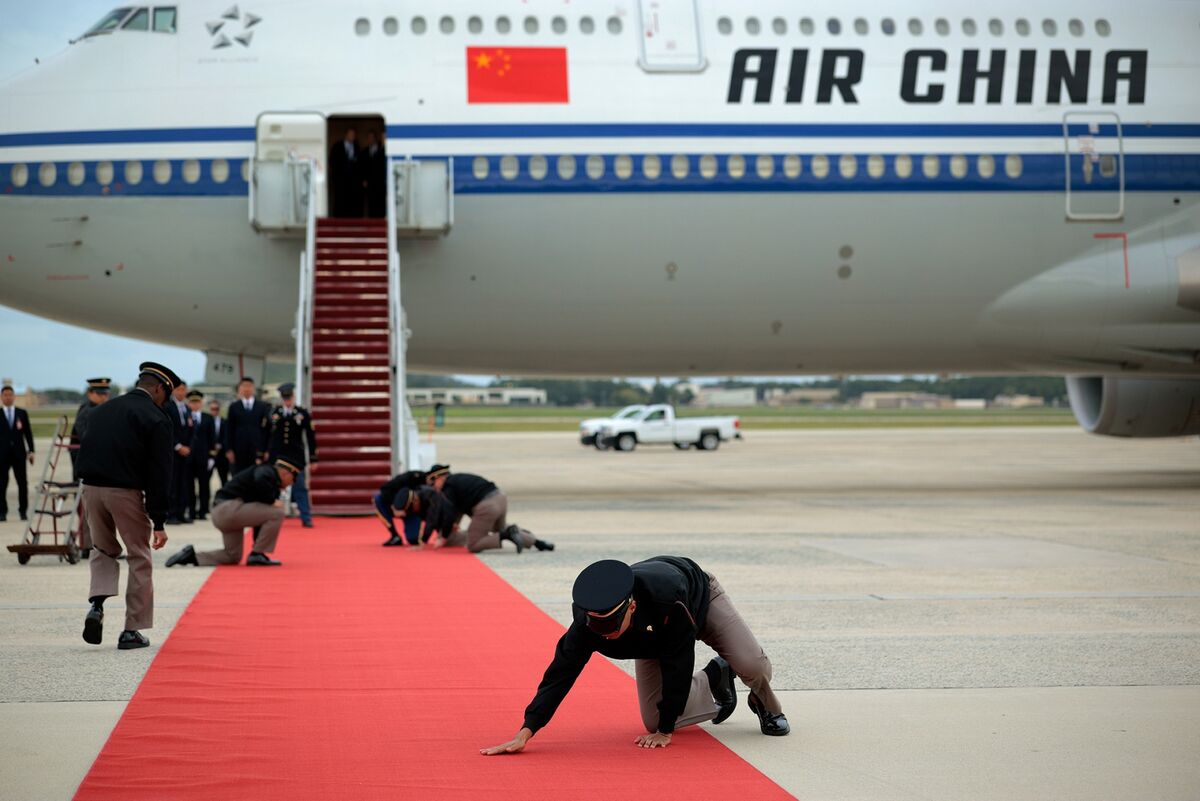
President Donald Trump is giving Chinese President Xi Jinping a high-profile welcome, but both the White House and China are signaling limited ambitions for the summit. Low expectations reduce the likelihood of a major US-China trade or geopolitical breakthrough, leaving policy uncertainty intact for companies exposed to bilateral trade and global supply chains.
Analysis
The market-relevant outcome is not a breakthrough but a reduction in near-term escalation probability. That favors the most China-exposed cyclicals and semiconductor supply-chain names only if the meeting produces verifiable follow-through—tariff exclusions, export-license approvals, or a suspension of new controls—rather than rhetorical de-escalation. In the absence of those specifics, positioning should remain defensive: bilateral policy remains a headline-driven volatility regime, and companies with concentrated China revenue can still face abrupt demand, sourcing, or licensing shocks.
Near term, broad China proxies such as FXI and KWEB may rally on a lower geopolitical risk premium, but their upside is capped by weak evidence that commercial restrictions will materially loosen. A more durable 6-18 month implication is continued supply-chain duplication: Mexico/ASEAN manufacturing beneficiaries and US industrial automation vendors retain structural support even under a temporary thaw, because corporate capex decisions are based on policy uncertainty rather than summit optics. The contrarian view is that low expectations make a modest deliverable tradable, but the first positive headline is likely more valuable for trimming China-beta shorts than initiating an unhedged risk-on position.
The key falsifier for a cautious stance is a jointly announced, dated implementation framework covering export controls or tariffs, followed by observable licensing activity and improved order commentary from China-exposed hardware companies. Conversely, new restrictions on advanced semiconductors, retaliation targeting US agriculture or critical-mineral supply, or a breakdown in communications would quickly reprice tail risk; SOXX and SMH are the cleanest liquid indicators of that shift.
AllMind Terminal
AI-powered research, real-time alerts, and portfolio analytics for institutional investors.
Request TrialMarket Sentiment
Overall Sentiment
mixed
Sentiment Score
-0.10
Key Decisions for Investors
- Do not add directional China exposure solely on summit headlines; treat any FXI/KWEB strength in the first 1-5 trading days as tactical unless concrete tariff or licensing terms are published.
- Maintain a 1-3 month relative-value bias of long PAVE versus short FXI: US reshoring/infrastructure-linked capex has structural support while FXI remains exposed to renewed bilateral-policy risk. Reassess if a formal tariff rollback or export-control accord is implemented.
- For portfolios with concentrated semiconductor longs, buy 1-3 month SOXX put spreads around any post-meeting relief rally rather than reducing core exposure immediately; downside protection is attractive while the probability of policy reversal remains elevated.
- Create an event alert for explicit export-license approvals or tariff-exclusion schedules. If independently confirmed, shift tactically toward SMH/SOXX for a 1-3 month rerating; invalidate the trade on new US controls or Chinese retaliation.
More News
- US 30-Year Yield Hits Highest Since 2004
- Trump, Xi Address AI, Taiwan During State Visit
- Trump Hosts China’s Xi With Trade, AI, Taiwan in Focus
- Iranian-American group sues Trump over war
- What must happen for Boeing stock to get unstuck. The company needs, at least, to do its part
- ‘Hostile, but hooked’: What’s behind the US-China trade truce extension?